Rubio says Venezuela no longer poses same threat to US, draws contrast with Cuba
Published in News & Features
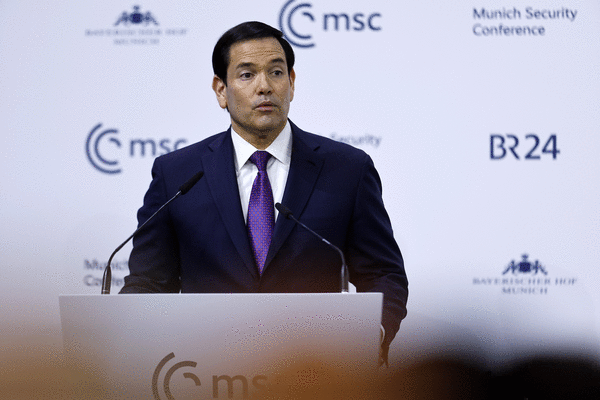
Secretary of State Marco Rubio told congressional lawmakers Tuesday that Venezuela no longer poses the same national-security threat to the United States that it did under Nicolás Maduro, pointing to what he described as significant reforms undertaken over the past five months by the country’s interim authorities.
But Rubio cautioned that Venezuela remains far from a democratic transition, saying the country still lacks the conditions necessary for free elections and continues to hold hundreds of political prisoners.
Rubio also used Tuesday’s Senate Foreign Relations Committee hearing to draw a stark contrast with Cuba, arguing that Havana remains trapped under a military-controlled economic structure incapable of meaningful reform.
He said the island’s economy is effectively controlled by GAESA, the powerful military conglomerate that dominates tourism, mining, fuel distribution and other strategic sectors, while ordinary Cubans endure worsening blackouts and economic hardship.
“First of all, I remind everybody — what’s today, the 2nd? So it’s literally been five months,” Rubio said when asked about developments in Venezuela. “I know it seems like it was 10 years ago, but it’s been five months.”
Rubio said Venezuela today is “in a better place” and on a “better trajectory” than it was before Maduro’s removal, while stressing that democratic normalization remains incomplete.
“Ultimately, in order to truly transition, they have to have multi-party, free and fair elections,” Rubio said while answering questions from Florida Sen. Rick Scott.
According to Rubio, that would require major institutional changes, including reforms to Venezuela’s National Electoral Council, guarantees for opposition political parties to organize freely and the existence of an open media environment in which independent journalists can operate without fear.
Despite those shortcomings, Rubio pointed to what he described as measurable progress.
One of Rubio’s most notable disclosures involved the removal of highly enriched uranium from Venezuela, an operation he said was carried out by the United States and Britain with Venezuelan cooperation.
“They had highly enriched uranium in their country because of an older reactor program, not because of nuclear weapons or anything, and they wanted it out of their country,” Rubio said. “And we were able to go in and actually retrieve it along with the U.K. mission that went in with us and get it.”
Rubio did not provide additional details regarding the amount of uranium removed, when the operation occurred or whether international nuclear watchdog agencies participated in the effort.
The secretary of state also pointed to what he described as unprecedented oversight of Venezuela’s oil revenues.
“For the first time,” Rubio said, “certainly since the post-Chávez era, the oil wealth of the country is not being stolen.”
Instead, he said, oil revenues are now being directed toward paying public-sector workers and purchasing medical equipment under auditing mechanisms overseen by accounting giant KPMG.
Rubio acknowledged that the current arrangement may not be permanent, but described it as a significant departure from the corruption and patronage structures that dominated Venezuela during the Chávez and Maduro years.
Rubio also pointed to the closure of the notorious El Helicoide prison and the release of numerous political prisoners, including several high-profile detainees, while acknowledging that roughly “400 and something” people whom Washington considers political prisoners remain incarcerated.
“You’ve seen reforms,” Rubio told senators. “You’ve seen a systemic reform in individuals involved in their government, replaced by new people.”
Some of those officials remain largely unknown to Washington, Rubio acknowledged, though he suggested several appear preferable to figures associated with Maduro’s former inner circle.
Rubio’s remarks also underscored the quiet normalization now under way between Washington and Caracas after years of sanctions, diplomatic rupture and mutual hostility.
Rubio noted that the United States now has a functioning embassy in Venezuela and that direct flights between the two countries have resumed for the first time in years.
“Venezuelans are now able to go back, not just visit relatives, but begin to engage in the economic life of the country,” Rubio said.
He also alluded to broader security cooperation between the interim authorities and Washington on matters he declined to discuss publicly.
“You’ve seen a level of cooperation on a couple of topics that I actually can’t even discuss in a setting like this,” Rubio told lawmakers.
Still, Rubio stressed repeatedly that Venezuela’s transition remains incomplete and fragile.
“This is not the direction we want Venezuela to be,” he said. “We are nowhere near where we want to get to there.”
Rubio argued that the most consequential change may be strategic rather than political: Venezuela, he said, no longer functions as a platform for hostile foreign activity directed at the United States.
“What I will say is that the Venezuela that’s there now, under the interim authorities, does not pose the threat to the United States that it posed five months ago,” Rubio said.
He said Maduro’s Venezuela had functioned as “an open base of operation for Iranian operatives, for Cuban intelligence and for others who used it as a base of operation against the national interest.”
Rubio’s comments appeared designed not only to defend the administration’s Venezuela strategy but also to frame the post-Maduro transition as a national-security success for Washington.
That framing became even more evident when senators asked Rubio to compare Venezuela’s situation with Cuba’s.
“Cuba is a very different thing,” Rubio responded.
Rubio offered a far darker diagnosis of Cuba, arguing that the island is governed less by civilian authorities than by GAESA, the sprawling military-run conglomerate that dominates much of the economy.
“GAESA virtually owns everything,” Rubio said. “They own the tourist sector. They own mining. They own the gas stations. They own everything.”
According to Rubio, approximately 70% of Cuba’s gross domestic product falls under GAESA’s control, while the organization itself controls between $14 billion and $17 billion in assets.
At the same time, he said, ordinary Cubans face deepening hardship.
“You have people literally starving,” Rubio said, describing a national electrical grid that he said “hasn’t been maintained in 10 years.”
Rubio argued that little or none of the wealth controlled by the military conglomerate reaches the Cuban public treasury, creating what he described as a structurally unsustainable system.
“Not a penny of the money in the military holding company translates over to the public treasury,” Rubio said.
He also rejected suggestions that Cuba’s ongoing blackouts stem primarily from recent U.S. policy changes, arguing instead that the island’s energy crisis long predates the current administration.
According to Rubio, Cuba’s problems were aggravated first by the loss of heavily subsidized Venezuelan oil previously provided by Maduro and second by the Cuban government’s failure to modernize its electrical infrastructure.
“They didn’t invest a single dollar back into improving their plants,” Rubio said.
Instead, he argued, authorities directed resources toward constructing tourist hotels that now sit largely empty because of declining tourism.
Rubio suggested that while Venezuela may still possess a pathway toward gradual normalization and democratic transition, he is far more skeptical that Cuba’s current leadership structure is capable of meaningful reform.
“The question is: Can they possibly reform given the people who are currently in charge?” Rubio said. “I really don’t believe this system is capable of reform unless new people take over or a new mindset takes hold.”
The contrast Rubio sketched before senators was striking: a Venezuela he portrayed as damaged but moving, however unevenly, toward normalization — and a Cuba he suggested remains trapped in an economic and political model incapable of reform.
_____
©2026 Miami Herald. Visit miamiherald.com. Distributed by Tribune Content Agency, LLC.



Comments