Florida Legislature sends property tax overhaul to voters after adding protections for schools
Published in News & Features
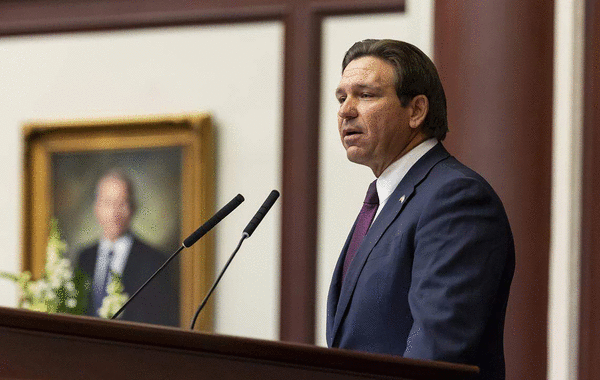
TALLAHASSEE, Fla. — Voters will have their say on Gov. Ron DeSantis’ plan to slash property taxes after the Republican-controlled Legislature on Tuesday voted mostly along party lines to place a modified version of the proposal on the November ballot — but only after inserting provisions to protect public schools from any cuts.
The proposal will ask voters in November to provide $250,000 exemption on homesteaded properties. The move would radically overhaul how local governments raise and spend money — costing counties and cities billions in revenue and, opponents say, putting many essential services at risk.
“I feel the passion on both sides of this issue, and it is one of the most important issues we have faced,” said state Sen. Bryan Avila, a Hialeah Springs Republican and chairman of the Senate Finance and Tax Committee who sponsored the Senate version.
Senate Democratic Leader Lori Berman, of Boca Raton, said the resolution would cripple many city and county governments that are already fiscally constrained. She also said she resented the attacks on local governments.
“There’s an assumption that local governments are not doing a good job,” Berman said. “They’re absolutely doing the best they can with what they’ve got.”
The Senate voted 30-9 to approve the bill. Three Democrats joined the Republican majority, but they were not needed to reach the required 60% majority of 24.
The House voted 75-26 — three votes more than needed to meet the 60% threshold —despite a House staff analysis that said the exemption would cost counties $4.6 billion in non-school tax revenue the first year and $8.4 billion the second year. At least one Republican voted with the Democratic minority.
State Sen. Carlos Guillermo Smith, an Orlando Democrat, said lawmakers were given a “Frankenstein bill” that would be the ultimate “defunding of police.” It would leave out many essential services and “eliminates a loadbearing wall of state government” that would put local communities in a “financial straitjacket.”
“This is why we should not be completely reforming our tax structure in the state of Florida in special session, which we have three days to do,” Smith said.
The move was opposed by state Democratic lawmakers and a handful of Republicans, as well as most city and county officials, who said it would “bankrupt” most local governments. They came to Tallahassee in droves Monday to warn about the harm it would cause and the services that would be cut if approved. Rows of committee hearing rooms were filled with firefighters in uniform, who warned of a 25% cut in services if the resolution is approved.
“I am here to sound the alarm that this would severely affect Florida libraries,” said Jennifer Abdelnour, executive director of the Florida Library Association. Without a stable revenue we will have to reduce hours and face possible branch closures.”
Even Florida Tax Watch, which usually advocates reducing taxes, cautioned that this proposal was moving too quickly.
Some Republicans also raised concerns ahead of Tuesday’s floor hearings about the impact this resolution would have if approved.
Republican Sen. Gayle Harrell of Stuart, who had expressed doubts about the measure in committee Monday, said Tuesday she was swayed by an amendment that protected school funding from being cut.
But she warned that the Senate will have “significant challenges moving forward” because of the impact it will have on counties and cities.
“The impact on the state will be there, no doubt, because this is a cost shift for those fiscally constricted counties,” Harrell said.
Noting that he has 12 fiscally constrained rural counties in the Florida Panhandle, state Sen. Corey Simon, R-Tallahassee, said he kept going back and forth until he heard from residents of those communities.
“For so long we’ve had a public that feels disconnected from their government. They feel like no one is listening,” Simon said. “One of the only reasons I can vote for this today is for those folks who don’t feel seen or heard by their government. This gives them the opportunity to show up at the polls and vote their wallet.”
State Sen. Tina Polsky, a Boca Raton Democrat, called the governor’s proposal the ultimate preemption of local government.
State Sen. Lori Berman, a Boynton Beach Democrat, agreed. “(Local governments) feel threatened and now we in the Legislature don’t know what to say to them.”
After several hours of debate extending into Monday evening, both the House and Senate approved amendments by Republican lawmakers to protect school tax revenue from proposed exemptions that would cost school districts an estimated $5 billion in revenue.
“School districts today (are) already making tough decisions,” said state Sen. Jay Trumbull, a Panhandle Republican who offered the amendment to shield school tax revenue. “I ... cannot support moving billions of dollars from education today. We are giving the state time to maintain our school choice program and fund education for the long-term.”
A similar amendment was approved in the House, introduced by state Rep. Sam Garrison, a Fleming Island Republican.
“That is encouraging development. I’ve got to tell you, I wasn’t feeling warm and fuzzy 24 hours ago,” said Maria Vazquez, Orange County’s superintendent of schools, on Tuesday.
Orange County Public Schools would have lost an estimated 7.3% of its overall budget if the state eliminated property taxes on homesteads, according to an Orlando Sentinel analysis. Seminole County Public Schools would have seen a 10.5% decrease, Lake County Schools would have faced an 11.5% shortfall, and Osceola County Schools would have lost 12.3%.
The new version also deletes a state trust fund to help local governments on the brink of financial ruin from the resolution’s ballot language that summarizes the amendment. State Sen. Erin Grall, a Vero Beach Republican who offered the amendment, said it would be misleading to voters to say there was a trust fund when the Legislature had not yet approved one or tapped a funding source.
“Here we are, giving permission to set up an empty bank account that can’t be relied upon,” Grall said. “When talking about this amendment we need to be clear there is not a pot of money for this backfilling.”
Grall also presented an amendment to cut the $5.5 million DeSantis wanted to provide local property appraisers to pay for mailing out notices to homeowners explaining the ballot amendment.
Democrats also filed amendments to clarify language, include other essential categories including services for senior citizens and veterans, libraries, mosquito control services and other categories. All the amendments offered by Democrats were voted down.
The resolution restricts what city and county officials can spend remaining revenue on to six broad categories, including public safety, education, debt service and retirement services for local government employees. An amendment introduced by Avila was approved to add a seventh category that broadly covered constitutional officers.
To protect against unintended consequences, Smith offered a sunset provision of the amendment in five years, with an option for the legislature to renew it.
“We are making transformational changes to our tax policy for better or worse. ... Maybe I am wrong. Maybe Avila is wrong. We have no idea,” Smith said. “This gives us a kill switch if things go terribly wrong.”
His amendment failed in the full Senate.
_____
(Orlando Sentinel staff writer Steven Walker contributed to this report.)
_____
©2026 Orlando Sentinel. Visit at orlandosentinel.com. Distributed by Tribune Content Agency, LLC.






Comments