Alabama asks Supreme Court to allow use of new congressional map
Published in News & Features
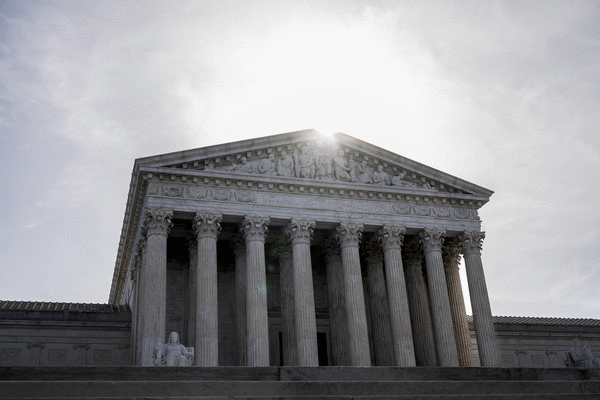
WASHINGTON — Alabama officials asked the Supreme Court on Wednesday to halt a lower-court ruling that blocked the use of a new congressional map in this fall’s elections.
In the pair of applications filed Wednesday, officials urged the justices to either pause the lower-court ruling pending a full appeal or set aside that ruling entirely. Officials asked the justices to act by Monday.
The Alabama officials argued that the lower-court ruling, issued Tuesday by a unanimous three-judge panel, incorrectly found a legislature-approved map known as the 2023 plan discriminated against Black voters and that the decision interfered with the ongoing primary process in Alabama.
The case is the latest in a fast-moving flurry of court fights since the Supreme Court last month overturned a Louisiana congressional map drawn with a second Black opportunity district drawn to satisfy the Voting Rights Act.
The applications said that the three-judge panel decision Tuesday went against the justices’ decision in that recent redistricting case, Louisiana v. Callais, and violated the “Purcell principle,” where federal courts should not interfere with state election proceedings close to an election.
“A stay is warranted so that Alabama is not again precluded from using its legislatively enacted 2023 Plan based on a decision that defies Callais, manipulates the Purcell principle, and offends the Constitution’s promise of equal protection for all,” one of the applications said.
The state officials argued that the lower court effectively found the state intentionally discriminated against Black voters by declining to draw a second Black opportunity district in the state, which was at issue in the Louisiana case.
And they contend the lower court read discrimination into the state’s policy goal of keeping Gulf Coast communities together in a single congressional district.
“Alabama, no different than Louisiana, may stick to its neutral political and policy goals. That’s not intentional racial discrimination,” one application states.
Following the Supreme Court ruling in Louisiana v. Callais, the state reinstated a congressional map first enacted in 2023 but blocked before the 2024 elections by a three-judge lower court.
In the 2024 elections, the state used a court-approved map that included five seats that favored Republicans and two that favored Democrats. Under the 2023 map, Republicans would be favored in six of the state’s seven congressional districts.
State officials then asked the Supreme Court earlier this month to lift that previous lower-court order blocking the 2023 map, which a majority of the court voted to do, sending the case back to the lower court for reconsideration.
The state held a primary in the three unchanged districts on May 19. Republican Gov. Kay Ivey announced an August primary for the four districts where lines would change under the 2023 plan.
Then, on Tuesday, the same three-judge panel found the 2023 plan still violated the Constitution. The decision Tuesday barred the state from using the map for the election this fall.
The cases are Wes Allen in his official capacity as the Alabama secretary of state et al. v. Bobby Singleton et al., and Wes Allen in his official capacity as the Alabama secretary of state et al. v. Evan Milligan et al.
©2026 CQ-Roll Call, Inc., All Rights Reserved. Visit cqrollcall.com. Distributed by Tribune Content Agency, LLC.






Comments