Boston Mayor Wu slammed for 'fiscal mismanagement' after revealing $70 million budget shortfall
Published in News & Features
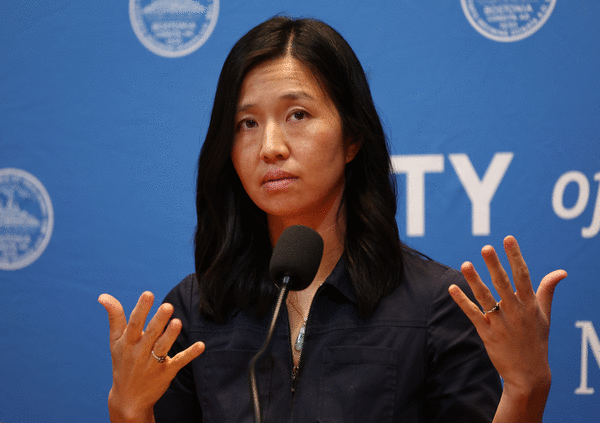
BOSTON — Boston Mayor Michelle Wu’s revelation that the city needs to ask for an additional $70 million in funding to cover this year’s budget shortfall was slammed by her critics as “fiscal mismanagement.”
Wu filed two supplemental budgets with the City Council Monday that will see her administration seek approval to use $47.1 million in emergency reserves to cover a city budget shortfall, and $22.8 million in reserves to cover a Boston Public Schools budget deficit.
That’s on top of the $4.8 billion in spending already allocated between the city and BPS as part of the city budget for fiscal year 2026, which ends on June 30, and has one policy analyst who closely watches City Hall finances concerned about future implications should the city continue managing finances as it has been.
“The combined $70 million in supplemental appropriation requests from Mayor Wu is historic, and points to serious fiscal mismanagement, the scale of which has not become public,” said Gregory Maynard, executive director of the Boston Policy Institute, a City Hall watchdog.
The city last dipped into its reserve fund to cover a $40 million budget gap in FY21 amid the global pandemic, the mayor’s office said.
Maynard said the city appears to be downplaying the significance of its financial woes, by pinning the blame for its overspending simply on unanticipated snow removal costs driven by two major winter storms.
He pointed to what the city is paying down as part of the BPS supplemental budget — $18 million in health insurance and $4.7 million in utility overspending — as an indicator that the $47.1 million city supplemental includes other factors beyond excess snow removal costs that aren’t being disclosed by the Wu administration.
“This $70 million is not the full extent of deficit spending in FY26,” Maynard said. “The FY26 police overtime budget was set at $55 million, but cost over $100 million, producing a $48.7 million deficit. … City officials have also mentioned healthcare overspending, but haven’t assigned a dollar figure.”
Maynard said the city faced budget deficits in recent years, due to how it underbudgets for areas that are expected to come in over budget, namely police overtime, but was able to avoid filing supplemental budgets because it ultimately came out in the black, due to taking in excess revenue.
“That this is not happening in FY26 signals that there are serious problems with Boston’s budget,” Maynard said.
City Councilor Ed Flynn, who has been critical of the Wu administration’s financial management as well, said he begrudgingly supports the mayor’s decision to tap into the city’s roughly $1.7 billion reserve fund to balance this fiscal year’s budget, but has concerns about its overall financial outlook.
“We must have a serious and honest accounting of why Boston is now in this position,” Flynn said. “Since 2024, independent fiscal experts repeatedly warned us the City of Boston could lose up to $2.1 billion in annual tax revenue due to falling commercial property values.
“Instead of listening to the recommendations of fiscal experts to cut spending, freeze hiring, and examine our dependence on the property tax, Boston increased the budget significantly, hired 300 new employees, and committed $135 million so far to a professional soccer stadium,” the councilor said.
Flynn added, “With the City of Boston over 70% dependent on property taxes, over 50% of our land belonging to large nonprofits or nontaxable, and Boston now having to dip into reserves to cover a $70 million deficit after two straight years of property tax increases on residents over 10%, it is long past time that Boston exercise fiscal discipline, fiscal responsibility, accountability and transparency.”
_____
©2026 MediaNews Group, Inc. Visit at bostonherald.com. Distributed by Tribune Content Agency, LLC.






Comments