Trump says holding off on new Iran strikes after Gulf appeal
Published in News & Features
President Donald Trump said that he’d called off a strike on Iran planned for Tuesday after an appeal by the leaders of Persian Gulf allies, who called for more time to pursue a diplomatic resolution.
“I put it off for a little while, hopefully maybe forever, but possibly for a little while, because we’ve had very big discussions with Iran, and we’ll see what they amount to,” Trump said at a White House event on Monday evening, hours after his announcement in a social media post.
“I was asked by Saudi Arabia, Qatar, UAE, and some others if we could put it off for two or three days, a short period of time, because they think that they are getting very close to making a deal,” Trump added. “If we can do that, where there’s no nuclear weapon going into the hands of Iran, I think, and if they’re satisfied, we will be probably satisfied also.”
The president has repeatedly threatened renewed military action against Iran without following through. There was no immediate confirmation from Tehran of renewed talks. Trump said the U.S. was prepared to attack if an acceptable deal wasn’t reached but didn’t set a deadline.
His comments were the latest indication of the bind he’s in with the war, where Tehran has taken a hard line in the absence of credible threats of renewed attacks by the U.S. Yet escalation would bring further increases in oil prices, something the White House has so far been unwilling to risk.
Oil and stocks whipsawed as traders parsed mixed signals about prospects for an accord to end the war and revive energy flows through the key Strait of Hormuz. West Texas Intermediate crude fell 1.4% while the S&P 500 nearly wiped out its losses in a choppy session after Trump’s remarks.
Earlier Monday, both sides said they’d rejected fresh proposals as insufficient to secure an agreement.
The White House said an offer delivered by Iran through Pakistani mediators on Sunday lacked meaningful improvement, failing to offer detailed commitments on the surrender of the Islamic Republic’s stockpile of highly enriched uranium and the suspension of further enrichment, Axios reported, citing a senior U.S. official and a person briefed on the issue.
Iran, at the same time, indicated that American demands remain unacceptable. Tehran has refused to budge on some of its key positions and insisted that its frozen assets be returned and compensation for the war paid.
With crucial oil exports from the Persian Gulf all but cut off amid the war, Trump has been pushing Iran to make a deal or face a resumption of strikes. Iran has vowed to fight back. Earlier Monday, the UAE reported a drone struck near a major nuclear power plant.
Iran’s Foreign Ministry said that Pakistan’s Interior Minister Mohsin Naqvi, who arrived in Tehran on Saturday, met with Iranian Foreign Minister Abbas Araghchi on Monday.
Iran’s semi-official Tasnim news agency said earlier the U.S. had offered to lift sanctions on the sale of Iranian oil until a final deal was reached, as part of a new draft proposal. A U.S. official who refused to be named due to the sensitivity of the matter said the story was false, but didn’t elaborate.
According to Tasnim, Iran said Washington’s demands were still excessive and that it would not agree to end the war at the expense of its nuclear program.
High oil prices have added to pressure on the Trump administration. Monday, the Treasury Department said it’s extending a sanctions waiver to allow sales of Russian oil for another 30 days.
Treasury Secretary Scott Bessent said in a post on X that the waiver will “provide the most vulnerable nations with the ability to temporarily access Russian oil currently stranded at sea.”
On his way back from a summit in Beijing last week, Trump told reporters he spoke with his Chinese counterpart Xi Jinping about potentially lifting sanctions on Chinese oil companies that buy Iranian crude. About 90% of Iranian oil exports before the war were purchased by China.
The drone strike at the UAE nuclear plant underscored the fragility of the truce. The country’s defense ministry said the projectile was launched from the west of the UAE, adding that two others were intercepted.
Emergency diesel generators were turned on to supply power to the plant’s unit 3, the International Atomic Energy Agency said in a social media post. There was no radiological impact, according to Abu Dhabi’s media office.
Saudi Arabia said it intercepted and destroyed three drones that entered its airspace on Sunday from Iraq, where many Iran-backed militias are located. It was unclear if those were part of the attack on the UAE.
Iran has made no public comment on the attacks.
Here’s more related to the war:
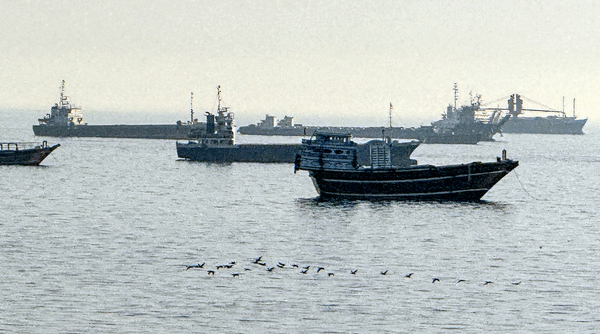
—Some 23 tankers were spotted around Iran’s Kharg Island oil-export hub, the largest cluster since the start of the U.S. blockade a month ago.
—U.S. Central Command said it has “redirected” 85 commercial vessels since the start of the blockade against Iranian ports.
—Iran has started a Bitcoin-backed insurance service for its shipping companies that want to transit the Strait of Hormuz, the semi-official Fars news agency reported.
—Russian President Vladimir Putin is due to visit China on Tuesday and Wednesday, where he is expected to discuss the Iran war with Xi.
—U.S. Treasury Secretary Bessent called on the G-7 nations and others to increase sanctions on Iran as the conflict drags on without an end in sight.
_____
(With assistance from Meghashyam Mali, John Harney, Rachel Cohrs Zhang and Derek Wallbank.)
_____
©2026 Bloomberg L.P. Visit bloomberg.com. Distributed by Tribune Content Agency, LLC.




Comments