US seeks to drop criminal charges against tycoon Gautam Adani
Published in News & Features
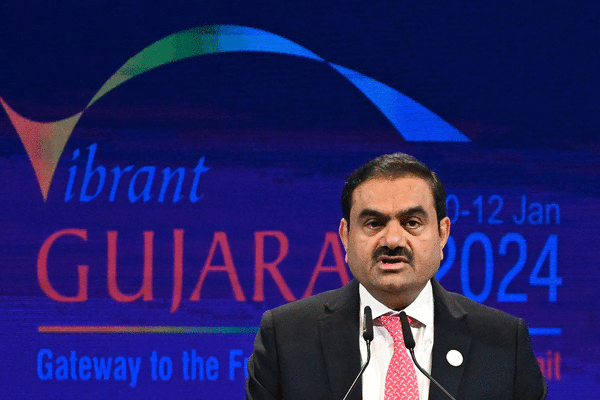
NEW YORK — In the span of a few hours Monday, Gautam Adani, Asia’s richest person, neared a resounding victory halfway around the world that had been months in the making.
In Brooklyn, New York, the Justice Department sought to drop criminal charges against the Indian billionaire, just after an announcement that the Treasury Department was resolving a sanctions-related probe involving the Adani Group’s flagship company. Last week, the Securities and Exchange Commission moved to settle a fraud case against him.
The moves by American authorities to end legal actions against Adani and his companies are a major boon for the conglomerate and signal a potential dramatic U.S. comeback for the tycoon. They’re also a stark reversal by U.S. officials on two high-profile cases brought at the end of the Biden administration.
“This settlement removes a big regulatory overhang on the Adani group,” said Shriram Subramanian, founder and managing director of InGovern Research Services, a proxy advisory and corporate governance firm based in India. “More importantly, it paves the way for settlement of other regulatory scrutiny.”
U.S. prosecutors said in court filing Monday that after a review they had decided “not to devote further resources to these criminal charges against individual defendants.” Adani Green Energy said in a stock exchange filing that prosecutors had moved to dismiss the charges against Gautam Adani, as well as Sagar Adani and Vneet S. Jaain, who are both executives at the entity, and other defendants.
Prosecutors sought the dismissal “with prejudice,” meaning the charges can’t be refiled. The judge overseeing the case will review the motion. A spokesperson for the U.S. attorney’s office in Brooklyn declined to comment.
Indian markets were rocked in late 2024 when prosecutors alleged that Adani and other defendants helped drive a $250 million bribery scheme in India to lock in solar-power contracts. The Justice Department claimed that Adani and others promised bribes to Indian government officials to win solar energy contracts and concealed the plan as they sought to raise money from U.S. investors.
The Adani Group consistently denied the allegations and none of the defendants, including Gautam Adani, had appeared in court over the Justice Department’s charges. The case was effectively stalled.
Even as the case wasn’t progressing, it had political and financial repercussions for Adani. To fight the criminal and civil case, Adani built a political influence operation in the U.S. that included white-shoe law firms and lobbyists.
Investment Pledges
But Adani’s efforts to build up goodwill with the Trump administration appeared to start before any charges were unveiled. Shortly after Donald Trump won the 2024 election and before the Justice Department and SEC unveiled their cases, he congratulated him and pledged to invest $10 billion in U.S. energy and infrastructure projects.
More recently, the conglomerate had discussed plans to triple that pledge to $30 billion, focusing on sectors including data centers, infrastructure and green energy, Bloomberg News has reported. But the investments were unlikely to start until the companies had more clarity on their U.S. legal issues, said people familiar with the matter, who asked not to be identified discussing private conversations.
According to a proposed agreement filed last week, Adani and his nephew Sagar have agreed to pay a total of $18 million to settle SEC allegations they made false and misleading representations about Adani Green Energy.
On Monday, Treasury announced that the Adani Group’s flagship Adani Enterprises Ltd. had agreed to pay $275 million over a probe by the Office of Foreign Assets Control related to apparent violations of Iran-related sanctions. The settlement agreement related to purchases that the company made of shipments of liquefied petroleum gas from a Dubai-based trader.
“Red flags should have put AEL on notice that the LPG actually originated from Iran,” Treasury said in a statement, referring to the company.
Adani Enterprises said earlier this year that it received a request for information from the U.S. Office of Foreign Assets Control related to transactions that may have involved Iran. That came after the Wall Street Journal reported that Adani companies were being probed by U.S. prosecutors about imports of Iranian liquefied petroleum gas through a port in Mundra.
©2026 Bloomberg L.P. Visit bloomberg.com. Distributed by Tribune Content Agency, LLC.





Comments