Trump says Iran blockade 'incredible' as pump prices keep rising
Published in News & Features
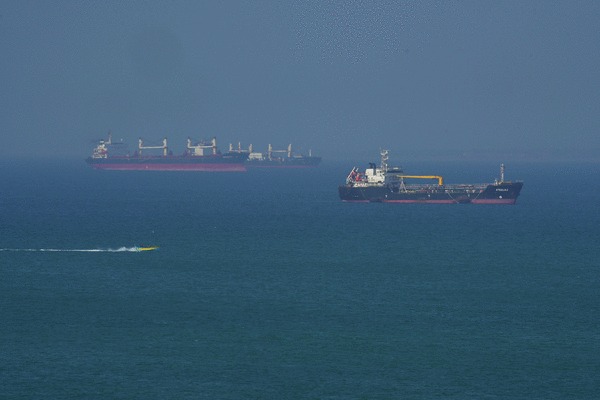
WASHINGTON — President Donald Trump said he was sticking with a naval blockade of Iranian ports amid concerns the vital Strait of Hormuz would not reopen anytime soon.
“Their economy is crashing, the blockade is incredible,” Trump told reporters at the White House. “Their economy is a disaster. So we’ll see how long they hold out.”
Oil prices steadied after surging on Thursday with little sign that Washington and Tehran were moving closer to an accord, as the U.S. doubled down on a blockade and strident comments from Iran’s new leader.
Brent futures initially rose to $126 a barrel — their highest level since the conflict began — before ending the session near $114. Early Friday, Brent for July delivery was trading at about $112 a barrel.
Traders are factoring in the possibility of a return to hostilities and a prolonged shutdown of the strait, which is crucial for global oil and gas flows but has been effectively shut since the U.S. and Israel started the war on Feb. 28.
Pump prices across parts of the U.S. are also rising sharply, with the national average at fresh highs and retail gasoline in California soaring above $6 a gallon. That’s increasingly becoming a concern for Trump’s Republican Party heading into the midterm elections.
“The gas will go down,” Trump said. “As soon as the war is over, it’ll drop like a rock.”
Earlier on Thursday, Iran’s new supreme leader Mojtaba Khamenei also cast doubt on the likelihood of a deal, giving a rare statement in which he vowed not to give up the country’s nuclear or missile technologies. He also signaled Tehran would keep control of the Strait of Hormuz.
Iranian President Masoud Pezeshkian said in a social media post Thursday he considered the U.S. naval blockade an “extension of military operations,” and that it was “intolerable.”
At the same time, U.S. military commanders were set to brief Trump on options on Thursday, Axios reported, citing unnamed sources. Central Command, which oversees American forces in the Middle East, has prepared a plan for a brief wave of strikes to break the negotiating deadlock, Axios said.
“Trump wants to end the Iran war, but not on the terms proposed by Tehran,” said Becca Wasser and Chris Kennedy, analysts at Bloomberg Economics. “That suggests the question is no longer whether he escalates to push for a better offer, but when and how. We think the most likely window for action is within the next two weeks, and that renewed U.S. strikes are the most likely course.”
Iran has said it won’t reopen the strait to commercial vessels until the U.S. lifts its blockade. It’s unclear how long Iran has left before it runs out of oil storage and is forced to cut production.
Here’s more on the war:
—U.S. Defense Secretary Pete Hegseth sparred with lawmakers as Democrats stressed the Iran war was nearing the 60-day threshold that triggers a requirement, per the War Powers Act, of Congressional authorization for any further action.
—Democrats say the Pentagon is underestimating the cost of the war. One U.S. senator said the $25 billion figure was “probably less than half, maybe less than a quarter, of the total cost of war.”
—Trump invited Iraq’s prime minister nominee to visit Washington after he forms a new government, as the U.S. seeks to limit Iran’s influence on its neighbor. In a telephone call, Trump and Ali al-Zaidi discussed “ways to develop and strengthen” bilateral relations between the U.S. and Iraq in various fields,” according to a statement from the Iraqi premier’s office.
—Signs of strain on the Iranian economy have emerged in recent days, with the currency weakening to a fresh low.
(Devika Krishna Kumar, Paul Wallace, Alister Bull, Patrick Sykes, Eltaf Najafizada, Omar Tamo, John Harney, Rob Verdonck, Michelle Jamrisko and Derek Wallbank contributed to this report.)
_____
_____
©2026 Bloomberg L.P. Visit bloomberg.com. Distributed by Tribune Content Agency, LLC.






Comments