Connecticut child takes own life shortly after DCF visit, official says
Published in News & Features
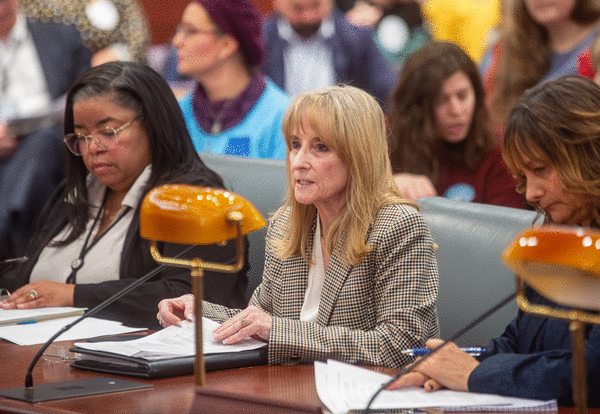
HARTFORD, Conn. — Connecticut’s child advocate addressed Gov. Ned Lamont, the Department of Children and Families commission, state policymakers and the public Thursday, saying deficits in care provided by DCF to the state’s children must be “urgently remedied” and that she is “increasingly alarmed” about the quality of services.
Child Advocate Christina Ghio’s letter of findings and recommendations was triggered by the death of another child under DCF supervision, though her concerns have been ongoing, she said.
The child died by suicide just an hour after telling DCF workers visiting the home that they didn’t feel safe and asking to be taken into foster care, the letter said.
“According to DCF’s records, during that visit the child told the DCF caseworker that the child did not feel safe and asked to come into foster care. The family had a lengthy DCF history in Connecticut, did not have stable housing, had moved in and out of Connecticut over many years, and none of the children were enrolled in school. Despite these facts and all of the information available to DCF, DCF made a decision to leave the child with the parent, indicating that coming into care was not an option,” Ghio’s letter said.
Ghio said she has become increasingly alarmed by her observations of reviews of “critical incidents and child fatalities, some of which have garnered significant public attention and some of which have not.”
Those incidents include the deaths of 11-year-old Jacqueline “Mimi” Torres-Garcia, whose emaciated body was found in a plastic container left behind an abandoned home in New Britain last year. Her family had extensive dealings with DCF and reportedly fooled caseworkers by having someone else pretend to be Mimi during a video call to check on her welfare. According to the timeline of events, she was likely already dead at the time.
Eve Rogers, 12, of Enfield was also recently found dead, and Enfield police reported making a referral to DCF for the girl a week before her death. Officers encountered her on a shoplifting call when the girl reportedly stole an energy drink from a convenience store after 2 a.m. and had walked away from her home. Eve’s stepfather, 39-year-old Anthony Federline, has been charged with sexually assaulting the girl.
Ghio told the Courant last week that “Visits with children and parents and contact with schools, providers and doctors are not happening with the frequency or quality required by current policies,” making it difficult for DCF to make sound decisions.
In Thursday’s letter, Ghio cites “ongoing deficits in the quality of case practice, which DCF has been unable to address” and calls on leadership to “ensure that caseworkers have the support needed to meet expectations, ensure that services are available to children and families, hold all staff accountable to expectations, and publish its internal quality assurance data.”
Ghio notes that for 30 years ending in 2022, DCF was under federal oversight through the Juan F. consent decree. The court monitor conducted qualitative case reviews aligned to outcomes data, Ghio said, and when exiting federal oversight, DCF had no assessment tools for in-home cases.
Ghio’s letter goes on, recalling the Office of the Child Advocate’s ongoing recommendations that DCF adopt assessments, quality assurance measurements and data publication, each tied to a report on the death of a new child under DCF care.
In 2022, it was “Kaylee S.,” a 1-year-old who died Feb. 8, 2022, of fentanyl and xylazine poisoning. DCF had opened an investigation into the family in August 2021. DCF dismissed the OCA’s recommendations, saying fentanyl was new to the experts at that time and the department’s work on the case was sound.
In January 2023, it was Liam Rivera, 2, who was found dead, buried in a Stamford park in January. A subsequent report from the OCA found that multiple instances of Liam being abused, maltreated and undernourished had been documented by the state before his death. He was under court-ordered protective supervision and his father was on adult probation supervision due to a previous child abuse charge, according to the report.
In response, OCA “recommended that DCF utilize frequent and reliable quality assurance protocols pertaining to safety planning and service delivery; that DCF assess the impact of telework and workforce trends on DCF case practice, staff retention, and supervision; and that the state develop a framework for oversight of DCF,” Ghio’s letter said.
DCF reportedly took steps to review data and make recommendations, created a tool for use during visits and promised increased trainings for social work supervisors and program supervisors, as well as a scorecard to gather key performance indicators.
Ghio also mentioned Marcello Meadows, a 10-month-old who died of fentanyl, xylazine, and cocaine intoxication in June of 2023. He and his 3-year-old brother had both been born exposed to drugs, his parents both had involvement with the criminal justice system and DCF was monitoring the family’s progress, according to the OCA report at the time. The OCA report shows failures at multiple levels, including a lack of regular random drug testing.
The OCA then noted DCF had been “making numerous efforts to strengthen practice” but “available data shows a marked decline in DCF’s risk and safety assessment and case supervision over the last two years,” and that three children had died in DCF supervision in the past year.
Still, Ghio said, performance and outcomes have not improved. DCF worker turnover is at 50% and employees report feeling overwhelmed and afraid they are unable to provide sufficient care. The state lacks sufficient foster homes, resources and treatment options for children and families, Ghio said.
“Workers and children are in a near constant state of crisis: caseworkers can’t find placements for children, and need to rely on emergency placements; children have significant behavioral health needs that go untreated, and foster parents can’t meet their needs without supports that are currently not available; children are placed in STTAR homes for many months with no real exit plan, lose hope, and engage in challenging behaviors. This constant state of crisis leaves workers feeling unsupported and burnt out,” Ghio said.
DCF Commissioner Susan I. Hamilton, in a statement, acknowledged the letter and the child’s suicide and said the department is already taking steps based on the data Ghio reviews.
“Since taking the Commissioner position in September of last year, our Department has undertaken a thorough review of this data, along with other information from our continuous quality improvement activities, determined that tangible and measurable changes are needed to elevate the quality of our work. This needs to include addressing workforce challenges and ensuring transparency and accountability,” Hamilton said.
“To that end, we have already initiated several improvement strategies and others will be implemented in the coming weeks. We take very seriously and support the recommendations outlined in the OCA letter and will continue to work in partnership with them to strengthen our practices and improve the larger child welfare system. As the OCA states, the work our Department undertakes — protecting vulnerable children and supporting families in crisis — is among the most challenging and essential responsibilities in state government. That fact underscores the urgency of getting this work right.
“We are committed to ongoing collaboration with our system partners, including the OCA, legislators, private providers, community partners, families and youth with lived expertise to address identified system gaps. These collaborative efforts will lead to improved oversight and enhanced data sharing and accountability so that DCF has the tools, training, and support needed to better serve children and families,” Hamilton said.
Sen. Stephen Harding, on behalf of the Senate Republican caucus, issued a statement calling for action.
“Awful, alarming and preventable. The child told the DCF caseworker that the child did not feel safe. The child asked to come into foster care. The child was in a dangerous, unstable environment and wanted out. What more did this child have to do? Senate Republicans demand leadership on this issue,” Harding said.
In response to the recent child deaths, the state lawmakers are considering a bill with sweeping reforms, including increased support for foster families and caseworkers, additional training for DCF employees and a public online database displaying information on DCF’s performance comparable to federal standards.
House Bill 5004 passed the House of Representatives Thursday.
But in her letter, Ghio said one piece of legislation would not be enough to fix the problem. She urged DCF leadership to take “swift and bold actions” to support workers and to hold staff accountable but said the department requires “ongoing external oversight, identified outcome measures, and public transparency.”
The alternative, she said, is continued suffering and deaths of children in DCF care.
“Every day, the deficits in case practice have consequences for children. OCA learns about some of these consequences when a new report comes in, when there is a critical incident, or when a child dies. Other children live with those consequences in silence, when they don’t receive the help they need. The deficits in the quality of case practice must be urgently remedied.”
She called on DCF leadership and the legislature to commit to supporting caseworkers and providing external oversight and accountability.
_____
©2026 Hartford Courant. Visit courant.com. Distributed by Tribune Content Agency, LLC.






Comments