Sen. Bernie Sanders looks to block sale of bombs to Israel
Published in News & Features
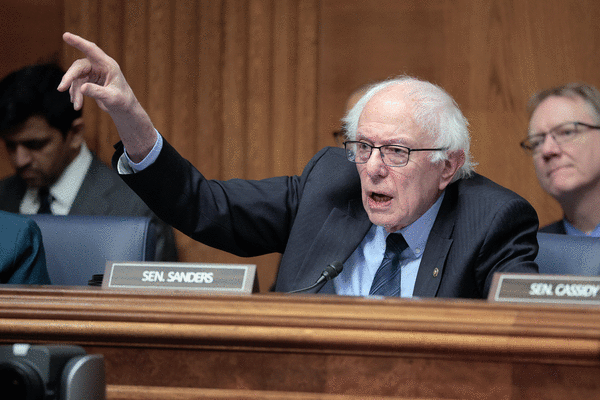
WASHINGTON — Sen. Bernie Sanders, I-Vt., on Thursday filed three joint resolutions to block a pending sale of nearly $659 million worth of weapons — including 22,000 bombs — to Israel after the Trump administration this month told lawmakers it would use emergency measures to bypass congressional review of the sale.
The sale and subsequent opposition to it come amid the ongoing U.S.-Israeli war with Iran, which has spread across the Middle East and tested the abilities of countries in the region to contend with missile and drone strikes by Tehran.
It also marks at least the fourth time in President Donald Trump’s second term that the State Department advanced a weapons sale to Israel over congressional objections, a defiance that critics have said bucks nearly half a century of tradition and reduces lawmakers’ oversight of U.S. arms exports.
“Given the horrific destruction that Israel’s extremist government has wrought on Gaza, Iran and Lebanon, the last thing in the world that American taxpayers need to do right now is to provide 22,000 new bombs to the Netanyahu government,” Sanders said in a news release.
Sanders was joined in putting forth the joint resolutions by Senate Democrats Chris Van Hollen of Maryland, Jeff Merkley of Oregon and Peter Welch of Vermont.
In a joint statement, the lawmakers cited the Foreign Assistance Act of 1961, under which arms transfers must advance U.S. foreign policy interests and avoid the association of the United States with any human rights violations.
The sale of the bombs to Israel, they contend, is a violation of that criteria as it would lead to civilian death and harm in Iran, Lebanon and Gaza.
Now that the joint resolutions of disapproval have been filed, the Senate Foreign Relations Committee will have five calendar days to consider the measures in committee. After that, the co-sponsors can force a Senate floor vote to discharge the resolutions from committee.
Such a vote faces an uphill battle, however.
Since 1974, when Congress amended the Foreign Military Sales Act, only one joint resolution of disapproval (out of 127 filed) has been enacted into law, according to the Congressional Research Service. That effort caused President Ronald Reagan to postpone a major arms sale to Jordan in 1985.
In September 2024, Sanders spearheaded a similar effort to block five arms sales to Israel via joint resolutions of disapproval. None of them garnered more than 19 votes in the Senate.
On Wednesday, the Senate voted, 47-53, largely along party lines to sidetrack an Iran war powers resolution by rejecting a motion to discharge it from the Foreign Relations panel — the second such vote this month.
Although that vote was related to direct hostilities with Iran, any attempt to deprive Israel of weapons it requested would almost certainly be viewed as interfering in the U.S.-Israeli ability to prosecute the war in Iran, and would face similar opposition.
Although the munitions in question are mostly 500- and 1,000-pound bombs, the proposed sale comes as weapons stockpiles are top of mind for the United States and its allies. The U.S. is exerting significant public pressure on defense contractors to quickly churn out additional precision strike missiles and interceptors, and some nations in the Middle East have reportedly run low on munitions critical to stopping incoming attacks, prompting requests to the U.S. for more.
©2026 CQ-Roll Call, Inc., All Rights Reserved. Visit cqrollcall.com. Distributed by Tribune Content Agency, LLC.






Comments