Thousands of doctors' licenses at stake in Michigan political standoff
Published in News & Features
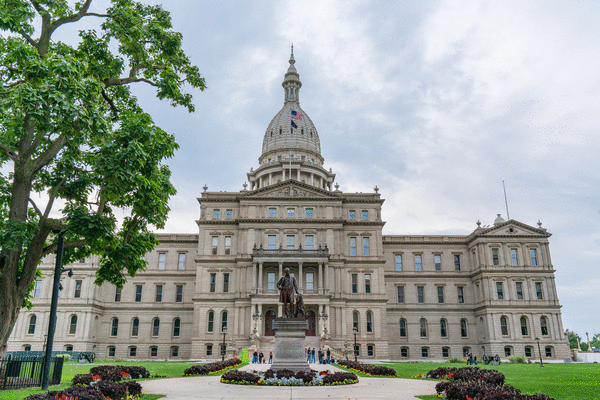
LANSING, Mich. — The Michigan Legislature’s Republican-led House and Democratic-led Senate are going down to the wire in a standoff over legislation that would allow more than 3,600 out-of-state physicians to continue practicing in the state.
On March 28, Michigan will withdraw from the Interstate Medical Licensure Compact unless the Legislature votes on a bill reinstating the state's participation before that deadline. The compact is an agreement among 41 states that streamlines licensing requirements for physicians who want to practice in another state in the compact.
A final vote on the issue has been elusive as the Legislature's politically divided chambers debate which bill — the House's February version or the May 2025 Senate version — should become the public act.
The political stalemate over which bill to pass looms over the Michigan Legislature this week because the House is scheduled to adjourn Thursday for a three-week spring break.
"This is an extremely important issue for the leader," said Rosie Jones, a spokeswoman for Senate Majority Leader Winnie Brinks, D-Grand Rapids. "It's very frustrating that House Republicans sat on a solution for 10 months, all the while creating immense stress for physicians, their patients and the teams they work with."
Both of the competing bills are sponsored by Republicans.
House Speaker Matt Hall, R-Richland Township, said Tuesday that legislative leaders were "working to try to get a deal" on the legislation and accused Democrats of procrastination. The Lansing-based "dysfunction," Hall said, stems from a fight over who gets credit for the final public act.
"We've made it known to them that we want to make a deal and we're waiting for a response," the speaker told reporters Tuesday.
Dr. Mark Komorowski, a plastic surgeon in Bay City, currently assists other out-of-state hospitals through the compact. Because of the interstate agreement, the licensing process for a doctor to work in another state is reduced from 6 to 12 weeks, in some states, to less than a week, Komorowski said.
Komorowski expressed frustration with the “foolish” infighting keeping the bill from moving forward, likening it to a game of chicken. Michigan already exports more physicians than it should and the uncertainty from the Legislature will only worsen that, he said.
“We’re already at a low point, and if this doesn’t improve, it’s going to create another void,” Komorowski said Thursday.
The state has been participating in the compact since at least 2019. As of February 2025, Michigan's licensing agency reported having about 3,600 physicians with compact privileges practicing in the state, according to a nonpartisan House Fiscal Agency analysis of the bill.
But the law currently authorizing the compact contained a March 28, 2025, sunset, meaning lawmakers would need to reconsider their involvement before that deadline.
Last year, with that sunset approaching, Dr. Mohammad Salameh, then chief medical officer for Trinity Health Michigan, told lawmakers that participation in the compact streamlines and expedites the licensing process, making it easier for out-of-state physicians to obtain licensing. That streamlining, he told the Senate Health Policy Committee, is particularly beneficial in rural communities where there is sometimes a shortage of physicians.
"By removing the sunset on this program, Michiganders can continue to receive care without significant burdens," Salameh said. "And I think, from a standpoint of someone who recruits providers on a daily basis, allowing them to streamline the process of credentialing, getting licensed, and being able to practice in the state of Michigan is a positive and allows us to attract the highest quality providers out there."
In February 2025, the Democratic-led Senate voted in favor of a bill to extend the sunset that was sponsored by Democratic state Sen. Paul Wojno of Warren. In the House, the Republican-led Legislature voted in March 2025 on a bill from Republican state Rep. Rylee Linting of Grosse Ile that also would extend the sunset.
Neither chamber voted on the other's bill, so the March 28, 2025, sunset came and went without the Legislature extending it. Because the withdrawal process from the compact takes a full year, the Legislature has until March 28 to pass a new law rejoining the compact and avoiding licensure headaches for the 3,600 out-of-state physicians, according to the Michigan Department of Licensing and Regulatory Affairs.
In May 2025, the Senate passed a second bill sponsored by Republican state Sen. Roger Hauck of Mount Pleasant to stop Michigan's withdrawal from the compact and reinstate Michigan's participation in the agreement. That bill has sat in the House for 10 months.
Last month, the House passed a nearly identical bill, again sponsored by Linting, which has also sat untouched in the Senate for the past few weeks.
If the House and Senate fail to come to an agreement on Thursday, the House will head for the exits with the hopes that the Senate, which is still scheduled to meet next week, passes Linting's bill before the March 28 deadline.
Hauck said he doesn't have a preference for which bill is passed and was uncertain Thursday morning about the status of negotiations between the House and Senate.
"I didn’t come down here to see how many bills I could get signed," Hauck said. "I came down here to do good legislation. If they want to use a rep's bill to do that, that’s fine with me.”
In a social media video posted Thursday by House Republicans, Linting called for the passage of her legislation.
"It really comes down to partisanship and political games, which is unacceptable because we are up against a harsh deadline here at the end of the month," Linting said.
------------
©2026 www.detroitnews.com. Visit at detroitnews.com. Distributed by Tribune Content Agency, LLC.





Comments