California quickly moves to rename Cesar Chavez Day after sex abuse allegations; calls come to strip name off schools, streets, parks
Published in News & Features
California is moving quickly to rename Cesar Chavez Day in the wake of sex abuse allegations against the famed labor leader.
The push to redesignate the March 31 holiday as “Farmworkers Day” was announced Thursday by Democratic leaders in the state Legislature.
“California’s farmworker rights movement never has been about one individual. To the survivors who have found the courage to come forward, uplifting the movement’s values of dignity and justice, and demanding accountability, our hearts are with you always,” Assembly Speaker Robert Rivas, a Hollister Democrat, and Senate President Pro Tempore Monique Limón, a Santa Barbara Democrat, said in a joint statement.
Some Republicans, too, have expressed a desire to continue honoring the wider farmworker labor movement, even while minimizing Chavez as an individual figure. State Sen. Suzette Martinez Valladares, a Santa Clarita Republican, and Assemblywoman Alexandra Macedo, a Tulare Republican, said Wednesday they were already working on legislation to rename the holiday to “Farmworkers Day.”
Gov. Gavin Newsom indicated support for the effort on social media and during remarks at an unrelated event.
“What Cesar represented was a movement — the farmworkers’ movement, the labor movement — and it’s right to celebrate that movement,” he said. “And so I’m certainly supportive of the direction that many are promoting, including members of the Legislature, and we look forward to moving that along in an expeditious way.”
Calls to purge Chavez from the litany of schools, streets and parks named in his honor came in the hours after the publication of a New York Times investigation detailing disturbing allegations that Chavez sexually assaulted two underage girls in the 1970s, as well as fellow iconic farmworker leader Dolores Huerta in the 1960s.
Huerta, as well as one of the girls, said Chavez raped her.
The claims immediately became a political issue across California and other states, where Chavez has been memorialized in many ways since his death in 1993.
On Thursday, L.A. Mayor Karen Bass and members of the City Council announced they would abandon the holiday honoring Chavez’s birthday and instead rename it Farm Workers Day to honor laborers who toil in the fields every day.
The mood was somber as Bass and four council members — all women of color who had once cited Chavez as an inspirational figure who played a role in their own political trajectories — spoke about what they characterized as devastating accusations.
“Usually, when we do these signings, it’s for something that we’re celebrating. This is not a celebration,” Bass said. “This a change that is fundamental, that all of us feel is important for us to do, because moving forward, this is about honoring the men and women and children who toil every day in our fields, and we will honor that.”
Bass, who once had a bust of Chavez near her office, had met Chavez years ago. Growing up, she said she admired him and the farmworker movement, joining the boycott against grapes in Delano with her parents. But on Wednesday, after the allegations became public, Bass quickly reached out to Council member Monica Rodriguez about getting the proclamation into motion.
“When I heard the painful news from the sister that I admire so much, Dolores Huerta, my heart broke from what she went through,” Bass said.
The next steps will include a process to conduct a citywide assessment to rename signs, parks and city property with community input. Bass said she reached out to the Chavez family, who supported her effort to rename the holiday, which falls on the last Monday of March.
“The reckoning is real and it’s palpable. We all feel it,” Rodriguez said. “I appreciate that my community has the integrity and the strength to reckon with these new revelations in a very expedient way, and as we do in Los Angeles, we lead by example.”
Council member Eunisses Hernandez said that, as a survivor herself, she has seen the patriarchy silence women. She has been told "calladita te ves más bonita" — “You look prettier when you’re quiet.”
“It exploits our labor, it dismisses our pain, it questions our truth,” she said. “I know that feeling too well, the feeling of carrying something and calculating every single day whether telling the truth will cost you your safety, your voice or your place in the world.”
“There are no perfect survivors,” she added. “There’s no clean version of this. There’s no right way to come forward, and no timeline that will magically make people comfortable. And survivors don’t owe you that.”
On Wednesday afternoon, near the intersection where Sunset Boulevard becomes Cesar E. Chavez Avenue, California Rising founder Raul Claros called on the city and elected officials to change the road’s name “as soon as possible.”
His organization, a coalition of nonprofits, faith-based groups and community leaders, has launched a Change.org petition to gather signatures to support renaming it Dolores Huerta Avenue.
“We’re demanding the city of Los Angeles to show leadership, for our school district, our state legislators and our federal partners join us in this movement,” he said.
“We know in the Latino community, a lot of this abuse has been tolerated for generations. In our culture, we’re told to stay quiet,” he added. “That stops now.”
In the agricultural Central Valley, Fresno City Council member Miguel Arias said he would pursue renaming the local Cesar Chavez Boulevard.
“Public streets and building names are meant to honor individuals who uplifted our community and represented its highest values,” he wrote on Facebook. “Given what we now know, Cesar Chavez’s actions do not meet that standard, and we have a responsibility to act accordingly.”
In Long Beach, where a park and neighboring elementary school are named for Chavez, Mayor Rex Richardson said the city would engage the community to consider “how we recognize the farmworker movement in our public spaces, holidays, and civic life — including reviewing the naming of public facilities — in a way that is responsive to this moment and grounded in our values.”
Bakersfield city leaders also announced they would end efforts to rename H Street in Chavez’s honor, a plan that was originally proposed in August 2025.
In Northern California, Sacramento Mayor Kevin McCarty announced on X that he is appointing a council subcommittee to guide renaming the city’s downtown plaza park, which is named for Chavez.
“We take these allegations seriously and will ensure the naming of our City facilities aligns with our values,” McCarty wrote.
The revelations also put California school districts — already gearing up for annual commemorative recognitions of Chavez and his contributions — in a difficult position.
The Los Angeles Unified School District said it is “reviewing curriculum and resources to ensure the emphasis remains on the important work of the farmworker movement, not on any one individual.”
“It is important to recognize the collective work of thousands who have advanced social justice, labor rights, and community empowerment,” the district said in a statement.
The district will continue, for this year, to give its students and faculty the day off that was scheduled in observance of Chavez’s birthday. In the nation’s second-largest school system, the holiday is observed on Friday, March 27, and has the effect of lengthening spring break, which extends across the following week.
Acting L.A. Unified Superintendent Andres Chait addressed the issue in a Thursday news conference that mostly covered matters related to labor negotiations.
“We’re all deeply, deeply troubled by the allegations that have come forward over the last couple of days, particularly yesterday, of course,” Chait said. “We are assessing the impact that it’s going to have on our educational program, specific to the holiday.”
Chavez’s name also adorns buildings and departments across California college campuses, especially those focused on Latino communities, Chicano studies and labor studies.
Rachel Zaentz, a spokesperson for the 10-campus University of California system, said university leaders were “deeply concerned” about the allegations against Chavez.
“We stand firmly with survivors and are evaluating these findings internally. We will communicate updates when appropriate,” Zaentz said.
On Wednesday, a spokesperson for UC Davis said the university had renamed an upcoming conference to remove Chavez’s name. It will now be known as the Avanza Rising Scholars Conference.
“Since 2001, tens of thousands of junior high, high school and community college students from predominantly low-income and underrepresented backgrounds have participated in our annual college access conference in coordination with UC Davis’ Avanza Initiative. The conference connects young people with campus resources, information and guidance to support their path to higher education, and that mission will continue,” said UC Davis spokesman James Nash.
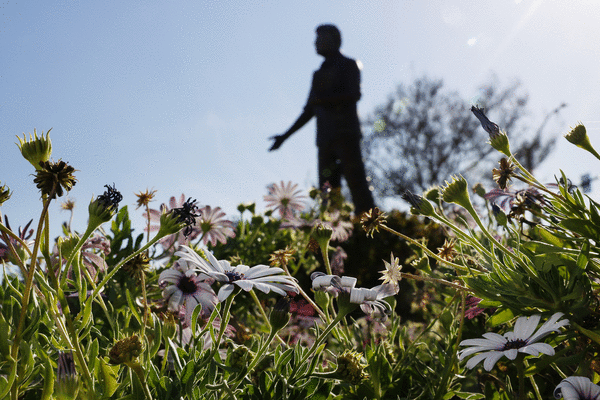
A statue of Chavez erected on the Fresno State University campus was covered Wednesday by a black tarp and plastic, Bakersfield Now reported.
University President Saúl Jiménez-Sandoval said in a statement that he was “deeply saddened and disturbed by the allegations” and noted that the monument in the campus’ Peace Garden was erected in 1996 “to honor the spirit of peaceful assembly and the broader labor movement that has shaped this region.”
“In light of the seriousness of the current revelations, as a first step, we are covering the statue while we determine appropriate next steps for its removal,” he said.
Arias, the Fresno councilman and a former farmworker himself, acknowledged that Chavez has “been an idol to us as a community, because he fought and advocated for ourselves and our parents who are farmworkers.” The same, he said, is true of Huerta — who “remains a matriarch of our Latino community.”
“When the abuelita sits you down at the dinner table and tells you the truth about what happened back in the days, we have a responsibility to listen and to act in a way that honors the pain and sets a new standard for the rest of us to adhere to,” he said.
_____
(Los Angeles Times staff writer Taryn Luna contributed to this report.)
©2026 Los Angeles Times. Visit at latimes.com. Distributed by Tribune Content Agency, LLC.






Comments