FBI, CIA chiefs meet with Senate GOP over spy authority renewal
Published in News & Features
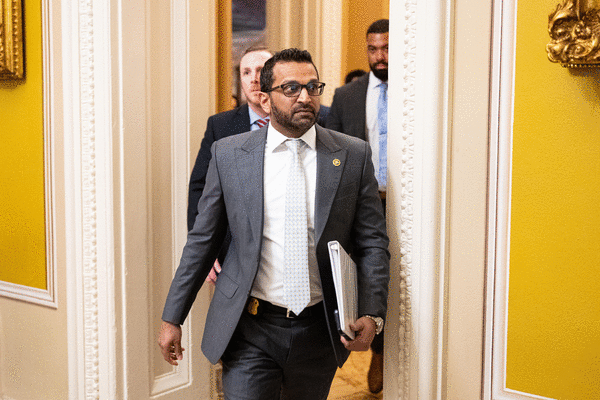
WASHINGTON — Two key Trump administration officials huddled with Senate Republicans behind closed doors Wednesday to discuss a powerful but controversial surveillance authority that expires next month, an issue that for years has bitterly divided privacy hawks and intelligence-focused lawmakers.
FBI Director Kash Patel and CIA Director John Ratcliffe came to Capitol Hill as the Republican-controlled Congress grapples with how to reauthorize Section 702 of the Foreign Intelligence Surveillance Act and whether to include further changes to the spy authority such as a warrant requirement for certain collected information.
Section 702 allows the U.S. government to collect digital communications of foreigners located outside the country, but it also sweeps up the communications of Americans and allows the FBI to search through data without a warrant, using information such as an email address.
Privacy advocates and members of Congress from both parties have cited past abuses and said the searching of Americans’ information violates Fourth Amendment protections. In committee hearings in recent months, they have said they would once again press for a warrant requirement.
After a Wednesday meeting in the Senate, multiple lawmakers said the Trump administration signaled it wants an extension of the authority with no changes, referred to as a “clean extension.”
The program as it stands has enthusiastic support from lawmakers from both parties who are focused on national security.
“I know the administration’s position is there needs to be a clean extension, and so I think they were there to answer questions and to get some feedback,” Sen. John Cornyn, R-Texas, said of Patel and Ratcliffe’s appearance.
Cornyn, a vocal supporter of the authority, said he would support a clean 18-month extension of the authority and would back an even longer extension.
Lawmakers reauthorized the program last Congress without a warrant requirement but made some changes aimed at making sure the government couldn’t misuse the authority.
“All the reforms that were passed are working well,” Cornyn said, adding there are “no problems that need to be fixed.”
Privacy advocates argue that the prior reauthorization ended up expanding the scope of Section 702.
Sen. Steve Daines, R-Mont., said after the meeting on Wednesday that he thinks Patel and Ratcliffe want to see a clean extension of some sort.
“It’s an incredibly important tool that has clearly kept this nation safe,” Daines said.
Sen. Shelley Moore Capito, R-W.Va., said Patel and Ratcliffe were emphasizing, “from the president’s perspective,” the necessary nature of Section 702, with the implication that the officials wanted a clean extension.
“We can’t let it lapse,” she said. “This is too important a topic.”
Compared with the Biden administration, the Trump White House has done far less to publicize what it wants out of this reauthorization cycle, perhaps a nod to the sensitive political dynamics on a topic that has split members of both parties.
Sen. Angus King, a Maine independent who sits on the Senate Intelligence Committee, said it’s his “understanding” that the Trump administration wants a clean extension.
“I haven’t seen anything on paper, or had a briefing on it,” King said, adding that he hopes they are going to be “communicating it to members of Congress.”
_____
©2026 CQ-Roll Call, Inc. Visit at rollcall.com. Distributed by Tribune Content Agency, LLC.





Comments