Data center gas plants to lift US power emissions 10%, BNEF says
Published in Business News
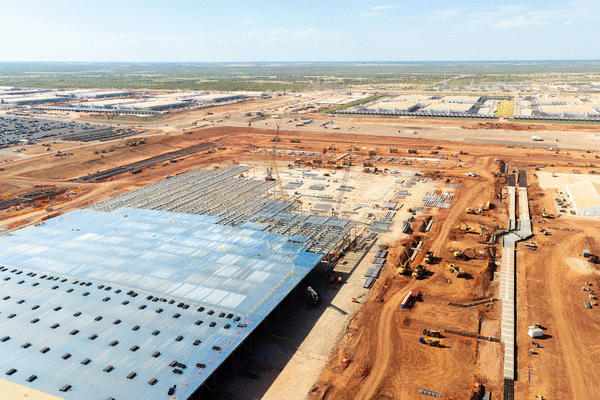
The gas-fired power plants currently planned for data center sites around the U.S. would significantly increase emissions from the country’s energy sector, according to a report from BloombergNEF.
If all the plants announced so far were completed, they would raise overall power-related emissions by about 10% compared with 2025 levels, said the report, which was commissioned by Bloomberg Philanthropies and released Wednesday.
Developers building data centers for the artificial intelligence boom need power faster than the U.S. grid can deliver it. As a result, more developers are planning to build their own gas plants to power the projects.
Many of the plants are meant to be stopgaps until facilities can get a grid connection, but BNEF warns that once they’re running, the economics may keep them going. That risks locking in fossil fuels as a power source for the sites for the long term.
“The grid performs well on reliability and cost and sustainability, but it has a major weakness: It fails on speed, and that’s the one thing we care about today,” said Musfika Mishi, an associate covering data centers and emerging technologies for BloombergNEF, at the BNEF Summit in Houston.
Developers have announced about 181 gigawatts of gas-fired generation proposed alongside data centers, with more than 90% in the U.S., Mishi said. One gigawatt is equivalent to the capacity of about one traditional nuclear reactor. The announced pipeline varies widely in maturity and timing and is an indication of potential scale rather than a forecast of what will ultimately be built.
Overall, BNEF found that if all announced on-site gas power for U.S. data centers is completed, it would emit about 345 million metric tons of CO2-equivalent a year. That’s 152 million tons or 10% more than 2025 emissions if the same data center capacity ran on average U.S. grid power.
Grid operators are looking for ways to connect data centers to the grid faster, Mishi said, including speeding up application processing and legalizing flexible transmission service. Under flexible arrangements, data centers could shift computing to non-peak times or draw less from the grid by leaning on backup power. Even when that backup is diesel, this approach produces fewer emissions than running on-site gas year-round, Mishi said.
©2026 Bloomberg L.P. Visit bloomberg.com. Distributed by Tribune Content Agency, LLC.










Comments