Ford team focuses on speeding up technology deployment to market
Published in Business News
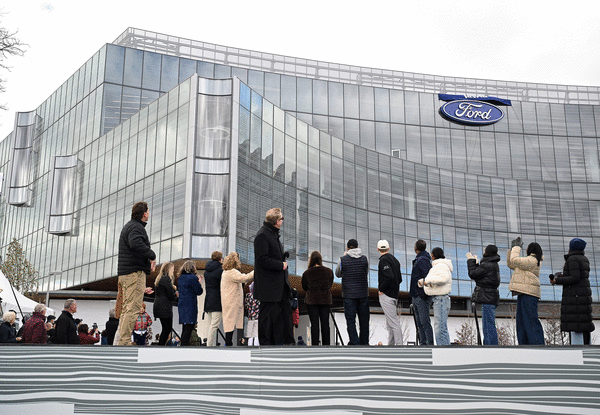
DEARBORN, Michigan — "Speed" is the first thing the director of Ford Motor Co.'s Research and Advanced Engineering team says his group needs to deliver in the future — or risk falling behind foreign rivals.
The group this year marked its 75th anniversary, highlighting its work to reduce vehicle greenhouse gas emissions, help design respirators during the pandemic, give the F-150 an aluminum body, revolutionize Lincoln's infotainment experience and identify the materials for the front and rear castings of the forthcoming Fathom electric midsize truck. But to have another 75 years as Ford faces increasing competition from Chinese automakers and technology disruptions, Matt Jones, who leads R&A and is Ford's executive director of technology platforms, says the group has to be at the forefront of addressing Ford's largest challenges — and doing so more quickly than ever before.
"Over the last five, 10, 20 years, our expectations have changed," Jones said. "And the biggest change is consumer electronics and the time that it takes to get technology."
The respirators born amid the COVID-19 pandemic were a great example of what the group is looking to help Ford accomplish on a regular basis, he said. R&A supported work in taking a napkin sketch to prototype within a week.
"How do we come up with an idea and four weeks later be able to produce 20,000 respirators," Jones said. "Or in the future, coming up with an idea and within 24 hours testing that new software feature on customers?"
Speeding up
For that to happen, he said, Ford needs a strong product vision (he says it does), to identify the problems its customers face and the processes and tools in place to solve those issues and deliver solutions as fast as possible. That's where a lot of the work from R&A is centering right now, he said.
Getting innovative ideas to production hasn't always happened quickly. The group's PROCO (Programmed Combustion) engine offered direct fuel injection in the 1970s. With obstacles for access to controls and hardware supply to support mass production, fuel injection didn't hit a product until 1994 for a diesel application and 2004 for gasoline-powered vehicles in Europe. It was introduced in the United States in 2009 on the EcoBoost, a smaller engine that produced high power but required less fuel.
Now, Chinese automakers are introducing new generations of vehicle models within 18 months to two years compared to the typical three to five years of a legacy car maker. Over-the-air updates can provide upgrades and new features faster than ever. Several Chinese electric vehicle startups have the advantage of developing an electrical architecture from the ground-up, creating advantages for updating vehicle computers. Legacy automakers tend to have more complex systems that make over-the-air updates difficult, though Ford's Fathom promises a simplified, zonal architecture.
"The main thing is that the faster you can develop something new and get it in the marketplace," said Sam Abuelsamid, vice president of market research at auto communications agency Telemetry Group, "it gives you the opportunity to respond more quickly if your competitors come up with something new and competitive. If you launch something, and six months to a year later, your competitor comes up with a step beyond what you’ve done, it might take you several years to provide your customers with the same thing."
R&A is looking to enable "Ford to make late decisions," Jones said, given how quickly the industry can change. "So, how can we pivot or change or adopt things faster?"
It requires "relentless" curiosity and energy, he said. R&A also emphasizes communication and collaboration across teams and skillsets, and early buy-in to address challenges sooner. Mechanical engineers, physicists, chemists, material scientists, biomedical specialists and more make up the diverse talents that seek to tackle Ford's toughest challenges here.
Artificial intelligence increasingly plays a role in accomplishing the team's goals: "They can try things faster," Jones said of employees' work. "They can fail faster, but they can achieve greater success faster than ever before."
The long, flat Research and Innovation Labs building off Mustang Alley (formerly Village Road) on the automaker's Henry Ford II World Center campus is home base for the group. Inside sits a conglomeration of labs and shops for experimenting, testing and failure: "We're trying to de-risk technologies, and failure — that's a positive result for us," said Cynthia Flanigan, a member of the group who is a Henry Ford Technical Fellow in sustainability, the highest technical leadership position at Ford. "If you're working on the next generation of technology, you should be failing, or you're not going far enough."
One lab is seeking to increase the use of soy in vehicle seat foam (currently a 5% soy-based polyol blend) to reduce reliance on oil-based products. Next door is work on anode slurry, the chemical mixture for batteries. Across the building is the Vertex driving simulator able to test advanced driver-assistance systems. Elsewhere, teams may be evaluating augmented reality infotainment displays on windshields after launching a panoramic screen in Lincoln SUVs.
Working with skunkworks
Despite all of this, Ford chose to create a small group of engineers based in California for its skunkworks team to bring forth the Universal Electric Vehicle Platform. The Fathom is the first vehicle off the platform that's expected to hit the market next year with a sub-$30,000 starting price. Executives have championed the truck as a product that could compete with a vehicle assembled by Chinese automakers in the United States. Some of those engineers were from R&A who relocated to Irvine and were able to call upon the group's expertise.
In some ways, R&A works like a skunkworks team with a "no holds barred" mentality, but it also knows how to get things done within the 123-year-old Ford, Jones said.
"Bringing that external expertise (from skunkworks) partnered at the right points in time with R&A, it's really enabled the whole company, especially UEV, to thrive," he said.
But R&A also has been a key part of bringing the advancements from skunkworks to elsewhere in Ford. Elements of the Ford cloud ready to support UEV are already servicing internet-connected Ford vehicles on the road today, Jones said. R&A is working on bringing the weight-saving benefits earned by the materials making up the modular castings for the vehicle's structure to other Ford vehicles.
"It hasn't just produced an amazing vehicle, which you will love," Jones said, "but it's produced all of these other technologies that are actually behind the scenes helping what we do in other vehicles."
R&A highlighted its previous and often secretive ongoing work in a showcase over the past week that was open to other Ford employees to spur inspiration and augment its talent pipeline.
"We want to be the disruptor," Jones said. "If we are a disrupter, then we're less likely to be disrupted."
©2026 www.detroitnews.com. Visit at detroitnews.com. Distributed by Tribune Content Agency, LLC.









Comments