Terry Savage: Why the national debt should concern us
Published in Business News
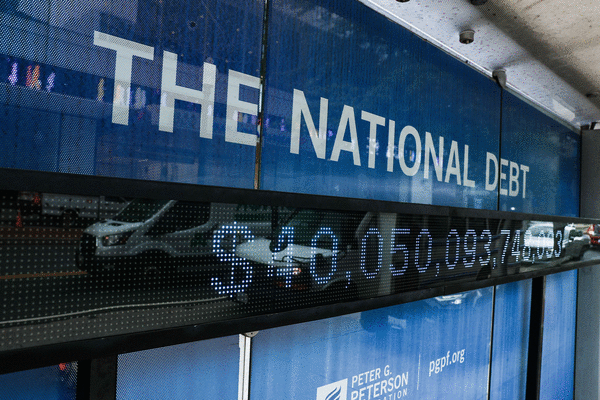
The U.S. national debt now exceeds $40 trillion — a MEGO number, which stands for "my eyes glaze over." Why should you care? No one else seems worried. Not Congress, for sure. They just keep spending and borrowing more.
There’s always been someone willing to lend us money. The rest of the world — until now — has been comfortable buying our IOUs. They have been willing to accept a relatively low rate of interest, compared to more risky debt from other countries.
Our debt consists of Treasury bills, notes, and bonds. T-bills have maturities of less than two years, Treasury notes have maturities of 2-10 years, and Treasury bonds are longer-term promises to pay. Individuals can purchase them through the official TreasuryDirect.gov website, in minimum amounts of $100.
(For a complete guide on how to buy T-bills, go to the special report at TerrySavage.com. Note: Starting in October, TreasuryDirect accounts must be accessed through the ID.me verification system.)
The vast majority of our national debt IOUs are owned by big institutions and foreign central banks. They set the interest rate at regular weekly auctions for T-bills, and monthly auctions for longer-term securities. Individual buyers agree to accept the average rate created through the auction process.
When those global buyers bid for the securities, they consider the strength of the American economy, the potential for inflation to impact the value of the dollars they receive when the security matures, and the very negligible risk that America will not pay its debt at maturity.
Compared to Greece, which defaulted on $264 billion in government debt in 2012, or Argentina, which defaulted on $82 billion in foreign debt in 2001, the dollar looks like a very secure investment.
Who owns our debt?
Foreign central banks own about one-quarter of our debt. As of June 2026, the largest holder was Japan with $1.1 trillion, followed by the UK ($940 billion); China ($633 billion); Belgium ($483 billion) and Canada ($460 billion).
Owning our debt has been a pretty good deal for them. We buy their goods (our imports) and send them dollars to pay for our purchases. They use some of the dollars to grow their businesses, and some is used to buy our debt. To the extent that they sell us more “stuff,” they earn more dollars — and help us finance our national debt.
And, to the extent that we place tariffs on their goods, so we import less stuff, they earn fewer dollars — and are less able to buy our debt!
Of course, that is only one component of international trade — but an important one. Without foreign purchases of our IOUs, the Treasury would have to offer higher rates to attract buyers of T-bills, notes, and bonds.
Higher interest rates do tend to attract money to the U.S. debt market, sending the dollar higher as demand increases. That’s helpful in financing our debt — but those higher rates are not so good for the stock market or our economy.
Are we the only choice?
Ever since World War II — now nearly 100 years ago — the United States has been viewed as the safest place in the world to invest your liquid cash. Treasury debt has an AA+ rating, just one notch below the highest level. That compares to the S&P Global rating of AA for the United Kingdom and A+ for Japan. Each pays a slightly higher rate for its borrowings, because of the slightly lower credit score.
China would like its currency to be the global standard. And its credit rating is about on a par with Japan. But it just doesn’t have the trust needed to be a reserve currency.
The U.S. would have to do something dramatic and unprecedented to lose its top rating. Something like piling on the national debt, or destroying international trade patterns, or allowing inflation to go unchecked, or starting a war it can’t win. Or losing the trust of the world in some other way.
There are potentially some alternatives to the dollar as the global standard for trade. Gold is cumbersome, and doesn’t pay interest. Bitcoin and crypto currencies have yet to demonstrate their reliability as a store of value. So for now, the dollar is the reserve currency of world trade and investment.
But if we have to pay higher interest rates to attract global investors, who fear that inflation will reduce the spending power of the dollars they invest, then those higher rates will cause a slowdown in our economy. Higher U.S. Treasury rates impact mortgage rates and the cost of borrowing to build businesses that create jobs. And they compete with the attractiveness of the stock market as an investment.
It’s a two-sided coin: Savers would earn more, but borrowers would pay more.
Maybe Shakespeare had it right when he wrote, “Neither a borrower nor a lender be,” in Hamlet as he was trying to illustrate the importance of financial discipline. It’s a lesson we could use today. And that’s The Savage Truth.
©2026 Terry Savage. Distributed by Tribune Content Agency, LLC.





Comments