Small fusion reactors compete to generate reliable, safe electricity
Published in Business News
While progress begins on small, modular nuclear fission reactors across the United States for electric generation, others are betting on fusion, the still-experimental fusing of lightweight atoms that powered Tony Stark’s fictional Iron Man suit.
South Korea’s Hyundai Motor Group is investing in a Bill Gates-backed U.S. nuclear firm, Commonwealth Fusion Systems, to build its commercial power stations in Massachusetts and Virginia.
“Fusion energy has the potential to play an important role in addressing growing global energy demand while supporting a more sustainable future,” Hokeun Chung, executive vice president of Hyundai Motor Group, said in an announcement.
Their technology relies on a tokamak reactor first invented by soviet researchers. It uses superconducting magnets to accelerate plasma in a donut-shaped vacuum chamber. This traps and heats hydrogen isotopes to temperatures hotter than the core of the sun, forcing them to fuse and release massive amounts of energy — 400 megawatts in the Commonwealth Fusion Systems design.
“CFS is focused on completing the assembly of its SPARC fusion demonstration machine in Devens, Massachusetts, and also continues to move forward with development of the world’s first grid-scale ARC fusion power plant at the company’s Fall Line Fusion Power Station in Chesterfield County, Virginia,” the fusion firm noted in its release.
The challenge is building high-powered superconducting magnets that work at high temperatures.
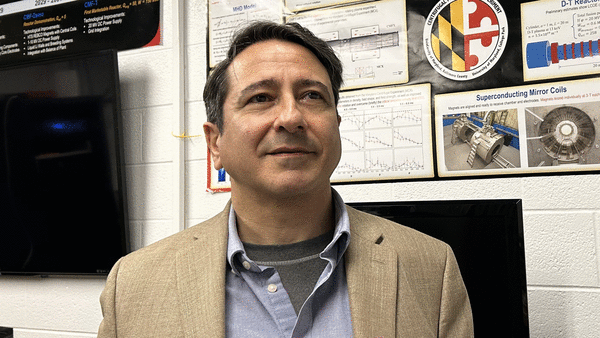
That’s not the only problem they will have to solve, said Carlos Talamás, an associate professor of mechanical engineering with the University of Maryland Baltimore County. Talamás founded Terra Fusion to develop his own fusion reactor for commercial electric generation.
“It turns out magnetic fields are not perfect. They are leaky,” he told The Baltimore Sun. “It’s like trying to compress jello using a slinky.”
The problem with the tokamak, Talamás said, is that maintaining an effective fusion reaction requires preventing leaks. If plasma gets hot enough, he said, “bubbles” of plasma escape from the containment field, bleeding off energy. It can also shed neutrons during the reaction, which can punch through and damage magnets.
Talamás completed his post-doctoral research at the Lawrence Livermore National Laboratory, which announced the first fusion reaction to generate more energy than it consumed in 2022. Researchers there have achieved fusion reactions multiple times using 192 lasers to force frozen deuterium and tritium together, but they cannot sustain the reaction more than briefly before everything has to be reset, Talamás said.
Terra Fusion is developing a linear reactor chamber, he said, which can overcome these limitations and contain the fusion reaction using high-speed rotation of electromagnetic fields, called a centrifugal mirror.
“If you can make plasma rotate supersonically,” he said, “you can eliminate the escape of particles.”
Talamas uses electromagnetic fields not just to contain his reaction, but to set different concentric layers of plasma spinning at ever-faster velocities toward the center of the low-pressure, sealed chamber. The shear, or difference in speed between different layers, creates friction that stops escaping particles and kicks them back toward the hotter, faster-spinning center, he said.
Terra Fusion is beginning work on a second-generation reactor in the Hollins Ferry area of Baltimore, he said. It will be able to produce 5 megawatts of electricity — enough to power about 4,000 homes, Talamás said. The design is also scalable and can produce more energy with a longer chamber.
“The biggest benefit of our design is it’s much simpler than tokamaks, accelerators and other reactors, and it also operates at a steady state,” he said. “All we require to get it started is electricity.”
©2026 The Baltimore Sun. Visit at baltimoresun.com. Distributed by Tribune Content Agency, LLC.










Comments