US strikes light-touch AI regulation accord with G20 members
Published in Business News
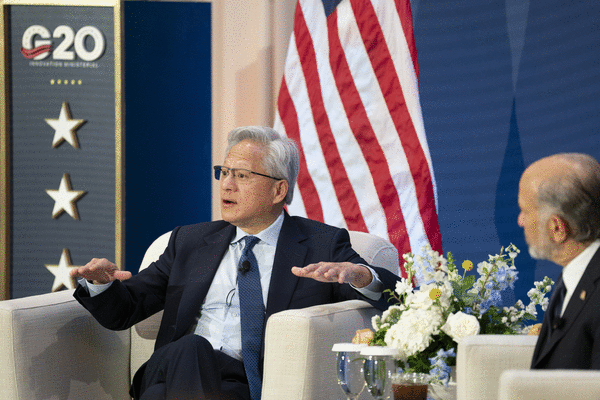
Representatives from the world’s largest economies unanimously agreed to adopt guidelines proposed by the U.S. that call for a lighter touch toward governing artificial intelligence and other emerging technologies, handing a win to the Trump administration and Silicon Valley.
The framework was endorsed on Wednesday by all of the Group of 20 nations, U.S. Commerce Secretary Howard Lutnick said at the conclusion of a tech and innovation summit hosted by the Trump administration in North Carolina.
Though the guidelines are non-binding, the support for them from G20 members marks a rare sign of cooperation in how technologies should be regulated amid an intensifying competition for AI leadership. Getting all the participating countries to agree was an “enormous amount of work,” Lutnick said. “When you bring global leaders together there’s always lots of politics.”
Dubbed the Carolina Principles, the document calls on G20 nations to apply sector-specific approaches to rule-making and avoid creating new regulatory bodies for AI governance. It urges closer collaboration between governments and private industry in vetting nascent technologies while also factoring in the potential costs of delays in adopting breakthrough products.
The principles will be presented for formal adoption by G20 leaders at their upcoming summit, which will be hosted in December by President Donald Trump at his golf club in Doral, Florida.
“The U.S. message to our guests has been very simple: we want more growth and innovation around the world,” White House Science and Technology Adviser Michael Kratsios said at a joint news conference with Lutnick in Chapel Hill to announce the accord.
Kratsios and Lutnick were joined at the two-day event by tech industry leaders including SpaceX Chief Executive Officer Elon Musk, Nvidia Corp. CEO Jensen Huang and OpenAI’s Sam Altman, who all supported the administration’s call to accelerate AI adoption with a hands-off regulatory approach.
In remarks to reporters, Huang urged governments to adopt narrow regulations for AI, saying that the responsibility for ensuring product safety should fall to companies rather than public officials.
“The technology is in its formative stages, and the advice that I would have is to regulate practical and actual harm, and not regulate theoretical and hypothetical harm,” Huang said after a fireside chat with Lutnick. “Every single company has to take it upon themselves to develop the technology safely.
The framework won full backing from the G20 — including by U.S. adversaries China and Russia — just weeks before Chinese President Xi Jinping is set to meet with Trump in Washington. Their meeting is expected to focus in part on artificial intelligence, a technology that’s become a growing source of friction between the two sides.
Earlier this week, China voiced its disapproval with top Silicon Valley AI companies, describing their models as “distorted” in a post on a social media account affiliated with Chinese state broadcaster CCTV. It accused the U.S. of trying to use safety boundaries to assert control over the technology and singled out Anthropic PBC, criticizing the company for not allowing China to access its most powerful models.
Lutnick said that U.S. officials met with their Chinese counterparts during the G20 innovation ministerial. “We really talked about how we could work together, the secretary said in a Bloomberg Television interview. “The G20 is all about a collaborative way to how to do things together.”
The U.S. has sought for years to contain China’s ability to gain ground in AI by barring Chinese companies from purchasing the most advanced semiconductors and chip equipment, and Lutnick indicated on Wednesday that he saw no reason to ease those export restrictions.
Even so, there are no enduring U.S. restrictions barring Anthropic and other American developers from sharing their AI tech with Chinese customers. The U.S. did briefly impose export controls blocking foreign access to Anthropic’s models, a signal that it does not want models capable of conducting powerful cyber attacks reaching U.S. adversaries.
Europe has had its own friction with the Trump administration over AI and tech policy. The U.S. decision in June to temporarily bar foreign access to Anthropic’s Fable 5 and Mythos 5 models also hit close allies in Europe. The administration has also been pressuring the European Union, through tariffs and other measures, to ease digital regulations opposed by the biggest American tech companies.
Henna Virkkunen, the European Commission’s executive vice president for technology sovereignty, said that AI is creating new opportunities and the EU is eager to boost innovation. At the same time, she cautioned that the technology is spawning new threats, notably the recent spate of attacks by rogue AI models, that will require governments to coordinate closely.
“We think that we should work together also to look at how we prepare for these kind of risks,” Virkkunen said in an interview following the G20 meeting. “It’s not easy to agree among so many different countries” about a topic like AI, she added.
—With assistance from Joe Mathieu.
©2026 Bloomberg L.P. Visit bloomberg.com. Distributed by Tribune Content Agency, LLC.






Comments