It's official: Cuba finally authorizes Cubans living abroad to own private businesses
Published in Business News
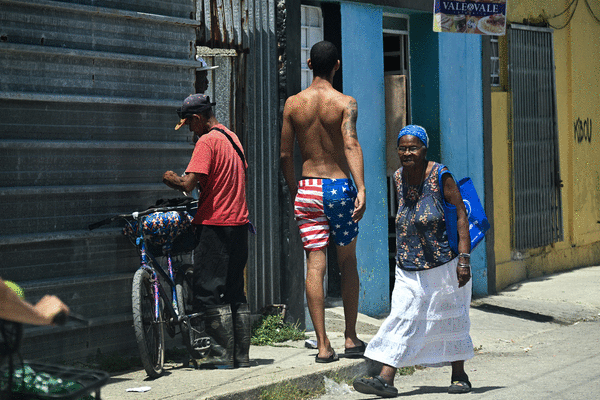
Years after it started toying with the idea, the Cuban government has finally approved a new legal framework allowing Cubans living outside the island to own private companies in Cuba, according to a decree law published Wednesday that also lifts restrictions on the size of private businesses and allows an individual to have stakes in several businesses at once.
The new legal framework, published in the Official Gazette, is the deepest overhaul of the island’s private sector since small and medium enterprises were legalized in 2021. The country’s leader, Miguel Díaz-Canel, advanced the new measures as part of a reform package he has insisted is necessary to save Cuba’s communist revolution, but should not be portrayed as “capitalist.”
Still, the measures entail a significant expansion of the island’s beleaguered private sector: businesses can hire more than 100 employees and expand to other provinces, paving the way for commercial chains across the country. Successful entrepreneurs can also create several companies and accumulate significant wealth on an island where the Communist Party is still in charge.
The new decree also implements other significant changes that had already been announced, including allowing the creation of private farming businesses, a restriction that has hindered food production on the island. Private businesses will be allowed to import and export directly, without the need for state intermediaries, but will still require authorization from the Ministry of Foreign Trade and Investment.
Last month, the government also expanded a list of authorized activities that private entities can perform on the island for the first time in six decades, including opening pharmacies and running gas stations.
It took Cuban leaders a raging humanitarian crisis, the loss of its foreign patron, Venezuela, and a hostile U.S. administration threatening military action to put in place measures that appear to have been in the books for years. In 2023, the Miami Herald reported that Díaz-Canel told a room of Cuban American business people that the Cuban government was contemplating letting Cuban Americans invest in and own businesses on the island, and was working on legislation to do it.
But then, in an example of the push-and-pull inside the government between hardliners and reformers, the government passed a decree in 2024 that further restricted ownership of private businesses to Cubans with “effective residency” on the island, a restriction eliminated by the new legislation.
Even if it has now become a legal reality, the possibility of investing on the island has elicited a tepid response and much skepticism among Cuban Americans in South Florida.
On the U.S. side, the embargo is still in place; Cuba is on the list of countries that sponsor terrorism, and the Trump administration declared a “national emergency” with respect to Cuba. That means U.S. nationals are prohibited from engaging in business transactions with Cuba unless the U.S. government authorizes them.
Economic conditions on the island, on the other hand — with electricity blackouts lasting days, a devalued local currency and dilapidated infrastructure — offer little incentive for investment. Cuban laws offer little protection to foreign investors, and private businesses will remain under strict government control and a heavy tax burden.
For example, firms must sell goods and services in Cuban pesos unless they are authorized to use foreign currency, companies in the rental business must report identifying data on tenants to the Interior Ministry when renting to people residing abroad, and notify authorities before traveling out of the country. The government continues to fiercely prosecutes its critics, barring Cubans who antagonize the communist regime from the pool of potential investors.
There is also little trust that these measures are permanent. The Cuban government has a long history of seizing private property from foreign investors and confiscating private businesses, back to the early days of the revolution, when Fidel Castro confiscated all private businesses.
______
©2026 Miami Herald. Visit miamiherald.com. Distributed by Tribune Content Agency, LLC.







Comments