Memory chip shortage drives up computer prices at Best Buy, other retailers
Published in Business News
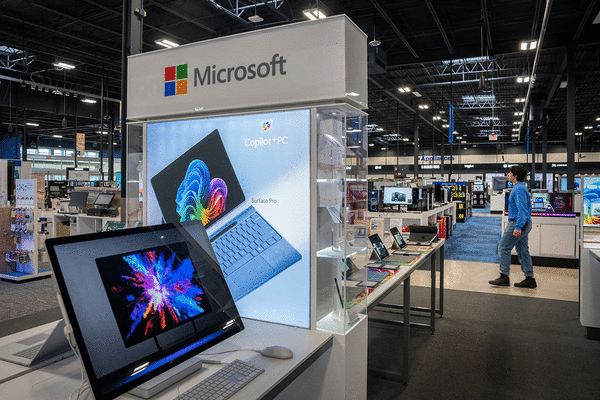
Computer sales drove much of Best Buy’s revenue growth this summer, but it was because of higher prices, not because more were sold.
The cause of inflation in this case: data centers.
Companies are shifting memory chip production toward more lucrative data center products to meet demand from the artificial intelligence boom, tightening supplies for PCs. As a result, computer makers, forced to change supply lines and fight for deals with chipmakers, passed on the costs, making computers more expensive.
Retailers like Best Buy then have to raise their prices or accept lower profit margins.
“There is still significant customer demand in this category,” incoming CEO Jason Bonfig said on an analyst call. “Finding the right product for their budget, making sure that we match them with the right product for their particular needs.”
Consumers are still price-conscious, executives said, and after a few quarters of growth from upgrades spurred by the end of support for Windows 10, Best Buy expects computer sales to slow in the second half of the year.
Still, for the May-to-July period, comparable sales rose 4.1%, driven largely by computer and mobile phone purchases.
It was Best Buy’s second consecutive quarter of growth, and the company raised its guidance for the year. It now expects comparable sales to increase 1.9% to 3%, up from earlier guidance of a 1% decline to a 1% increase.
Best Buy’s stock was down more than 4% in early trading, which analysts said likely reflected high expectations heading into the report.
Here are other takeaways from Best Buy’s second-quarter earnings:
Barry’s last earnings call as CEO
Corie Barry presided over her last earnings call as CEO of Best Buy. She handled both the chief executive and financial sides of the call with analysts, harkening back to the three years she spent as chief financial officer. Anne Bramman, the company’s new CFO, joined Best Buy eight days ago and will take part in future earnings calls.
Barry, who has led Best Buy since 2019, will step down this fall. Bonfig, the company’s chief customer, product and fulfillment officer, will take over Nov. 1.
“Twenty-seven years is a long time to be at a company, and while people focus on the last 7 ½ as CEO, it’s actually the culmination of those 27 that I think about in a moment like today,” Barry said in an interview with the Star Tribune. “What for me is most remarkable is the dedication of the teams here, and their willingness in such a resilient way to continue to drive this very unique business forward.”
Best Buy will lean more into store plan
Bonfig has said one of his priorities is to expand the retailer’s reach. The company has already made changes toward that goal, including investing in smaller-format stores.
Those locations, he said, allow the retailer to tailor the assortment to a specific market and show up in communities it wasn’t previously relevant.
Bonfig, in an interview with the Star Tribune, pointed to a smaller-format store in Bozeman, Mont. as an example, which he said has a “few more premium elements” because of the area’s high-income demographic.
Best Buy’s overall foot traffic grew 2.2% year-over-year in the second quarter, the first quarterly gain in at least four years, according to Placer.ai.
Appliance sales dragged down by slower home sales
The company also made investments in its appliance category, which has been dragged down by slower home sales and fewer remodels. Bonfig said Best Buy only had next-day delivery available in half of its metro markets last quarter, compared with “almost all” metro markets this quarter.
He added that Best Buy is also focused on pricing and in-stock availability, and that customers are still focused on replacing what breaks, such as a washer, instead of upgrading the whole set.
“We needed to change our approach to make sure that we were meeting a customer where they were at,” Bonfig said. “When an appliance breaks, there is a certain level of availability and speed that is very, very critical.”
The company also recorded a $34 million tariff refund, significantly smaller than that of Minneapolis-based Target, whose refund amounted to almost $1 billion. Best Buy has said previously it’s the importer of record on only 2% to 3% of its merchandise.
©2026 The Minnesota Star Tribune. Visit at startribune.com. Distributed by Tribune Content Agency, LLC.








Comments