SpaceX plans $100 billion Louisiana site in post-IPO growth push
Published in Business News
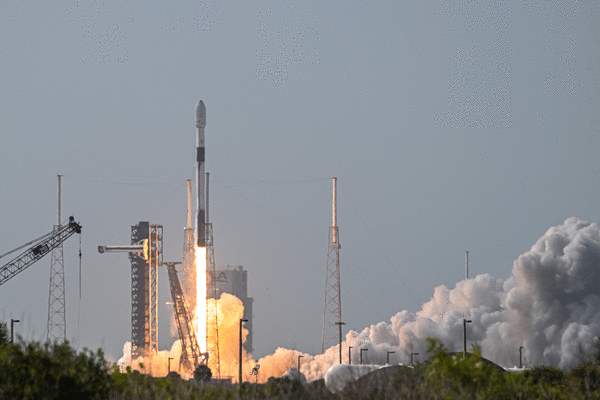
SpaceX plans to build a new $100 billion launch site for its Starship rocket on the southern coast of Louisiana, allowing the company to expand operations of the behemoth vehicle that’s critical to its future.
Louisiana Governor Jeff Landry and SpaceX executives announced the plans on Tuesday, authorizing the company to build a facility across roughly 125,000 acres (about 506 square kilometers) in a coastal area known as Pecan Island.
The site will provide SpaceX with a third potential location for launching Starship, which SpaceX primarily builds and launches in South Texas. The company is also developing a second launch location in Cape Canaveral, Florida.
“This will be a project like no other, another piece of science fiction transported into reality, or what I call science fact,” SpaceX President Gwynne Shotwell said at the announcement event in Louisiana.
SpaceX, which completed the largest-ever initial public offering in June, has embarked on a massive building spree. The company has begun construction of a chip factory in Grimes County, Texas, known as the Terafab, key to Chief Executive Officer Elon Musk’s vision of vertically integrating the supply chain and launching orbital data centers.
Musk has set ambitious targets for Starship, predicting that the rocket will launch several times a day when it is fully developed. Having multiple locations gives SpaceX greater flexibility to increase that cadence, though Starship has still only taken off twice this year.
The Louisiana location will allow SpaceX to launch Starship southward over the Gulf of Mexico and send the vehicle over Earth’s polar regions. That is key for SpaceX’s plan to build a fleet of as many as one million data-center satellites, which the company hopes to place in near-polar orbits. The site is also attractive for its access to nearby natural gas that’s needed to fuel Starship, according to SpaceX.
The facility, which SpaceX is calling Starbase, Louisiana, is expected to include five launch complexes with two launchpads apiece, a propellant production facility, power generation, vehicle processing and residential housing for employees and their families, according to the state’s announcement.
Production on the site starts in 2027, with first planned launch in 2029. Shotwell also mentioned the possibility of building an airport and predicted that the project could bring between 3,000 to 10,000 jobs to the area.
SpaceX’s Starship rocket is slated to become the most critical vehicle in the company’s fleet. In the near-term, Starship is meant to launch larger, upgraded Starlink satellites to help increase capacity of the company’s existing internet-from-space system.
The rocket is also supposed to fly orbital data centers as early as 2027 and land astronauts on the lunar surface for NASA as early as 2028.
On Tuesday, SpaceX also launched its last planned Starlink mission from Florida on the company’s workhorse Falcon 9 rocket. All future Starlink missions on that rocket will take place from California, with Florida Starlink flights using Starship when it’s fully operational, according to a SpaceX executive.
For decades, the Pecan Island site previously belonged to ExxonMobil Holdings Corp., but was returned to the state as part of a settlement over lawsuits accusing the company of coastal land loss.
“Too often, Louisiana was left with the scars, while others enjoyed the profit,” Landry said during the announcement event, comparing the deal to the historic Louisiana Purchase. “Today, what Elon Musk and his team is offering Louisiana is different. They are offering us a permanent future and lasting prosperity.”
Along with the announcement, SpaceX executives said they would conduct an extensive coastal restoration project of the area in partnership with the state to preserve marshland, conserve wildlife and provide storm protection.
“Pecan Island and the surrounding wetlands are high-value habitat for migratory waterfowl, shorebirds, wading birds and other coastal wildlife,” Shotwell said. “Now the birds might fly away during a launch, but I guarantee they come back.”
____
—With assistance from Ruth Liao.
©2026 Bloomberg L.P. Visit bloomberg.com. Distributed by Tribune Content Agency, LLC.









Comments