Trump's 100% tariff on drones deepens US-China tech decoupling
Published in Business News
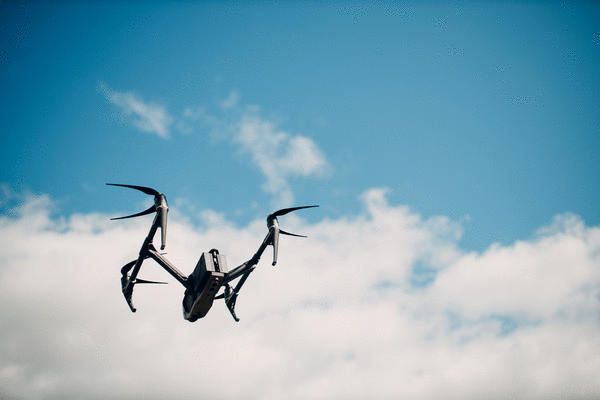
The Trump administration is imposing tariffs of as much as 100% on imported drones and their components, escalating efforts to reduce U.S. reliance on foreign suppliers and potentially accelerating a decoupling of drone supply chains with China.
The top rate will apply to heavier drones — weighing more than 25 kilograms — or those that possess certain capabilities, the White House said Thursday. Smaller drones will be taxed at 25%, while lower rates apply to some trading partners such as the European Union and Japan.
The statement didn’t mention China, but the tariffs risk reinforcing a two-way separation with the world’s dominant drone manufacturer already under way. They also add to a drumbeat of tit-for-tat measures just weeks before Chinese leader Xi Jinping is expected to meet with President Donald Trump in the U.S.
“In the long term, we’re probably slipping towards an outcome of a hard decoupling for at least certain types of drones,” said Christopher Beddor, deputy China research director at Gavekal Dragonomics. “I think this is part of a broader pattern in which both the U.S. and China uphold their basic trade agreement but continue to take relatively low-grade actions against each other.”
U.S. restrictions on new foreign-made models last year have curbed Chinese access to the American market, while Beijing has tightened scrutiny of drone-related exports to the U.S. Chinese drone exports to the U.S. fell to about $50 million in the first half of this year, roughly half the level recorded a year earlier, according to Chinese customs data.
Shares of U.S. drone makers AeroVironment Inc. and Aevex Corp., along with parts supplier Unusual Machines Inc., jumped in post-market trading after the announcement. Shares of major Chinese drone manufacturers closed with small gains on Friday, in line with increases seen across hardware peers.
According to the proclamation released Thursday, Commerce Secretary Howard Lutnick concluded that import penetration from foreign drone producers is “substantial,” and that the U.S. is “too reliant” on foreign unmanned aircraft systems and their parts.
Adding to the Washington’s urgency to protect its domestic industry, Russia’s war in Ukraine has showcased the military effectiveness of drones, helping both sides hold territory and ushering a new era of hybrid warfare. Trump, in the proclamation, declared the unmanned aircraft systems “essential to the national and economic security” of the U.S.
The announcement follows other actions aimed at China’s dominance in advanced technology. The Federal Communications Commission moved in December to block imports of some foreign-made drones including new models from Shenzhen-based DJI Technologies, which accounted for about 70% of the U.S. commercial drone market last year.
More recently, the FCC also banned some foreign-made robots and power inverters. These curbs provoked retaliation from China’s Ministry of Commerce, which placed exports of drones, their key components and related technologies that can be used for military purposes on “strict case-by-case review,” among a barrage of countermeasures.
“This is about reducing dependence on from China for advanced drones and importantly components, as previous FCC barriers did not cover imports of grandfathered models and many drone components,” said Alicia Garcia-Herrero, chief economist for Asia-Pacific at Natixis.
China exported nearly $300 million of drone and aircraft parts to the U.S. in the first six months of this year, compared with $580 million for all of last year, according to China’s General Administration of Customs, which does not provide a separate breakdown for drone components.
Thursday’s decision marks another move by Trump to impose tariffs since the Supreme Court ruled in February that he exceeded his authority by invoking emergency federal powers to impose sweeping global levies.
The drone duties rely instead on Section 232 of the Trade Expansion Act of 1962, which requires an investigation before allowing import restrictions on national security grounds. Trump has invoked the same power to collect tariffs on goods including steel and aluminum, semi-finished copper, and cars and auto parts. Probes into robotics and wind turbines are ongoing under 232 authority.
Smaller drones lacking capabilities deemed especially sensitive for national security will face a 25% duty, as will other components. Tariffs on drones from several economies that struck trade deals with Trump will be 15%, so long as all hardware and technology originates from those places and the U.S.
Those locations include the European Union, Japan, Switzerland and Taiwan. The United Kingdom will be subject to a 10% tariff on its drones and components.
Most of the levies will take effect in 21 days after Trump signed the proclamation. Tariffs on components that aren’t considered particularly sensitive will begin after 180 days.
(With assistance from Derek Wallbank, Jordan Fabian, April Ma and Jiyeun Lee.)
©2026 Bloomberg L.P. Visit bloomberg.com. Distributed by Tribune Content Agency, LLC.








Comments