US core inflation comes in subdued, easing pressure on Fed
Published in Business News
Underlying U.S. inflation was subdued in July, likely easing pressure on the Federal Reserve to raise interest rates.
The consumer price index, excluding often-volatile food and energy categories, increased 0.2% from a month earlier, according to Bureau of Labor Statistics data out Wednesday. On an annual basis, it advanced 2.5%, matching the slowest pace since March 2021.
Overall, consumer prices rose 0.1% from the prior month and 3.4% from a year earlier.
The report suggests the impact of the energy-price shock from the Iran war continued to fade in July. The figures may give the Fed more room to weigh inflation pressures against a recent slowdown in hiring as it debates whether to lift borrowing costs at its Sept. 15-16 meeting.
Policymakers will see additional reports on employment and inflation before the September meeting, and investors will be listening closely to Fed Chairman Kevin Warsh’s expected remarks at the central bank’s annual Jackson Hole symposium later this month.
“It’s good news for those Fed officials who want to be patient here,” said Oscar Munoz, head of U.S. economics at TD Securities. “At least for the Fed officials who are looking for signs of progress, disinflation, it’s a second consecutive report.”
U.S. stocks opened higher and Treasury yields fell as investors pared bets on a September rate hike.
Energy and gasoline prices fell for a second month. U.S. gasoline prices rose above $4 a gallon again in July after a U.S.-Iran ceasefire collapsed and hostilities reignited, but remained lower on average across the entire month than in June.
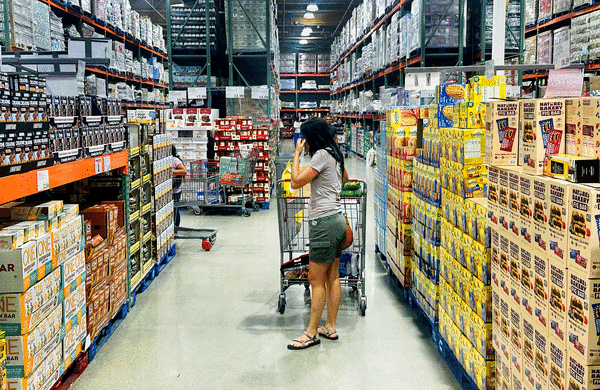
Grocery prices, meanwhile, fell for the first time since March, thanks in part to a record decline in the cost of lettuce amid the cyclospora outbreak. Uncooked ground beef prices fell 1.6%, the most since 2020.
Shelter prices rose 0.1%, restrained by a 3.3% decline in hotel and motel rates, the most in more than a year. The report’s measures of rents both rose 0.3%.
Services prices, excluding energy and rents, rose a modest 0.2% following a decline the month before, according to data compiled by Bloomberg. Medical care and airfares were among services categories that saw rising prices.
Computer inflation
Goods prices, excluding food and energy commodities, rebounded following two months of declines. Computer software and accessories prices rose a record 21.2% from a year earlier, while computers, peripherals and smart home assistants advanced by the most in more than four years.
Economists are monitoring the impact of price increases announced in June on popular consumer tech products like Apple Inc.’s Macs and iPads, which have been driven by a global shortage of memory chips amid a race to build data centers.
Figures on producer prices due Thursday will offer insights on additional categories that feed directly into the Fed’s preferred measure of inflation, based on the price index for personal consumption expenditures, which will be released later this month. Core inflation by that measure has generally been running faster than in the CPI this year.
In September, the Bureau of Economic Analysis will implement changes to how prices are calculated for certain categories in the PCE index, including legal services, computer software and investment advice.
A separate report Wednesday that combines the inflation figures with recent wage data showed that real average hourly earnings declined 0.2% in July from a year earlier, extending a string of weak readings since the Iran war began.
(With assistance from Augusta Saraiva, Jeffrey Sparshott and Julia Fanzeres.)
©2026 Bloomberg L.P. Visit bloomberg.com. Distributed by Tribune Content Agency, LLC.










Comments