Boeing is selling flying taxi venture Wisk, WA-based Insitu to Archer
Published in Business News
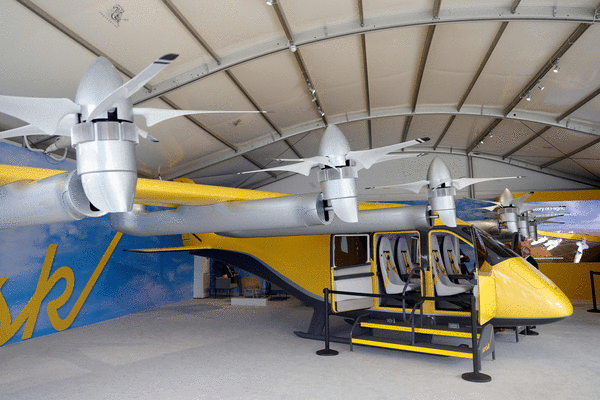
Boeing is selling three subsidiaries to Archer Aviation, a California-based company working on so-called flying taxis, drones and artificial intelligence, according to a joint news release from both companies Monday.
The aerospace giant is selling Wisk, its autonomous flying taxi subsidiary based in California, as well as Washington-based Insitu, which develops unmanned aircraft systems. It is also offloading SkyGrid, its ground-based air traffic management solution headquartered in Texas.
As part of the deal announced Monday, Boeing will take a stake in Archer and retain access to Wisk’s autonomous flight technology for its current and future aircraft, the companies said.
Boeing will take a nearly 20% stake in Archer, according to Archer's financial statements publicized Monday.
Combining Boeing’s three subsidiaries with Archer’s own air taxi, unmanned systems and AI technologies will bring “new and innovative solutions to the market,” the companies said.
“This transaction is a win-win for Boeing and Archer,” said Brian Yutko, Boeing’s vice president for commercial airplanes product development and Wisk’s former CEO. “Having worked with the incredible teams in these companies firsthand, it's clear this transaction will create an industry leader in the advanced aviation market.”
Archer's CEO Adam Goldstein called the deal a watershed moment for Archer and the future of physical AI in aerospace and defense.
Flying taxis, officially known as electric vertical takeoff and landing, or eVTOL, aircraft, take off more like a helicopter than a traditional commercial jet. Because they rely on rechargeable batteries rather than jet fuel, they are part of the aviation industry’s push to decarbonize.
The industry has been promising to bring eVTOLs to passengers for years but progress has been slow, with some startup-style companies running out of money and dropping out of the race and others missing their own deadlines.
Wisk, one of few companies working on a fully autonomous eVTOL, had hoped to certify its first aircraft with safety regulators by the end of the decade and celebrated the successful first flight of its sixth-generation aircraft in December.
Boeing has participated in two of Wisk’s funding rounds and the California-based plane-maker has been a wholly owned subsidiary of the larger manufacturer since 2023.
Boeing has also invested in Archer in the past, part of an agreement reached between the two companies in 2023 after Wisk sued Archer over trade-secrets allegations. Wisk had accused a pair of its former engineers who joined Archer of stealing proprietary information. As part of the settlement, Archer said it would exclusively use Wisk’s autonomous technology in the future.
Archer is aiming to fly passengers in its eVTOL aircraft Midnight by the 2028 Olympics in Los Angeles. It is participating in a federal pilot program meant to speed up development by allowing some manufacturers to start collecting data and testing their operations before the planes are certified. Wisk was also slated to participate in the program.
Last month, Archer announced it was partnering with defense contractor Anduril to develop a hybrid-electric vertical takeoff and landing aircraft for both defense and commercial applications.
Archer’s stock price soared nearly 12% Monday after the news that it would acquire Boeing’s subsidiaries. Boeing's stock dropped 0.7% by the time the markets closed Monday.
Boeing and Archer expect the deal will close by the end of 2026.
Last year, Boeing sold its flight navigation unit Jeppesen to private equity firm Thoma Bravo in a roughly $10.6 billion deal. Boeing CEO Kelly Ortberg, who took the reins in 2024 after a nearly catastrophic midair fuselage blowout, said early in his tenure that he was reviewing the company’s portfolio in an effort to keep focused on core parts of the business.
Insitu, based in Bingen, Klickitat County, and part of Boeing's defense business, has offices in the U.S., Australia, the UK and the UAE. It has manufactured more than 3,500 unmanned aircraft systems and generates $200 million in annual revenue, according to the news release published Monday.
It's unclear what the acquisition will mean for Washington-based workers.
A Boeing spokesperson said Monday that Boeing and its subsidiaries worked closely with Archer to ensure a seamless transition for employees.
Because the three subsidiaries involved in the deal range in geographic location and business function, the details and transition process will vary by country and business, the spokesperson said.
©2026 The Seattle Times. Visit seattletimes.com. Distributed by Tribune Content Agency, LLC.








Comments