Why related-party loans at issue in the Mark Walter probe are considered risky
Published in Business News
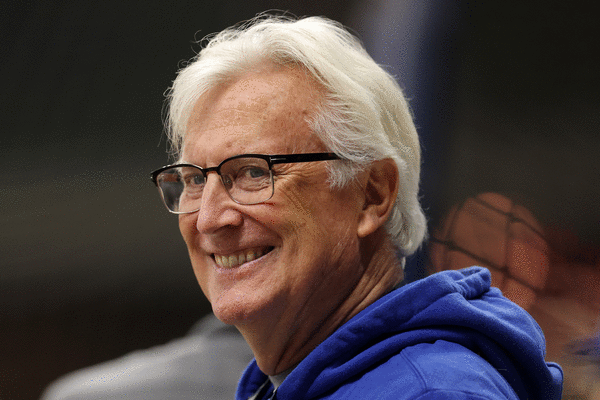
LOS ANGELES -- The federal law enforcement probe into the financial affairs of the Dodgers' controlling owner, Mark Walter, seems to focus on what looks like an obscure financial maneuver: related-party transactions.
They are deals between entities with business or personal ties, including loans, sales and other transactions, that can have legitimate reasons but pose potential conflicts of interest and typically require extra scrutiny.
Walter tapped insurers he controlled to provide most of the financing for the $2.15 billion acquisition of the Dodgers in 2012, The Times has reported — a deal later vetted by state insurance regulators.
Now, regulators reportedly are investigating whether billions of dollars' worth of similar loans made by Walter's companies were properly disclosed.
There are examples in which related-party transactions led to trouble, including the 2001 bankruptcy of Enron Corp., the largest at the time in Wall Street history. Bernie Madoff profited from his Ponzi scheme through related-party loans.
At issue with Walter is $21 billion in loans not disclosed to state insurance regulators that were made by two Delaware insurers he owns, according to ratings agency Fitch. The loans reportedly were made to companies with ties to Walter or his TWG Global holdings company.
The seriousness of the investigation has been highlighted by subpoenas served on the insurers and the reported seizure of Walter's cellphone and laptop by federal authorities. Still, investigations by prosecutors and securities regulators can result in no action.
Here are more details on the risk presented by related-party transactions and why they require disclosure and extra regulatory scrutiny.
What do the investigations mean for his ownership of his sport teams?
The 66-year-old billionaire also took a majority stake in the Los Angeles Lakers last year and owns the Chelsea soccer team in the English Premier League. There is no indication yet that any of this has affected his ownership stakes, but the probe has yet to be completed.
What is the problem with related-party transactions?
Bruce Dubinsky, a forensic accountant who worked on the Enron and Madoff cases, says the issue comes down to the motivation of the parties and can be explained through an analogy.
Sell a car to a stranger and you both research its worth and come to an agreed "fair market value," he said. Sell it to your brother, you might cut the price to "give him a deal," and later even forgive the payments.
"That's why, from an audit standpoint, there should be more scrutiny if you're doing business with the left hand and the right hand, because it's easier to manipulate things," Dubinsky said. "Repayments can be delayed indefinitely. They are always more suspect to fraud."
How does that play out in the insurance industry?
Insurance is one of the most regulated industries, since the companies hold premium dollars from policyholders for future claims payouts — and regulators want to ensure the money is there when it's needed. Related-party transactions can threaten that.
"There is a conflict of interest between the policyholders' interest in the company being profitable and the owner's interest in getting the least expensive financing that is available," said Jim Donelon, who served as Louisiana insurance commissioner for 18 years before stepping down in 2024.
"It potentially threatens the solvency of the company, which then threatens the welfare of the policyholders," Donelon said.
The National Assn. of Insurance Commissioners, for whom Donelon served as president, provides guidance to regulators on how to review related-party transactions.
What are some of the most notable examples of related-party transactions turning into financial disasters?
The failure of Enron was a prime lesson in how related-party transactions can lead to a company's downfall.
As the Houston energy trader struggled and racked up $30 billion in debt, chief financial officer Andrew Fastow thought he found a way to keep it off Enron's books. He created off-balance sheet entities to unload the debt and took personal stakes in them, allowing Fasto to sit on both sides of the negotiation and pocket millions.
They were "transactions with related parties that were not at arm's length," Dubinsky said.
The debacle was a driving force in the passage of the Sarbanes-Oxley Act of 2002, which tightened regulations over governance, accounting and related-party transactions.
What about the Madoff fraud?
The Madoff scandal, in which investors lost $17.5 billion in invested principal, operated like a typical Ponzi scheme with returns to older investors paid by money from new investors.
However, related-party transactions were key too, and some literally involved family members. Madoff's brother, Peter, pleaded guilty to receiving $15.7 million in sham loans and giving $9.9 million in sham loans to family members. What's more, the auditor was a related party.
"In Madoff, what were called 'related‑party loans' were just sham transactions — there was no real economic substance. It was simply Madoff taking money out of his own firm," said Dubinsky, an expert witness for the government.
Is there anything comparable with the Walter probe?
The three situations appear entirely different, but the investigation into the related-party loans made by Walter's Delaware Life and its affiliate, Clear Spring Life and Annuity, involves vast sums of money.
After receiving the subpoenas, the firms conducted internal investigations. They had reported having $1 billion in related-party loans but, after the review, they reclassified $21 billion worth of loans as related, including $4.6 billion held by Clear Spring, said Fitch analyst Jamie Tucker, senior director of North American insurance ratings.
Executives said they were unaware the loans were going to an affiliated company.
Is there any indication what the money was used for?
"Unclear at this stage," Tucker said. "This a developing situation with ongoing investigations."
One clue may be a report that Walter tapped insurers to fund more deals than the Dodgers acquisition. The Wall Street Journal said five insurers had provided more than $10 billion in deal funding since Walter's financial services company, Guggenheim Partners, got into the insurance business after the 2008 financial crisis.
What have been the implications for the insurers owned by Walters ?
Fitch said the financial restatement increased the two insurers' related-party loans from 2% to 40% of their portfolios, the highest exposure among life insurers it rates in North America.
Fitch, A.M. Best and S&P Global also downgraded Delaware Life's outlook to negative, though they said the insurer maintain a high level of financial strength.
"Our capital position and liquidity remain strong, and our financial strength ratings are unchanged," said Group 1001, the insurers' parent company, in a statement.
What has Walter had to say about all this?
He has not publicly commented, but a TWG spokesperson stated that, "Mark Walter and TWG have always acted in good faith, and those who have done business with Mark know him as honest and straightforward. Nothing about these transactions was any different."
©2026 Los Angeles Times. Visit at latimes.com. Distributed by Tribune Content Agency, LLC.




Comments