Futuristic design or stability? Engine makers diverge as Boeing looks ahead
Published in Business News

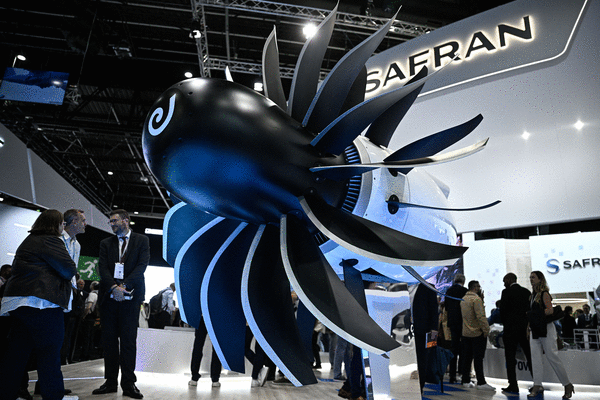


FARNBOROUGH, England — Airbus and Boeing are each considering their next new aircraft programs, and the competition for who will make those engines is heating up.
CFM International, a 50/50 joint venture between GE Aerospace and France-based Safran Aircraft Engines, has bet big on a futuristic open-fan design which, unlike conventional engines seen today, doesn’t include a casing around the fan blades.
The open-fan technology, meant to increase fuel efficiency and therefore lower carbon emissions and costs, is still far from reality. But CFM said this week it is making progress.
On the other side of the competition, Pratt & Whitney is sticking to its geared turbofan engine, upgrading parts of the same engine structure that powers commercial planes today. Rick Deurloo, president of commercial engines at Pratt & Whitney, said that decision positions them as the low-risk engine maker at a time when airlines need stability.
The next new aircraft also represents a chance for Pratt to get back on Boeing’s planes, Deurloo told reporters at the Farnborough Airshow this week. Boeing’s 737 Maxes are powered solely by CFM engines while its 787 engines are manufactured by either GE Aerospace or Rolls-Royce.
The next narrowbody aircraft Boeing or Airbus launch must be significantly more efficient than the planes being built today, as the aerospace industry faces looming regulatory deadlines to lower emissions and aircraft carriers expect fuel savings on planes that they will use for decades to come. To meet those goals, Boeing and Airbus are testing radical design changes, from the engines to the wings.
Looking to the future, the manufacturers often say engine availability is a “pacing item,” or the part of the complicated supply chain that could hold up deliveries.
That’s partly because the engine makers are still navigating concerns with their existing portfolio.
CFM told reporters this week it has made significant progress on new hardware to improve the durability of its LEAP engine, which powers Airbus’ A320 and Boeing’s 737 Max.
Pratt has fixed nearly all of the Airbus A220 planes that were grounded due to corrosion issues, and expects to complete that work this year, Deurloo said. The company was also making progress on fixing the engines that power Airbus’ A320 family, though Deurloo didn’t provide a timeline for completing that work. Earlier this year, Airbus expressed its frustration that Pratt was spending resources fixing the already deployed engines, taking away from its production of new planes.
Lars Wagner, the head of commercial airplanes for Airbus, is confident the manufacturer is nearing the end of its engine saga, telling reporters that by 2028, “all these engine issues are behind us.”
Durability fixes for LEAP
Ten years ago, CFM’s LEAP engine began powering single-aisle aircraft, an upgrade from its legacy CFM56 engine. Today, the CFM56 and LEAP engines together power three-quarters of the narrowbody planes in service, CFM President Gaël Méheust said.
The LEAP-1A serves Airbus’ A320, while the LEAP-1B powers Boeing’s 737 Max and the LEAP-1C China’s COMAC C919.
CFM delivered 1,800 LEAP engines last year, a 25% increase from the year prior and a record-breaking production rate. This year, it expects to best its record again, delivering 15% more engines in 2026 than a year earlier.
With so much demand from airplane manufacturers, “we’re going to break records like that until the end of the decade,” Méheust said.
Of course that interest is nice to have, Méheust continued, but “it’s almost impossible to be prepared for such an overwhelming demand of our products.”
Méheust said CFM is “aligned” with the plane-makers as they seek to increase production rates, including Boeing’s continuous push to bring up monthly Max rollouts, from 47 to 52 and beyond, and Airbus’ goal to produce 75 A320 family aircraft per month.
Customers also want CFM to increase the LEAP’s “time on wing,” or the amount of time that it can fly before needing maintenance or replacement. The engine maker has designed two solutions and has made progress in incorporating the fix into its LEAP-1A engines for Airbus. But it is further behind on Boeing’s LEAP-1B.
The first issue involves the engine’s high-pressure turbine, a critical engine component that extracts energy from exhaust gas and endures some of the most extreme temperatures of any engine part. In hot, dry areas, like the Middle East and India, dust can get inside the engine and slowly degrade a protective coating, leaving the turbine vulnerable.
CFM designed a hardware solution, known as a “durability kit,” to reduce the damage and introduced the solution on its LEAP-1A engine last year. It has now been installed on 40% of the Airbus fleet using the LEAP-1A.
At the news briefing, CFM announced it had achieved certification for the same solution on its LEAP-1B engine and expected to incorporate it into new engines in 2027.
That marks a “huge milestone for the Max program,” Tom Levin, GE’s vice president for commercial programs, told reporters.
Separately, CFM has introduced a “reverse bleed system,” or an engine cooling system, as Levin put it.
That system automatically turns on when the engine shuts down and cools the fuel nozzle to prevent carbon buildup. The system has been installed on 70% of the Airbus fleet; a similar fix for Boeing’s Max jets is expected this year.
RISE nears testing takeoff
Looking to the future, CFM said this week it was making progress on its open-fan RISE engine, a project that aims to create a more fuel-efficient engine.
Today’s engines include a covering around the fan blade, known as the nacelle. The RISE fan will not, leaving the blades whirring in the open. CFM turned to the new design because there’s a ceiling on fuel efficiency for the traditional ducted engines.
To make a ducted engine more fuel efficient, engine makers increase the size of the fan blades and, consequently, the casing around it. But that increased size and weight leads to more drag, eventually zeroing out any fuel savings.
CFM says the RISE engine could be 20% more fuel efficient than the ducted fans in use today.
The program — which is an acronym for Revolutionary Innovation for Sustainable Engines — is still a long way from commercial service but CFM told reporters at a press briefing this week that it is on track to begin flight testing for the open-fan design this decade.
It has already run about 500 test campaigns on aspects of the RISE program, which encompasses a suite of technologies, including the open-fan concept, changes to the engine’s compressor and combustor to improve thermal efficiency and durability, and hybrid electric power systems.
It has settled on the design for some of those aspects, meaning it is ready to begin manufacturing parts for testing.
CFM is partnering with Airbus for a full-scale flight demonstrator, creating a mock-up of Airbus’ A380, its iconic double-decker airliner that is no longer in production. That testing, at Airbus’ flight test facility in Toulouse, France, will focus on the open-fan design.
CFM and Airbus are partnering with the Civil Aviation Authority of Singapore to test how RISE and open-fan technologies impact airport operations.
At the air show, GE promoted another aspect of its RISE program, announcing that it had flown its hybrid electric flight demonstrator at 30,000 feet, bringing the technology closer to commercial service. For that project, it partnered with NASA, Boeing subsidiary Aurora Flight Sciences and startup Beta Technologies, which is developing an electric vertical takeoff and landing aircraft.
CFM expects its RISE engine could be available in the second half of the 2030s.
But Arjan Hegeman, GE’s vice president for future of flight engineering, said that timeline is up to the aircraft manufacturers, who must design new aircraft for the new engines. GE’s role, he said, is to “have the technologies prepared and ready to go when airframers kick off a program.”
Boeing Commercial Airplanes CEO Stephanie Pope said in an interview with aviation publication Leeham News and Analysis this month that it is “too early to have a position” on whether it will use open-fan technology on its next aircraft. But Pope said Boeing is “interested and curious” about the technology.
Separately, Hegeman also told reporters the RISE open-fan technology could address durability concerns that have worried LEAP engine operators. Because there’s no duct around the fan, dust is more likely to go around the engine, instead of getting sucked inside.
Pratt pitches stability
While CFM touted its open-fan design at the air show this week, competitor Pratt & Whitney took the opposite tack.
Pratt, a subsidiary of RTX Corporation, considered the open-fan technology but decided to stick with the existing geared-turbofan design, Deurloo told reporters at the air show.
“We like the architecture. We like the learnings we’re getting on it, and we consider ourselves a low-risk next-gen solution,” Deurloo said.
While Airbus publicly touted its ambition to introduce its next new airplane as soon as 2030, Deurloo said he didn’t think a new airplane from either manufacturer would launch until 2040.
He wasn’t hearing the urgency for the next big thing from airline customers, who were still reeling from COVID-19-induced supply chain disruptions and, more recently, escalating fuel prices amid the Iran war. Both manufacturers have thousands of plane orders in their backlog, representing years of production work.
“Our industry needs some stability,” Deurloo said. “That’s going to drive some of the timing.”
©2026 The Seattle Times. Visit seattletimes.com. Distributed by Tribune Content Agency, LLC.










Comments