Airbus tests long, thin wings for its next new, narrowbody plane
Published in Business News
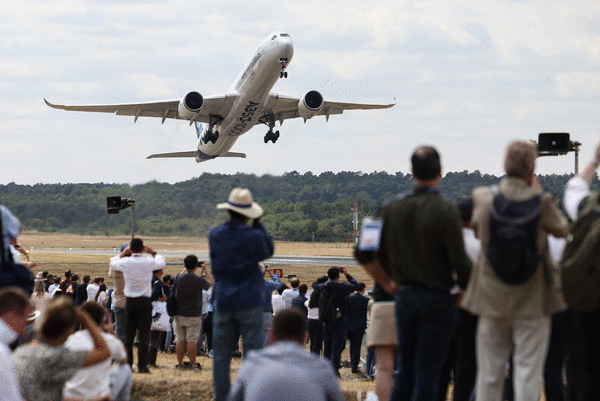
FARNBOROUGH, England — European plane-maker Airbus wants to extend the wings on its narrowbody A321neo, hoping to use “flight physics” to reduce the amount of fuel the aircraft burns, lowering carbon emissions and fuel costs.
Boeing has also tapped into the fuel-savings of long, thin wings for its 777X family, designing wings that are so long they must include foldable wing tips to fit into commercial airport slots today.
But Airbus’ project, announced Tuesday at the Farnborough Airshow, would see the first flight tests of long, thin wings on a narrowbody aircraft. The 777X is a family of widebody aircraft, while the A321neo is comparable in size to Boeing’s 737 MAX 10 narrowbody aircraft. The MAX 10 is its largest variant.
Narrowbody aircraft — single-aisle planes, with room for fewer passengers and less weight than their widebody, twin-aisle counterparts — account the vast majority of sales by both major manufacturers. Efficiency gains in that segment could translate to a competitive advantage for Airbus.
The new wing design Airbus is testing now could be part of its next-generation single-aisle plane, a topic that has come up often at this year’s airshow as the industry increasingly looks for clues on what each airframer will launch next. Airbus CEO Guillaume Faury has said the company could launch its next new plane by 2030.
https://twitter.com/airbus/status/2079842996141404505?s=46
Airbus aims for that new plane to reduce fuel burn by 20%-25% compared with its current narrowbody family. Long, thin wings would contribute to that fuel efficiency, said Sue Partridge, who heads Airbus’ Wing of Tomorrow program, which studies ways to improve the manufacturer’s wings.
“The biggest levers we have to improve the efficiency of our aircraft are the engines and the wings,” Partridge said. “We have technology programs running in Airbus on both engines and wings in order to de-risk those technologies and mature them, ready for our next-generation aircraft when we launch them in the future.
“By increasing the span of our wings, making them longer, lighter and more slender, we can make a real step change in aircraft efficiency,” Partridge said.
As Richard MacPherson, tech lead for the project, put it, Airbus is “rewriting the rules of flight.”
Airbus plans to spend the next three years building and flight testing wing extension devices on its A321neo, MacPherson said, using sensors attached to the devices to study how the longer wing behaves in flight. It has already manufactured parts for the first device and will start flight testing this year.
Once in service, the long, thin wings Airbus is studying will need to include foldable wing tips to fit in today’s airport infrastructure. But because the wings will fold and unfold on the ground, the test extension devices won’t include the folding section, Partridge said.
The extended wings for the narrowbody aircraft will measure about 55 feet along the main box, plus an extra 13-16 feet for the foldable wing.
Boeing’s 777X widebody wings are 110 feet plus an 11-foot wing tip.
Boeing has long partnered with NASA to study the use of long, thin wings to reduce fuel burn. In April, the two parties said they had completed a round of wind tunnel testing for their experimental truss-braced wing configuration, which includes trusses anchored at the base of the fuselage and angling out and up to the wing for extra support.
Boeing and NASA last year paused work on a full-scale flight demonstrator with the truss-braced wing, but said they would continue ground testing. Engineers working on the flight demonstrator would instead focus on helping Boeing finish regulatory requirements to certify long-delayed plane models, including two MAX variants and the 777X.
Back in 2023, when Boeing launched the flight demonstrator, then-CEO Dave Calhoun hinted that the long, thin wing was the type of radical design change that was needed to justify the huge investment of building a new aircraft.
Airbus’ project is part of its Wing of Tomorrow program, which launched in 2014 and has received roughly $260 million in funding from the U.K. government-backed Aerospace Technology Institute.
Airbus said Tuesday it had recently finished building its third wing demonstrator, which would be used to test the best way for the plane-maker to assemble the wings of the future, Partridge said. The first of the three wing demonstrators would be used to test technology choices, while the second would be used for structures testing.
Airbus’ technology will remain futuristic for now; Partridge said Airbus won’t retrofit its existing A321neo fleet to include the wing extension devices.
©2026 The Seattle Times. Visit seattletimes.com. Distributed by Tribune Content Agency, LLC.










Comments