Starbucks' shifting 'center of gravity' worries WA officials
Published in Business News
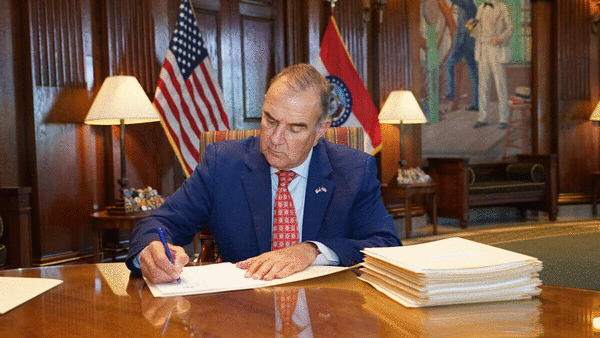
Since Starbucks’ March announcement of plans for a corporate office in Nashville, Tennessee, the company has tirelessly declared that Seattle remains its global headquarters.
But top Washington officials were clearly worried about the optics of Starbucks’ Nashville move, particularly given the layoffs and other cuts that have already diminished its presence in the state.
“The Nashville acquisition and continued Washington layoffs and closures continue to raise public questions about whether (Starbucks) is gradually shifting its center of gravity,” noted an April 10 briefing on Starbucks by Gov. Bob Ferguson’s staff.
Of particular note: The head count at Starbucks Center in Seattle's Sodo neighborhood is currently “about 2,800,” down 25% from around 3,750 in 2023, according to the briefing, which was obtained by Seattle’s KVI News Radio and posted Monday.
As some Starbucks watchers will have noticed, 2,800 isn’t that much larger than the 2,000-person staff planned for the six-story, 250,000-square-foot office building it leased in Nashville.
The briefing was prepping Ferguson for an April 15 meeting with Starbucks CEO Brian Niccol and anticipated a discussion of the Nashville office as well as the company’s concerns over taxes and the state’s business climate. Niccol joined Starbucks in late 2024 and launched a major turnaround effort.
On Tuesday, Ferguson’s office confirmed he met with Niccol on April 15 but didn’t share additional details about what was discussed.
Starbucks wouldn’t confirm the figures in the briefing. On Tuesday, a company spokesperson reiterated Starbucks’ intent to remain headquartered in Seattle.
“We remain deeply invested in Washington, where Starbucks was founded more than 50 years ago and continues to maintain its global headquarters and we’re committed to partnering with Washington lawmakers and other stakeholders on solutions that strengthen the state’s economy and help Washington thrive,” the company said in a statement.
Starbucks says the Nashville office will support a planned regional retail expansion. It also says Nashville provides “proximity to key suppliers” and “access to a deep and growing talent pool in the region—particularly in technology.”
The coffee giant’s lease at Starbucks Center on Utah Avenue South runs through 2038, with no options for “termination,” according to a July credit rating report by Morningstar.
But some industry experts and Starbucks employees think Niccol now wants to gradually shift more of Starbucks’ operations to Tennessee under a broader restructuring aimed at shaving costs and boosting growth.
In any case, Starbucks’ decision to expand in Tennessee, and not its home state, has become Exhibit A for local business leaders and commentators critical of what they see as Washington’s high-tax, unfriendly business climate.
Making the case for Washington
Challenging that perception appears to have been a goal of the April 15 meeting, which came just days before Starbucks publicly shared the size of its Nashville office.
The briefing called the meeting “a key opportunity to make a case for ‘why Washington,’ and to gather information to inform your future strategy navigating (Starbucks’) continued corporate and retail presence.”
It recommended Ferguson emphasize how his own “focus is getting Washington back to delivering excellent core public services like schools, roads, and bridges, promoting good governance, and emphasizing what continues to make Washington a unique magnet for attracting elite talent and innovation.”
But the briefing also acknowledged Ferguson’s uphill task.
“Mr. Niccol may raise concerns about the overall business environment in Washington,” along with concerns about business taxes enacted in 2025 and the state’s new 9.9% “millionaires tax” on income above $1 million, the briefing notes.
On the millionaires tax, Niccol’s “concerns are more likely to be directed at retaining executive talent in the state,” the briefing noted.
At least six of Starbucks’ senior executives, including Niccol, earned $6 million or more in total compensation in fiscal 2025, according to the company’s 2026 proxy statement.
Tennessee has no income tax.
The briefing also reminded Ferguson of the recent departure of one of Starbucks’ most well-known former executives.
“Just a note – former CEO Howard Schultz, who played a central role in the company’s expansion into a global brand, recently relocated to Florida in his retirement,” the briefing said.
Schultz has since publicly chastised state leaders for their inability to reform a “broken tax system.”
But the briefing also detailed how Starbucks had already reduced some of its Washington presence under its companywide restructuring plan.
On top of a smaller headquarters head count, the company has permanently closed 31 Starbucks locations in Washington, including the Reserve Roastery on Capitol Hill, and cut more than 1,300 retail and corporate staff in the state, the briefing noted.
Starbucks still has 346 corporate-owned stores and 933 licensed locations in places such as airports and grocery stores in Washington, and it employs “approximately 10,790 Washingtonians across its retail, roasting, and corporate facilities,” the briefing stated.
‘Lengthy, direct conversation’
It’s unclear when Ferguson learned of Starbucks’ Nashville plans or whether the April 15 meeting was the first time the two men discussed the move.
According to the briefing, Ferguson and Niccol met at a Feb. 5 event and “Starbucks requested a follow-up meeting at their Seattle headquarters.”
On April 28, Ferguson told KOMO News he’d had a “lengthy” discussion with Starbucks’ leadership before the announcement.
At a public event last month, Ferguson reiterated that he had “a lengthy, direct one-on-one conversation” with Niccol about Nashville and added that his office has “a direct line of communication” with the company.
“We understand how important Starbucks is,” Ferguson said.
A spokesperson for Ferguson reiterated that point Tuesday. “We maintain a positive working relationship with Starbucks. Our staff know each other well and have open lines of communication.”
In its Tuesday statement, Starbucks said it “regularly meets with elected officials and policymakers at the local, state and federal level.”
©2026 The Seattle Times. Visit seattletimes.com. Distributed by Tribune Content Agency, LLC.







Comments