Newsom revives local news fund at a fraction of the amount first promised
Published in Business News
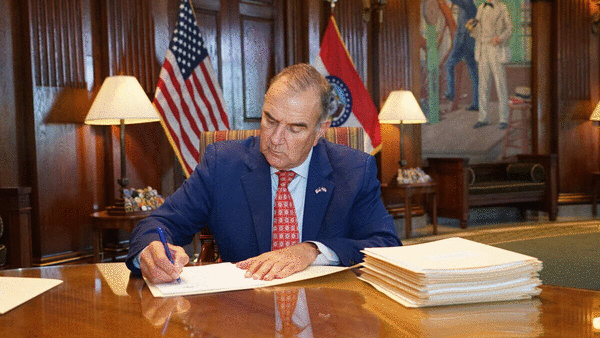
Months after Gov. Gavin Newsom stripped state funding from a much larger plan to support California journalism, his office announced Tuesday that the state and Google will put a combined $40 million into grants for local newspapers over the next two years.
California and Google will each contribute a total of $20 million to the California Civic Media Program. Eligible newspapers — TV and radio are excluded — can apply for grants of up to $250,000. The funding falls far below the nearly $250 million public-private package promoted by state officials in 2024, most of which they said would support local news outlets.
The announcement follows a lengthy political battle to force technology giants Google and Meta to help support local newspapers. Publishers have watched advertising revenue shrink drastically as audiences moved online and the companies’ platforms captured more than half of global digital ad spending.
Funding will be allocated mostly based on the number of journalists at an outlet, with $2.5 million set aside “for organizations whose impact exceeds what headcount alone reflects,” according to the program’s terms. Applications are due Aug. 21. Both for-profit and nonprofit companies can apply, and the funds are expected to be disbursed in the fall.
“Every Californian deserves access to accurate, trusted information,” Newsom said in a press release Tuesday. “By investing in local newsrooms, California is bolstering the journalism that keeps communities across the state informed, connected, and engaged.”
Newsom’s office did not respond to questions about the amount of funding compared with the sum touted earlier.
Former California state Sen. Steve Glazer, who authored a failed bill that would have required three major technology companies to help support local news, said the new program represents a step backward from the funding his proposal and other unsuccessful initiatives would have provided.
“It will be helpful on the small outlets, community and ethnic outlets, but not at all helpful on the legacy publications where most of the journalists are employed,” said Glazer, a Democrat who represented District 7 in Contra Costa and Alameda counties. “If you’re the Los Angeles Times publisher and you have 300 reporters, you’re going to get $250,000, which is not going to stabilize your news outlet. If you’re a small community paper with five reporters, that $250,000 is much more meaningful.”
Newspapers can receive grants of $20,000 per full-time journalist for the first five journalists, then $10,000 per additional journalist up to 20. That cap disadvantages large outlets with more than 20 journalists, said Chuck Champion, president of the California News Publishers Association, which represents hundreds of outlets, including the Bay Area News Group.
Bay Area News Group, which includes the Mercury News and East Bay Times, would be eligible to apply for funding under the program.
“When you handicap a large newspaper simply because of its ownership or its size, you damage the community,” Champion said Tuesday.
Over the past two decades, nearly 40% of all local U.S. newspapers have disappeared, Northwestern University’s Medill School of Journalism said in its 2025 State of Local News report. From 2024 to 2025, California lost eight daily newspapers, leaving 57, the report said.
Google and Meta came to dominate digital advertising through platforms that use extensive consumer data to target ads. Publishers have argued that the companies also benefit from distributing and displaying links to journalism while absorbing advertising revenue that once supported newsrooms.
According to an April bulletin from data firm Emarketer, Google took 26% of the world’s digital ad spending in the first quarter of this year, and Meta took 27%. Google parent Alphabet reported $132 billion in net income last year, while Meta reported $60 billion. The companies do not disclose how much of that profit comes from advertising associated with news content.
The decline prompted California lawmakers to propose requiring large technology platforms to support local media financially. Assembly Bill 886, the California Journalism Preservation Act, would have forced technology giants to negotiate annual payments into a fund for news outlets or enter mediation or arbitration over a share of their digital advertising revenue. The California News Publishers Association sponsored the bill.
Senate Bill 1327 would have imposed a fee on data collected by Google, Meta and Amazon and was projected to generate an estimated $500 million annually for news organizations.
Neither bill survived. Newsom “indicated he would veto either of our bills if it got to his desk,” Glazer, the author of SB 1327, said earlier this year.
The bills were replaced by a five-year agreement that state officials promoted as a nearly $250 million package. But that total included money for an artificial intelligence initiative and existing Google journalism programs, while the specific commitments to the new journalism fund were considerably smaller.
Under the figures released at the time by the office of East Bay Assembly Member Buffy Wicks, the author of AB 886, California was to contribute $30 million the first year and $10 million in each of the next four years to the journalism fund. Google was to contribute $15 million to the fund in the first year, plus $5 million for an AI accelerator and $10 million for existing journalism programs. In each of the following four years, Google was to put $10 million into the fund and $10 million into its existing programs.
Newsom later eliminated state funding for the California Civic Media Program in his proposed 2026-27 budget, despite having celebrated the agreement in 2024. The state Finance Department said the previous budget included $10 million for the program, matched by Google. It was unclear why the contributions from the state and Google were less than initially pledged.
Glazer said either legislative proposal would have generated substantially more support than the program announced Tuesday.
“We would be not just stabilizing but growing local news, which would have enhanced the oversight and accountability of governmental leaders and all the community problems that they’re working to solve,” Glazer said.
Google and Meta have fought measures requiring them to support news outlets. Canada in 2023 passed a law requiring technology companies to pay for the use of news content. Meta responded by removing news links from users’ feeds, while Google agreed to pay about $73 million a year.
Australia in 2021 passed a law requiring digital platforms such as Facebook and Google to pay local media outlets and publishers for displaying links to their content in news feeds and search results.
Google did not respond to a request for comment.
Glazer lamented the decline of the “robust, independent journalism” he described as essential to a healthy democracy.
“It’s both a combination of legacy media losing their power and the technology community asserting their power to avoid any of the responsibility for the damage they’ve caused to independent news,” Glazer said. “There are more than 2,000 lobbyists in Sacramento but none of them have democracy on their client list.”
Champion called the funding “a start.”
“In order to really get the industry back to health, you’re talking about nearly $1 billion,” Champion said. “We’ve got a long way to go.”
©2026 MediaNews Group, Inc. Visit at mercurynews.com. Distributed by Tribune Content Agency, LLC.










Comments