Econometer: Was it the right move to not renew the USMCA?
Published in Business News
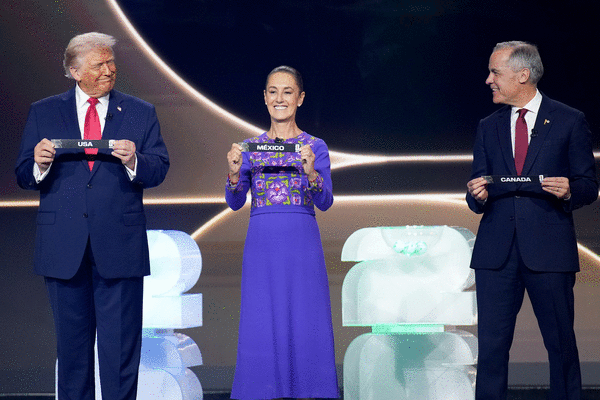
The Trump administration decided recently not to renew its trade pact with Canada and Mexico, instead opting to do annual reviews.
The United States-Mexico-Canada Agreement, or USMCA, stays in place unless someone pulls out. The difference now is annual reviews could result in debates over policy every year.
One concern in not renewing the deal is that it creates uncertainty for businesses that rely on the agreement’s rules. Also, consumers may be more subject to more price swings.
Still, some experts have argued annual reviews might not be horrible if it helps the U.S. keep an eye on Chinese goods and investment sneaking their way in through Canada and Mexico.
Question: Was it the right move to not renew the USMCA?
Economists
Alan Gin, University of San Diego
NO: Annual reviews of the USMCA introduce an element of uncertainty into the deal which makes it difficult for businesses to make long-term plans. This is particularly important because Mexico is the leading trade partner for the U.S. while Canada is second. The ostensible reason for the trade actions against Canada, Mexico, and the rest of the world was to get manufacturing to return to the U.S. That hasn’t been successful as manufacturing jobs are down 75,000 since January 2025.
James Hamilton, UC San Diego
NO: Every business needs to know its costs to be able to plan and invest in the future. The president believes that increased uncertainty will maximize his negotiating power. But nobody likes to be bullied. Many people in Canada and Mexico, who should be our natural friends and allies, have developed a negative view of America as a result of the president’s heavy-handed negotiating style that will hurt us for many years to come.
Norm Miller, University of San Diego
NO: During his first term, Trump withdrew from several major agreements, including the Intermediate-Range Nuclear Forces Treaty, the Iran nuclear deal, the Trans‑Pacific Partnership, UNESCO, the UN Human Rights Council, and dozens of other international organizations. Although the USMCA improved on NAFTA and the U.S. has recently formed non‑binding reciprocal deals with the EU, Japan, Britain, and tentatively, Mexico, no new agreement with Canada has emerged, and it remains uncertain if the current administration is capable of negotiating binding treaties.
David Ely, San Diego State University
NO: The USMCA has facilitated trade with Canada and Mexico, two major export markets. The trilateral trade agreement has allowed U.S. businesses to develop cross-border supply chains, resulting in improved operating efficiency and lower prices for consumers. The enhanced trade flows have boosted growth in all three economies. Not renewing the USMCA means annual reviews will be conducted, leading to uncertainty over what rule changes might be renegotiated. Business investment will become riskier.
Ray Major, economist
YES: USMCA was a poorly negotiated agreement that put the U.S. at a competitive disadvantage. Properly renegotiating an agreement could create more local jobs by reducing job outsourcing and boosting domestic wages. Trade deficits could be reduced or eliminated, improving our balance of trade. Furthermore, the U.S. would have the ability to negotiate more flexible bilateral trade agreements that better serve each country. And most importantly, we could secure our supply chain and revitalize the production of domestically produced strategic goods and services.
Caroline Freund, UC San Diego School of Global Policy and Strategy
NO: USMCA should have been renewed. The real contest is with China, and deeper integration of North American supply chains makes the U.S. more competitive. The good news is that the agreement remains in effect. The bad news is that without renewal, it faces annual reviews. That means more policy uncertainty and less investment in the cross-border supply chains that keep us globally competitive. Wrong call, wrong time.
Kelly Cunningham, San Diego Institute for Economic Research
YES: Confusion over the Trump administration’s imposition of tariffs negates much of the benefits purportedly established. Tariffs harm citizens of the U.S. by literally increasing our own costs and taxes. There were also plenty of other restrictions imposed by government regulations to manage trade and limit foreign freedoms. When the agreement heavily depends on thousands of pages of rules and regulations being enforced, it can scarcely be considered “free trade.” The agreement flaws should be reformulated.
Executives
Chris Van Gorder, Scripps Health
NO: We should have renewed the United States-Mexico-Canada Agreement. Our relationship with Canada and Mexico has evolved over generations into one of the world’s most important economic and security partnerships. Given that, we need to treat our friends and economic allies better. Building protections that apply to all countries might be appropriate, but at the same time, we should not forget history, nor our friends and colleagues.
Jamie Moraga, Franklin Revere
YES: In the long run, it can strengthen the U.S. negotiating position, but there are short-term costs. Politically, the U.S. can gain leverage by shifting to annual reviews and using tariffs to adjust trade rather than relying on an automatic 16-year extension. From a business standpoint, not renewing the USMCA can create economic uncertainty, especially for small businesses. Supply chain instability and fluctuating tariffs can raise costs, limit growth and investment, and potentially lead to job losses.
Mark Kersey, San Diego County Taxpayers Assoc.
NO: Businesses need reasonable levels of certainty to justify making mid- to long-term investments, and the USMCA provides that. While the agreement technically remains in effect, the annual reviews and the uncertainty they bring could make it more difficult for companies to justify the investments under which border regions like San Diego-Tijuana have prospered. Negotiating a long-term successor pact to NAFTA and USMCA that benefits all three countries needs to be a top priority.
Phil Blair, Manpower
NO: It is a more restrictive behavior by this administration. Mexico and Canada should be treated as key trading partners of the U.S. If mutually agreeable terms could not be met by the deadline, then there should have been a short-term extension.
Gary London, London Group Realty Advisors
NO: Whether the matter is about Iran or trading, this is another signal of either ineptitude or disingenuousness within the Trump administration. While it is unclear what actually needs fixing, addressing shortcomings is never a bad thing. But such a move sacrifices long-term trade stability for short-term negotiating leverage. This move is bound to perpetuate uncertainty in North American trading, which is likely to inflate commodity pricing such as groceries and automobiles.
Bob Rauch, R.A. Rauch & Associates
YES: Not renewing the USMCA is a strategic reset. The agreement no longer matches the realities of North American trade, and allowing it to lapse forces all parties back to the table. That creates leverage for stronger labor standards, tougher enforcement, and a framework built for modern supply chains and digital commerce. It’s a bold and potentially disruptive move but aimed at securing a more durable, future‑ready deal.
Austin Neudecker, Weave Growth
NO: The USMCA is imperfect, but stable trade rules are valuable. Businesses make long-term decisions around supply chains, manufacturing and investment. Annual renegotiations create uncertainty that discourages investment and raises costs for consumers. The administration is right to address Chinese transshipment and other loopholes, but these concerns are better handled through targeted enforcement rather than by subjecting North America’s entire trade framework to annual turbulence.
©2026 The San Diego Union-Tribune. Visit sandiegouniontribune.com. Distributed by Tribune Content Agency, LLC.










Comments