Not everyone is leaving California -- new commercial battery maker sets up shop in Sacramento
Published in Business News
The lithium-ion batteries that supply much of today’s clean energy come with some infamous drawbacks, from fire risk to reliance on foreign mining.
Alternatives have been slow to get off the ground.
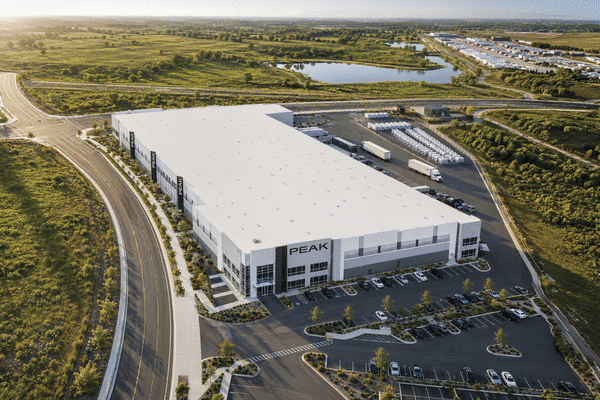
But California start-up Peak Energy announced Wednesday it’s building a factory in Sacramento that will be the first in the U.S. to make sodium-ion battery packs at commercial scale.
Sodium-ion batteries have long held promise. They are made from cheap and abundant sodium ash deposits. The materials are less prone to overheating, so they don’t have the fire risk of lithium.
But they also store less energy per cubic inch. That means they have to be bigger and heavier, which makes them harder to fit into electric vehicles. So far, they’ve struggled to compete.
Peak Energy thinks it has an edge. The company focuses on storage systems big enough to power large data centers, factories and whole segments of the grid, where battery size matters less.
The company already delivers battery packs out of a small pilot project in San Francisco, but has gotten $1.1 billion in pre-orders and now it needs more space.
CEO and co-founder Landon Mossburg said its first products, each about the size of a shipping container, will begin rolling out in early 2027.
“We’re a three-year old company with over a billion in deposit-backed customer contracts, we’ve got grid deployment already, and all those products are exceeding expectations on the grid,” said Mossburg. “Those are really great signals.”
He founded Peak after working at Tesla and the now-folded Swedish battery company Northvolt. Initially, the elements that make up the systems, the battery cells, will come from China.
Customers for Peak who have out down a deposit include independent power providers Jupiter Power, Energy Vault and RWE Americas, who are connecting utilities, and increasingly data centers, with batteries. Peak also works with utilities directly including one unnamed customer in California, and is “in fairly advanced discussions with two of the major hyperscalers,” Mossburg said.
Not everyone is so optimistic about the technology. Lithium-ion batteries are still cheaper, at least up front.
“Sodium-ion batteries attracted considerable interest when lithium-ion battery prices surged in 2022,” said Isshu Kikuma, an energy storage analyst at BloombergNEF. Since then, he noted, those prices have come down.
And as with lithium-ion battery chemistry, Asian manufacturers already have an edge.
“Sodium-ion cells are currently exclusively manufactured on a commercial scale within China,” said Evan Hartley, a research manager at the Benchmark Minerals consulting firm. Large producers, like BYD and CATL, he said, are spending enormous amounts to research and develop new products.
Other U.S.-based sodium-ion startups have floundered of late. Natron Energy canceled plans to produce sodium-ion battery cells in North Carolina last year after funding difficulties. Bedrock Materials, which was making sodium-ion batteries for EVs, also closed up shop, citing a bet on a lithium supply shortage that hadn’t panned out.
But Peak Energy’s model is different, said Mossburg. Unlike Natron, it won’t be trying to make the batteries that go into their systems at first. They’ll import them, initially from China and later from other countries in Asia.
“While working at Tesla, I saw the advantage of focusing on a great end product that customers want before you try to bite off more of the scope,” said Mossburg.
Last month, Peak announced a partnership with General Motors to develop their own cells.
Once up and running, Peak Energy’s Sacramento factory will make three to four battery systems per day, each filled with almost 8,000 battery cells. One system can power hundreds of homes for four hours, Mossburg said. Customers will deploy 10s or 100s in a single project, “basically creating a power-plant sized battery” that can store power and supply the grid when energy is expensive, or directly serve facilities like data centers.
Although sodium-ion batteries cost more than lithium ones, Mossburg said their battery systems still save customers money: The technology does not heat up like lithium, so it eliminates the need for expensive cooling technology.
“Because lithium-ion needs to actively cool, you’re basically paying to refrigerate your batteries or using energy to refrigerate your batteries, and we don’t need any of that stuff,” said Mossburg.
The upshot is a battery that’s cheaper, quieter, and safer.
“Safety is a major advantage for sodium-ion batteries,” Kikuma said.
That could matter in California, where battery opposition has surged after a fire at a Moss Landing energy storage facility drove the evacuation of 1,200 residents and contaminated nearby wetlands.
California has typically been a hub of battery research and development, not manufacturing. Mossburg said Peak Energy, which also has offices in Colorado, chose Sacramento for its proximity to a talented workforce, a growing energy storage market and the company’s engineering teams in Burlingame. He said the factory would create 239 new jobs.
The company hasn’t received any federal clean energy tax credits, but it got a $10.5 million tax credit from the state of California.
While sodium-ion is likely to remain a small fraction of the global battery market, Kikuma said stationary energy storage is one of the fastest growing applications for sodium-ion batteries.
Mossburg sees Peak as being ahead in this corner of the market.
“Everybody from CATL to GM have sort of validated now what we’re doing,” he said. “The market is trying to catch up.”
©2026 Los Angeles Times. Visit at latimes.com. Distributed by Tribune Content Agency, LLC.









Comments