Best Buy banking on next-gen TVs to spur shoppers to upgrade
Published in Business News
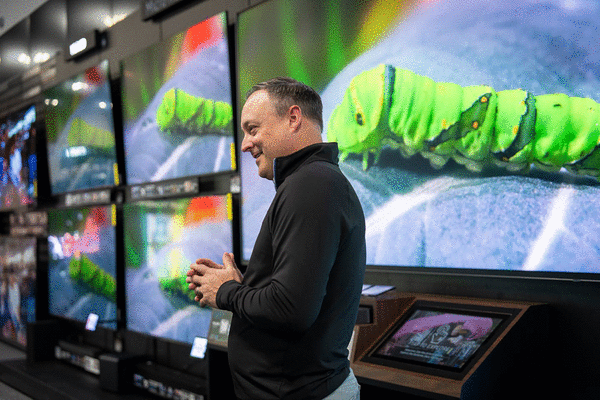
How much better does a TV have to work before shoppers are willing to spend upward of $1,500 to replace the one already hanging on their walls?
That’s the question facing Minnesota-based Best Buy as it becomes the exclusive national retailer for a new generation of premium TVs that promises brighter colors, deeper contrast and less glare than today’s models.
After several sluggish years for consumer electronics following the pandemic buying boom, executives and Wall Street analysts believe the TV market may finally be on the verge of a long-awaited replacement cycle.
Best Buy is betting that improved picture quality — combined with millions of aging TVs purchased during COVID-19 — will finally persuade shoppers it’s time to upgrade.
Incoming CEO Jason Bonfig has said Best Buy is “not just a retailer anymore,” but its stores remain central to the company’s strategy and generate most of its revenue. Expanding into categories such as Lego and trading cards is part of that evolution, but the electronics chain still relies on new phone and TV releases to drive store traffic.
“For us, it’s always been about making sure we serve customers across every price point,” Bonfig said in an interview at the Richfield store. “When new technology comes in, that absolutely helps our business. But at the same point in time, it’s our job with our vendors to tell them what customers want. That’s really when our model works best.”
Best Buy is the national retailer with exclusive rights for one year selling RGB LED televisions from leading manufacturers including Samsung, Sony, LG, TCL and Hisense.
The sets are positioned above conventional LED models and compete with OLED televisions, with prices ranging from about $1,000 to more than $30,000 for a 115-inch screen.
The challenge is convincing shoppers the technology is worth the premium. Bonfig believes seeing the TVs in person will make the difference — a tagline Best Buy has embraced with its “Believing Is Seeing” marketing campaign.
“There is really something very powerful about when people get an opportunity to see it,” he said. “Or some people say, ‘Oh, it’s amazing, but I actually need something in this price range.’ We have that covered as well.”
Unlike traditional LED televisions, which use a white backlight, RGB LED sets use separate red, green and blue LEDs, producing brighter colors, stronger contrast and less glare in sunlit rooms.
Bonfig said innovation also has returned to a more “normal” pace since the pandemic, when companies were focused on producing “as much product as possible,” a shift he said has helped improve sales trends across categories, including TVs.
Best Buy has struck similar deals before. In 2023, it became the exclusive retailer for Roku-made TVs. A few years before that, it partnered with Amazon on a multiyear agreement to sell Toshiba and Insignia TVs.
That wasn’t the case when OLED TVs entered the market. In 2013, Best Buy became the first U.S. retailer to sell LG OLED TVs, but it didn’t have the kind of market exclusivity this deal provides.
“It’s not about just asking for an exclusive,” Bonfig said. “The exclusive means that we’re going to represent the products in a way the vendors want. We’re going to show the technology like nobody else can. We’re going to train our employees [and] have the digital resources.”
Analysts say the technology arrives at an important moment for Best Buy.
Millions of televisions purchased during the pandemic are now nearing the industry’s typical five- to seven-year replacement cycle. D.A. Davidson estimates roughly 49 million TVs were sold during the COVID buying surge and says RGB technology could give consumers the extra push to replace them, much as OLED did more than a decade ago.
“Consumers are re-engaging with the category,” D.A. Davidson analyst Michael Baker wrote after meeting with Best Buy executives this month.
The firm estimates new display technologies historically grow to account for about 20% of television sales and believes RGB could follow a similar path.
Jefferies analysts reached a similar conclusion in a June research note, saying RGB televisions could appeal to Best Buy’s higher-income customers who are willing to pay more for premium technology.
When Bonfig takes over in November, he will be tasked with proving Best Buy can remain relevant in a rapidly evolving consumer electronics market.
In its most recent quarter, Best Buy’s sales growth slightly lagged the broader electronics market, according to Neil Saunders, managing director of GlobalData. In a post-earnings note, he wrote the retailer was becoming a “less relevant player in the electronics landscape.”
The company has shown signs of improvement, posting positive comparable sales in two consecutive quarters last year and again in the February-to-April period. But demand remains uneven, and the most recent holiday shopping season was disappointing.
Best Buy’s home theater business, which includes televisions, has struggled in recent years as consumer spending shifted to phones, computing and gaming consoles. Sales were down in the most recent quarter, though the company reported improvements in TVs specifically.
Best Buy also faces growing competition from Amazon, Costco and Home Depot, which have been gaining market share in big-ticket categories such as appliances and televisions.
Jefferies analyst Jonathan Matuszewski estimates Best Buy has historically accounted for about one-third of television sales, giving the retailer an “enviable position” despite growing competition.
Bonfig said the retailer has eliminated one of the “pain points” by connecting a delivery team with every purchase of an RGB TV. That includes installing the new television, taking down the old one and recycling it.
“One of the biggest things with TVs right now is people want to upgrade, but in some cases the TV they have in their home still works,” he said. “So there’s a bit of, ‘well, this is still working. Should I wait until it’s not working anymore?’ What we’ve done is use all of our capabilities to say, ‘let’s just make it really simple.’”
Whether RGB catches on as quickly as OLED did remains an open question, analysts say.
OLED televisions spent years as a niche product for home theater enthusiasts before prices fell enough to reach a broader audience. RGB televisions are launching at similarly premium prices, meaning early buyers are likely to be technology enthusiasts, gamers and movie fans.
“These TVs are materially more expensive than what is traditionally available, so like every adoption cycle, it may take some time for the technology to gain significant traction,” Truist Securities analyst Scot Ciccarelli wrote in a May research note.
Bonfig acknowledged adoption will take time but said he believes the technology will appeal well beyond early adopters, allowing Best Buy to benefit long after its one-year exclusivity period ends.
“I think RGB will be a technology that continues to become more and more popular with customers,” he said. “The interesting thing about this ... is we’re seeing a lot of interest from a lot of different customers.”
©2026 The Minnesota Star Tribune. Visit at startribune.com. Distributed by Tribune Content Agency, LLC.










Comments