An electric truck for less than $25,000? Deliveries begin this year
Published in Business News
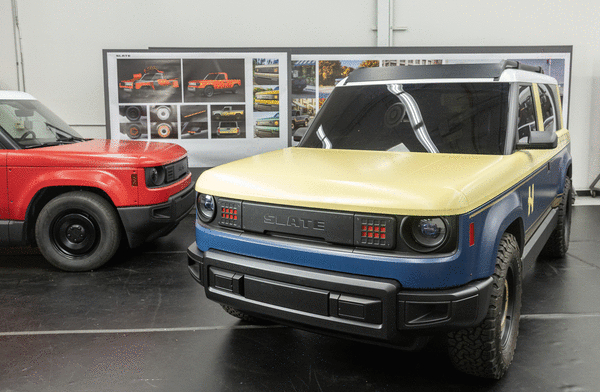
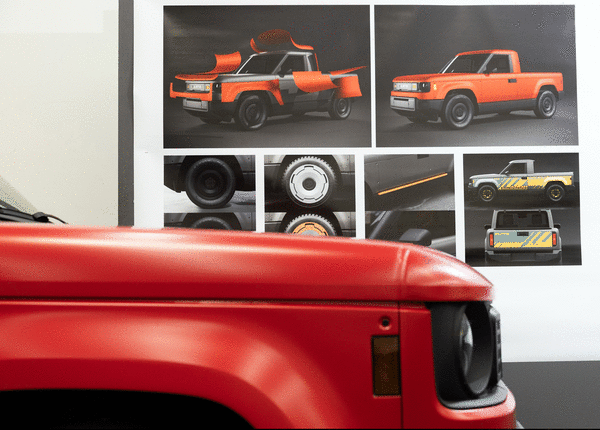


The electric vehicle company Slate Auto set out in 2022 to make the most affordable electric truck in the country. This week, it unveiled the price tag: $24,950.
At a time when demand for new electric vehicles is cooling and cars are getting harder to afford, Slate’s customizable truck could bring a fresh wave of excitement to the industry.
Deliveries will begin later this year and accelerate in 2027, the company said. Slate’s vehicle is built around a simple concept — pay only for what you actually want.
Buyers will start with a basic truck without power windows or even paint and can then customize it however they like. They can tailor-make their “blank slate” by paying extra for smart phone-compatible screens, speakers, colored wrap or paint. A $5,000 kit even converts the truck into an SUV.
Slate’s design team is based in Los Angeles County and recently moved into a new space in Carson, California, which employs about 50 workers. The company’s headquarters are in Troy, Michigan, and its vehicles will be produced in Warsaw, Indiana.
Squeezing out as much cost as possible while making it as easy as Legos to snap on different options has required complex engineering, which is why the company decided to set up its design studio in Southern California. The region is full of experts.
“Slate has done something smart,” said auto industry analyst Brian Moody. “Their EV isn’t only about price, there’s also a strong personalization element. In Southern California, the boxy, retro look will earn it a lot of attention.”
The company is building a marketplace of accessories for customers to choose from, including 54 basic wraps that cost less than $500 each. In contrast, a paint job on a car can cost thousands of dollars. The marketplace also offers roof stacks, zip-on seat covers and stereos.
For just under $30,000 total, customers can get a basic SUV in a fastback or squareback style. Whether it’s configured as a truck or SUV, the EV will have an estimated range of 205 miles and will be compatible with Tesla chargers.
“This is the first time in automotive history that consumers are going to get to choose,” said Slate Chief Executive Peter Faricy, who joined the company in March after 13 years with Amazon.
“It started with design, then engineering, and eventually manufacturing, and we figured out innovations in all three of those phases that make the vehicle less expensive,” he said.
For example, Slate vehicles were designed from the beginning to be wrapped instead of painted. The company will offer more than 100 colors of wrap at its launch, or customers can choose a custom color.
Slate did not disclose financial information or how much the vehicles cost to produce. However, Faricy said the company will generate a positive gross margin on its vehicles, meaning they are selling for more than what they cost to make.
“Whether Slate succeeds or fails, it has already influenced the conversation ... forcing the industry to ask why affordable vehicles have become so rare,” said Jesse Toprak, an industry analyst and founder of OptiCar.ai. “They are betting on making higher profit margins on the accessories and do-it-yourself angle.”
Slate says it has already received more than 180,000 reservations. The earlier a customer placed their reservation, the sooner they’ll get their vehicle. Pre-orders opened Wednesday for $300, or $250 if the customer has already paid a $50 reservation fee.
Despite the hype, Slate is still a startup that has yet to prove itself in the market. The company has about 750 employees and has raised more than $700 million from Amazon’s Jeff Bezos and others.
“For the vehicle itself, the concept is brilliant,” Toprak said. “I think the execution risk is enormous.”
The EV industry has been under fire from the Trump administration, which has removed incentives for ownership and clean-car goals. Major automakers including Ford and Stellantis have pared back their EV offerings, and other startups have struggled to turn a profit.
The Irvine, California-based EV company Rivian, which hasn’t reached profitability since its founding in 2009, recently laid off hundreds of workers. It launched its highly anticipated R2 SUV earlier this month, which will eventually be available for less than $45,000.
Lucid, the luxury electric vehicle maker based in Newark, California, announced this week that it’s reducing its workforce by 18%. The cuts come just months after it laid off 319 Bay Area employees in February.
Faricy, Slate’s chief executive, said the company’s vehicle will appeal to a wide range of customers.
“There will be a lot of people that are attracted to the affordability but have never had an EV before,” he said.
According to Cox Automotive, the average transaction price for a new EV in the U.S. is $55,000, compared with $49,000 for a gas-powered vehicle.
“The EV market at this point doesn’t have a technology problem anymore,” Toprak said. “It has an affordability problem. Slate is one of the first companies built entirely around solving that.”
©2026 Los Angeles Times. Visit at latimes.com. Distributed by Tribune Content Agency, LLC.










Comments