Chris Hughes: Lachlan Murdoch has unveiled a shocking $22 billion plot twist
Published in Business News
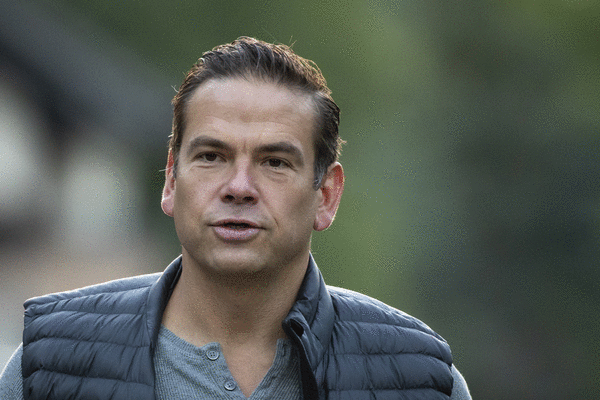
Lachlan Murdoch has worked wonders on Fox Corporation’s stock price over the last two years and tidied up his family’s messy ownership of the media empire. Now with one big, pricey deal, he’s written a shocking plot twist into the investment narrative.
Fox agreed on Monday to buy streaming service Roku Inc. for an enterprise value of $22 billion. The enlarged company will take the No. 3 position in U.S. television by share of viewing, largely by joining the free, ad-supported Tubi, which Fox bought in 2020, with Roku’s streaming platform of more than 100 million subscribers. For Fox, best known for its strong live news and sports programming, the sudden acceleration into streaming marks a radical departure.
Strategically, the deal is a bet that the combined company will somehow capture more viewers than Fox and Roku do separately. That hope seems to rest on the view that couch potatoes have only so much appetite to scroll through different interfaces, and Fox content might find new eyeballs through Roku. Fox isn’t putting any numbers on what additional revenue this union might generate — and the market would most likely not give much credence to such guidance anyway.
The downside is that Fox will now be rubbing up against Roku’s existing content partners. As analysts at Barclays Plc caution, that could lead to “meaningful friction.”
The one clear concrete financial benefit is $400 million of annual cost savings. Deduct tax and apply a simple 10 times multiple to that profit boost, and it could be worth more than $3 billion on the combination’s market value. But this added value on its own isn’t enough to justify the $7 billion premium being offered at the headline $160-a-share offer value, nearly 40% above Roku’s stock price before it started edging higher last week.
Moreover, Fox’s leverage will go up. That shouldn’t be such a concern given that Fox’s investment-grade credit rating will stay intact. But it exacerbates worries about the strategic shift and a high price.
Cue a savage market reaction, which slashed Fox’s market capitalization by $4 billion to around $22 billion. The transaction may simply represent too much of a change in the Fox investment thesis, say analysts at TD Cowen.
Meanwhile, the slide in Fox’s shares has lowered the value of the cash-and-stock offer, taking it to just less than $150 for each Roku share. Roku shareholders may now grumble that the reduced price feels a bit low for a company that has shown decent growth lately. Perhaps a slightly less generous deal would have actually been worth more to Roku shareholders, assuming it wouldn’t have had such a negative impact on Fox’s shares.
Minority shareholders on both sides may have little recourse. Roku founder Anthony Wood controls the company, and he’s on board. Murdoch controls nearly 40% of Fox — not decisive in securing shareholder approval, but certainly helpful.
The transaction looks in part like a reaction to Paramount Skydance Corp.’s $110 billion takeover of Warner Bros. Discovery Inc. The quest for scale appears to be the driver of most deal activity this year, especially in media. But scale on its own doesn’t make a takeover.
Murdoch had to do something sooner or later to address Fox’s reliance on legacy cable-TV. Buying a sizeable digital-streaming platform does indeed make strategic sense. The debts being taken out to fund the acquisition also look manageable. But at this price, Murdoch’s attempt to future-proof Fox is looking incredibly expensive. And Roku has got the better side of the deal.
©2026 Bloomberg L.P. Visit bloomberg.com/opinion. Distributed by Tribune Content Agency, LLC.





Comments