Yum to offload struggling Pizza Hut chain for $2.7 billion
Published in Business News
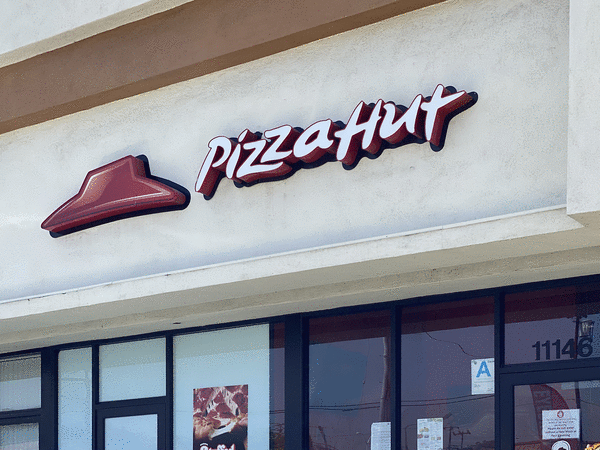
Yum! Brands Inc. is selling its struggling Pizza Hut division for $2.7 billion, allowing the restaurant operator to focus on its better-performing KFC and Taco Bell chains.
Private equity firm LongRange Capital will acquire Pizza Hut excluding China for $1.5 billion, Yum said in a statement Tuesday. Yum China Holdings Inc. will buy the rest of the business for $1.2 billion. The transactions are expected to close in the third quarter.
Yum shares rose as much as 3.6% Tuesday morning in New York. The stock had gained 2.2% this year through Monday’s close, trailing the S&P 500’s 10% advance.
Investors had been expecting Yum to offload Pizza Hut, which it has owned since the restaurant company spun off from PepsiCo Inc. in 1997. The sale should help Yum sharpen its focus, Bloomberg Intelligence’s Michael Halen said.
“This enables them to divert their resources, their people, their energy and their capital toward one very high-growth chain and one very solid-growth chain,” he said.
Bloomberg reported in May that LongRange had entered exclusive talks with Yum to buy Pizza Hut. The company said last year that it was conducting a strategic review after years of trying to revive stagnant sales at the chain known for its pan pizzas with thick, buttery crust.
Domino’s has trumped Pizza Hut in areas including menu innovation, marketing, ordering technology and delivery infrastructure, said Neil Saunders, managing director at GlobalData. Pizza Hut also is a less-popular option for casual diners who are eating in, as they look for larger menus and more contemporary environments, he said.
Pizza Hut’s U.S. business has underperformed peers in recent years, according to data from restaurant research firm Technomic Inc. The category got a lift as Americans ordered in during the pandemic, but sales have petered out since. Chains have launched a bevy of deals to boost traffic. Pizza Hut has struggled to compete.
“This is as promotional an environment as I’ve seen,” Halen said. At Pizza Hut, “the quality of the product wasn’t good, and the real estate here in the U.S. was a problem. You have these big stores and nobody is coming to your stores to sit down and eat.”
Pizza Hut’s share of Yum’s revenue has declined every year since 2019, shrinking to about 12% in 2025 from more than 18% six years earlier, according to data compiled by Bloomberg. During that period, Pizza Hut’s revenue has hovered around $1 billion, while Yum’s revenue grew by about 47% to $8.2 billion last year.
The deal will leave Yum with KFC, its largest brand at $3.5 billion in annual sales, Taco Bell ($3 billion) and Habit Burger & Grill ($570 million).
“Pizza Hut has dragged on the otherwise solid results from the group,” Saunders said in his note. “In essence, the good numbers from KFC and Taco Bell have been clouded by the ongoing sales slides and profit slips at Pizza Hut.”
For Yum China, acquiring Pizza Hut in China will give it control of what it describes as the largest casual dining brand in the country, with segment revenue of $2.3 billion last year. It plans to boost locations to more than 6,000 by 2028 from roughly 4,400 at the end of March.
LongRange, based in Stamford, Connecticut, also owns companies including 24 Hour Fitness.
(With assistance from Michelle F. Davis and Erinn Gardner.)
©2026 Bloomberg L.P. Visit bloomberg.com. Distributed by Tribune Content Agency, LLC.










Comments