Kaiser spent $1 billion to withstand a major strike. What did it cost?
Published in Business News
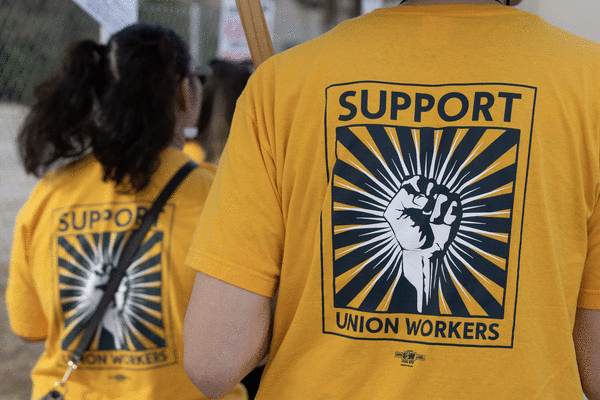
When confronted with an enormous labor strike this January in California and Hawaii, Kaiser Permanente spent an additional $1 billion to buck union demands and operate its facilities with temporary workers, a spokesperson said.
While Kaiser management and striking workers with the United Nurses Associations of California/Union of Health Care Professionals were $1 billion apart in wage negotiations during the work stoppage this winter, the nonprofit health giant dug in and spent big on replacement workers at hospitals and clinics.
Ultimately, union leaders called off the strike and accepted Kaiser’s plan: improved staffing and 21.5% raises over four years, not the 25% they had demanded for months.
“There’s no question that it cost a fortune to keep running during this strike. And yet Kaiser was prepared to do it,” said John Logan, a professor and labor expert at San Francisco State University. “They knew that this was going to be an expensive strike for them.”
But experts said the hardball strategy and expensive strike have an even bigger cost: frayed relationships between California’s largest private employer and its workforce in a unique partnership once considered a national model for labor relations.
“That’s the real cost,” said John August, former executive director of the coalition of Kaiser labor unions from 2006 to 2013. “The cost of having a breakdown in trust, in one of the most important health care systems in the country.”
On strike were 31,000 nurses, physical therapists, nurse anesthetists and other professionals at Kaiser hospitals, clinics and facilities. Workers walked off the job on Jan. 26. The open-ended strike officially ended four weeks later.
However, Kaiser spokespersons claimed nearly half of striking workers — who were not paid from a strike fund — returned to their jobs before the strike’s official end. The alliance of unions ratified their new contracts in March, putting an end to months of bargaining, accusations of bad faith and work stoppages.
Antonia Ehlers, a spokesperson for Kaiser, said the strike “disrupted care and service for our members and came at a significant cost at a time when keeping care affordable is more important than ever.”
During the strike, spokespersons said the unions’ $3 billion pay proposal would force Kaiser, California’s largest private health insurer, to raise prices on members and customers. It could pay for its $2 billion proposal without doing that, they said.
Ehlers did not directly respond when asked via email if Kaiser members could expect premium increases in 2027 associated with the cost of the strike. At the beginning of the year, Kaiser hiked premiums 7%, not because of the work stoppage but as expired federal subsidies and use of GLP-1 drugs raised costs for insurers broadly.
Kaiser, a closed network of doctors, hospitals and clinics, opted to keep its facilities open by onboarding temporary workers during the strike. Patients were notified if appointments had to be postponed.
Kaiser’s cost tally is “staggering” and sheds light on its financial strategy, UNAC/UHCP Executive Director Joe Guzynski said in a statement.
“If the organization was able to spend that level of money over a matter of weeks on temporary staffing, travel costs, housing, recruitment and related contingency measures, it naturally raises questions about the relative cost of investing in workforce stability, retention, staffing and labor peace before a dispute reaches that point.”
The acrimonious strike has independent experts questioning the health of a decades-old partnership between Kaiser management and its workers, with impacts that could spill beyond individual contract negotiations.
Kaiser’s labor-management partnership is a unique style of labor relations in the U.S. economy. Since the 1990s, unionized workers, doctors and managers have had shared decision-making over staffing levels and workflows. That’s been credited for preventing strikes in the past.
That relationship has often been tested, and new cracks have appeared in the past decade. In 2018, tensions between the Service Employees International Union and smaller unions split the labor coalition into two factions. The SEIU-led faction went on strike twice in a year and won 21% raises in 2023, along with a new state law signed by Gov. Gavin Newsom that raises the minimum wage for health care workers to $25 an hour in July.
August, the former labor coalition leader, said the rival group’s success inspired the nurses and other professionals to launch their open-ended strike this winter, “trying to do better than that.”
“I think management drew a hard line in the sand,” he said. “They weren’t going to go as far, and they really dug in.”
Adding to tension between Kaiser management and workers this winter, the sprawling nonprofit has expanded into Pennsylvania and Nevada, and reported a series of financially flush years. The nonprofit, which does not pay taxes on profits, reported a $9.3 billion net income in 2025 and $12.9 billion in 2024. Kaiser poured money into reserves and investments in recent years. Kaiser put $27 billion into reserves in just four years, for a total of $67 billion in savings and investments, the nonpartisan Center for Media and Democracy found .
Kaiser executives say the reserves protect its health and stability in the fast-evolving industry. Labor leaders, however, said Kaiser has amassed wealth while rejecting serious investment in its workforce — putting “profits over patients.”
August said the labor-management partnership has always been a national model, but it needs repair.
“It’s going to take a long time to put this back together,” he said. “I’m sure the feelings on both sides are deep.”
Logan, of San Francisco State, said that partnership has been severely tested.
“More than ever, this brings into question the future of the collaborative labor partnership,” he said. “It will take some time to try to rebuild that relationship within the nurses in the alliance and Kaiser management. Maybe they will be able to rebuild that trust, maybe not. We’ll see.”
Since the alliance of unions ratified their new contracts, both labor and Kaiser executives have signaled interest in turning over a new leaf.
“Since the strike, the parties have worked alongside Kaiser to strengthen our relationship and build a more collaborative foundation for the future,” Guzynski, the union leader, said in his statement.
But elsewhere, Kaiser is facing fresh challenges with other groups of workers. About 2,400 Kaiser therapists in Northern California carried out a one-day strike in March over concerns that managers were replacing workers with artificial intelligence tools.
©2026 MediaNews Group, Inc. Visit at mercurynews.com. Distributed by Tribune Content Agency, LLC.







Comments