Autonomous boats launched from San Diego by this local startup track Chinese ghost fleets
Published in Business News
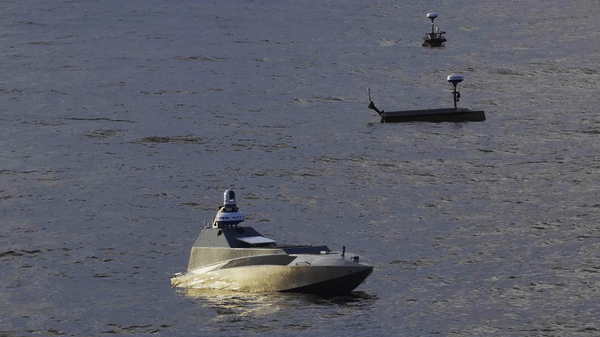
Buoyed in the Pacific, small sea vessels have traveled autonomously from San Diego shores to locate Chinese ghost fleets in Taiwanese waters.
These small skiffs, created by San Diego-based startup Seasats, are vital to reconnaissance, intelligence, and surveillance missions at sea. In the middle of the ocean, dependable internet is hard to come by — but these sea satellites work to discreetly relay information from the ocean to people on land.
Seasats built a number of these autonomous sea satellites for the U.S. Navy. Since 2020, the company has raised $40 million from investors and collected $100 million in defense contracts. Now, the startup is expanding with a new Clairemont headquarters and hiring spree as it races to meet growing demand.
Their 12-foot skiff, the Lightfish, can communicate coordinates of ghost fleets, track hurricanes, signal submarines, monitor the status of pipelines, spot smugglers and locate illegal fishing operations.
The boats listen for acoustic messages underwater, then translate that data into radio signals that beam up to satellites and back to commanders on shore.
“Radio waves don’t go through water,” explained Matt Flanigan, CEO and co-founder of Seasats. “Submarines or divers or underwater robots can’t talk to the internet, so you have to have something right at the surface of the ocean.”
Seasats tests and demonstrates boats off the San Diego coast and in Navy exercises in Coronado. “It’s the perfect place,” Flanigan said. “We did a demo, and then the Navy was like, ‘That works, we’re gonna buy them.’”
Because the boats can relay information from far-flung locations, they can help carry out different types of missions.
Last month, the company said one of its Lightfish uncrewed vessels completed the first autonomous crossing of the Taiwan Strait, a contested waterway separating Taiwan and mainland China.
The startup said in a news release that its vessel encountered “multiple Chinese warships” and that the vessels were allegedly operating well within Taiwan’s exclusive economic zone without transmitting their identity.
“In this era of ubiquitous satellites and sensors, it may surprise some that a ship can hide in the ocean environment,” said Declan Kerwin, chief of staff at Seasats. “That’s why these long-range autonomous vessels are so compelling. They can provide maritime awareness where shore-based radars can’t reach.”
Besides military applications, some of the unmanned vehicles are equipped for climate science. A few years ago, Scripps Institution of Oceanography used the boats to collect deep sea ocean samples. NOAA has also used the crafts to forecast harmful algal blooms in the Pacific Northwest.
Meanwhile, Flanigan sits in the mission control room in the new Clairemont offices.
Seasat’s new headquarters at 5965 Santa Fe St. will house its 70 employees and includes two buildings totaling more than 61,000 square feet. The new facility will open fully in August, the company said.
The new headquarters gives Seasats room to turn its cramped workshop into a true production line, ramping up manufacturing from about a boat a week to roughly a boat a day while adding more jobs and customer space.
Seasats is hiring 12 new positions in software, operations and electronics. Salaries for these roles range from $75,000 for a field service representative to $275,000 for the head of software based in San Diego.
©2026 The San Diego Union-Tribune. Visit sandiegouniontribune.com. Distributed by Tribune Content Agency, LLC.










Comments