Jury awards $49.5 million to family of Boeing 737 Max crash victim
Published in Business News
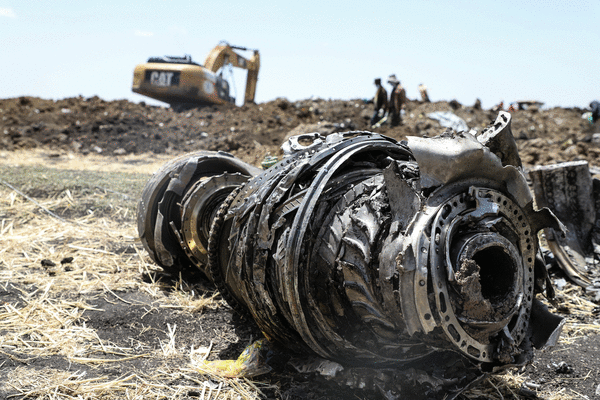
A jury on Wednesday awarded $49.5 million to the family of Samya Rose Stumo, a 24-year-old who died when a Boeing 737 Max plane crashed in Ethiopia in March 2019, the second deadly Max crash in a matter of months.
The trial, which started May 4 in a Chicago federal court, resolves one of the last remaining cases filed against Boeing by the families who lost loved ones in those crashes. It also marks only the second time Boeing has faced a civil trial related to the crashes, which killed 346 people.
Boeing reached an agreement with the Department of Justice to avoid criminal prosecution and has reached confidential settlements in dozens of lawsuits brought by the victims’ families.
In the first case that went to trial, taking place over a week in November, a jury awarded the family of Shikha Garg more than $28 million in damages. Another case was set to go to trial in January but the parties reached a resolution just after jury selection.
The $49.5 million award included $21 million in damages for Stumo’s pain and suffering, according to a copy of the verdict shared with The Seattle Times. Law360 reported news of the verdict earlier Wednesday.
Shanin Specter and Elizabeth Crawford, attorneys from Kline & Specter who are representing Stumo's estate, said Wednesday we are gratified for the opportunity to try the compensatory damages case."
The attorneys intend to pursue punitive damages against Boeing executives and parts manufacturers, seeking an appeal of an earlier ruling.
The trials and settlements so far have focused on how much compensation to grant each family who lost loved ones in the fatal crashes. As part of a legal agreement reached between Boeing and most of the victims' families in 2021, Boeing admitted sole responsibility for the Ethiopian Airlines crash and the families agreed not to pursue punitive damages.
Stumo's family was one of two families who did not sign the stipulation.
Following the two fatal crashes, investigators determined that a faulty software system on the then-new Max had repeatedly forced the plane’s nose down in both instances, leaving pilots unable to control the aircraft. The first crash, off the coast of Indonesia in October 2018, killed 189 people. The second, in Ethiopia, killed 157 people.
The Stumo family has waited years for its case to reach trial as the court methodically wound through dozens of other lawsuits. U.S. District Judge Jorge Alonso put the cases of the two families who did not sign the agreement on hold while the court addressed most of the other cases in the docket.
The agreement was meant to guarantee payments to each family to recognize the loss of their loved ones, something that is never a sure thing if a case goes to trial, attorneys representing the families have said. It also ensured that Boeing could not ask a judge to move the cases to a family’s home country, where they may receive smaller sums.
“We are deeply sorry to all who lost loved ones on Lion Air Flight 610 and Ethiopian Airlines Flight 302," a Boeing spokesperson said in a statement Wednesday. "While we have resolved nearly all of these claims through settlements, families are entitled to pursue their claims through the court process, and we respect their right to do so."
But critics of the agreement worry it is letting Boeing off easy. Ralph Nader, the longtime consumer advocate known for using tort law to hold corporations to account and Stumo’s great-uncle, has been sharply critical of the agreement. In 2021, he likened it to "a collective slap on Boeing's wing.
Meanwhile, a group of families representing victims from both deadly crashes have been pushing federal prosecutors to do more to hold Boeing criminally accountable. The Justice Department filed a fraud charge against Boeing in 2021, alleging the company intentionally misled safety regulators about its new software system on the Max.
After two previous deals fell apart, Boeing and the Justice Department finalized a nonprosecution agreement last year and won judicial approval to move forward in November. The deal would drop the criminal fraud charge and impose new fines and compliance requirements on the company.
The victims' families asked an appeals court to reverse the decision to grant judicial approval, arguing the agreement was not in the public interest and violated the rights of crime victims. But in April, the 5th U.S. Circuit Court of Appeals upheld the earlier ruling.
The families have asked the court to again reconsider the decision.
In an interview with The Seattle Times shortly after the fatal Ethiopian Airlines crash that killed her daughter, Nadia Milleron had many questions for Boeing. She wanted all the facts and details, she said. But, mostly, she wanted to know “why did our daughter fall out of the sky? … Why did that happen? … Why did it happen twice?”
(This story includes information from The Seattle Times’s archives.)
©2026 The Seattle Times. Visit seattletimes.com. Distributed by Tribune Content Agency, LLC.




Comments