Former Starbucks CEO Howard Schultz calls Seattle 'hostile' to business
Published in Business News
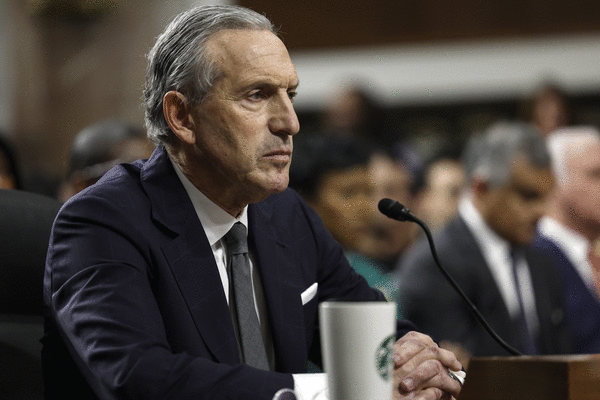
Former Starbucks CEO Howard Schultz has taken a jab at Seattle’s mayor and its business climate for what he called “hostile” and “socialist rhetoric.”
Schultz, still Starbucks chairman emeritus, spent decades in Seattle building the coffee company into a global empire. But two months after departing his longtime Seattle home for Miami, he heavily criticized Seattle and Washington’s business environment in a Wall Street Journal op-ed published Monday.
Schultz, 72, said he felt a responsibility to “speak up about the business and job climate in a city and state that gave me so many opportunities.”
The billionaire has a lot of complaints about Seattle, according to his op-ed — chronic homelessness, persistent budget deficits, declining public safety, falling foot traffic, slower hiring, and downtown vacancies among them.
Seattle has changed — the city that once birthed business giants like Starbucks, Amazon, Costco and Microsoft rewarded risk taking and encouraged private enterprises, he said.
But now, Seattle’s attitude toward business has turned hostile, he said.
“Seattle’s mayor, Katie Wilson, has chosen to cast business as a foil rather than a partner,” he wrote. “Her socialist rhetoric vilifies employers, even while she continues to rely on them for revenue. She has encouraged residents who disagree with her policies to leave.”
Wilson has recently faced backlash after saying at an April Seattle University event that the claims that millionaires will leave Washington are overblown.
“The ones that leave … like, bye,” she said with a wave.
As mayor-elect, Wilson urged Seattleites to boycott Starbucks at a Nov. 13 union rally.
“I am not buying Starbucks, and you should not either,” she told the crowd.
In a statement Tuesday, Wilson said Starbucks is part of Seattle’s culture and identity, and that she wants the company and other large employers to continue their success in the city.
Her office is in regular communication with the executive team at Starbucks on “shared priorities,” including homelessness, public safety and affordability, she said.
“Seattle is a special place because of our history, our culture, our workforce, and a shared understanding that companies and workers can succeed together,” she said, adding there is plenty of room “to find common ground and work together on our city’s biggest challenges.”
Starbucks declined to comment.
Some of Schultz’s qualms are evident. Despite some progress on public safety and economic recovery after the COVID-19 pandemic, the city still struggles with homelessness, substantial downtown vacancies, widespread layoffs and budget woes.
The warning from the influential businessman strikes a chord as conversations around businesses and wealthy figures fleeing reach a pinnacle.
Starbucks announced last month a new office in Nashville and pledged a $100 million investment in Tennessee. The Nashville office will grow to up to 2,000 workers over the next five years — more than half as big as the workforce currently at Starbucks headquarters in Seattle’s Sodo neighborhood.
Despite concerns that Starbucks would leave Seattle entirely, the coffee giant says it’s staying put.
Schultz didn’t seem to imply that Starbucks would abandon Seattle, either. However, he said, “Seattle has no clear answer to the question of what will provide the next set of jobs and revenue growth” as companies reduce their local roles and recruitment.
Schultz also pointed to Washington’s reliance on sales taxes, calling it “a broken tax system” and “deeply regressive.” The Washington Legislature has focused too much on taxation to solve its financial problems, he said.
He noted that the state has increased taxes on businesses and successful entrepreneurs.
“The theory appears to be that prosperity can be mandated through redistribution rather than generated through growth,” he said.
Washington faces its most challenging fiscal environment in recent history with a projected $4.3 billion deficit for the 2027-29 biennium. The state recently gained national attention for passing a “millionaires tax” — a 9.9% levy on any income over $1 million.
Although Schultz didn’t mention the tax directly in his op-ed or departure announcement, many have speculated that it played a hand in his exit. Schultz has a net worth of $3.5 billion, per Forbes, which is less than his 10-year high of almost $5 billion in 2019.
However, in his op-ed, Schultz said his move to Miami “had much to do with family choices” and his “stage of life.”
Schultz said he hopes Washington will follow in the footsteps of other states trying to attract businesses by “simplifying” regulation, “reforming” tax systems and investing in workforce development.
“Washington once embodied the future of the U.S. economy, and it can again. But the current government needs to learn that future entrepreneurs won’t be attracted by ineffective public systems, especially when joined with policy and political rhetoric that demonize businesses,” he said.
©2026 The Seattle Times. Visit seattletimes.com. Distributed by Tribune Content Agency, LLC.






Comments