Under Armour reports losses as turnaround effort continues
Published in Business News
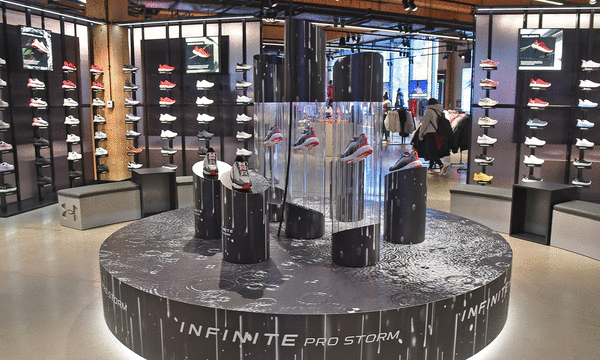
Baltimore-based Under Armour reported another year of declining sales Tuesday as the athletic apparel company continued a sweeping restructuring effort under founder and CEO Kevin Plank aimed at stabilizing the business and repositioning the brand around premium products and performance innovation.
The company reported fourth-quarter revenue of $1.2 billion, down 1% from the same period a year earlier, while full-year revenue fell 4% to $5 billion. North America, Under Armour’s largest market, remained a challenge, with quarterly sales down 7% and annual sales declining 8% to $2.9 billion.
Still, the company pointed to signs of improvement internationally, where fourth-quarter revenue rose 10% to $539 million. Sales grew 13% in Asia-Pacific and 22% in Latin America during the quarter.
“Intentionality will define this chapter for the brand,” Plank said during a conference call with analysts. “We’ve executed a deliberate reset of the business, making more intentional choices about where and how we compete.”
Under Armour posted a fourth-quarter net loss of $43 million, or 10 cents per share. For the full fiscal year, the company reported a net loss of $496 million, or $1.16 per share, driven in part by restructuring costs and a $247 million valuation allowance tied to U.S. deferred tax assets.
Adjusted earnings, which exclude restructuring and other one-time charges, remained positive. The company reported adjusted annual net income of $50 million, or 12 cents per share.
Plank, who returned as CEO last year, said the company is deliberately shrinking parts of the business that were not profitable while narrowing its focus on fewer products, tighter operations and higher-margin categories.
The restructuring effort has included reducing product offerings, reorganizing around sports categories and tightening marketing spending. Under Armour said it has reduced its product assortment by 25% over the past two years and expects further cuts.
The company has now incurred $261 million in restructuring and transformation costs under its fiscal 2025 restructuring plan. It expects total costs to reach about $305 million before the initiative is substantially complete by the end of 2026.
Plank said the company’s strategy centers on elevating Under Armour to a premium athletic brand built around performance credibility. He pointed to marathon runner Sharon Lokedi’s second consecutive victory at the Boston Marathon, while wearing Under Armour footwear, as evidence that the company can compete at the highest levels of performance athletics.
The company is also attempting to strengthen its apparel business, which remained relatively stable compared with footwear. Annual apparel sales declined 2% to $3.4 billion, while footwear revenue fell 11% to $1.1 billion.
Plank said Under Armor plans to emphasize “fewer, better products” and to focus on items that can crossover from athletics to everyday wear. Among the products highlighted was a new “bouncy cotton” T-shirt that the company plans to market as both a performance and lifestyle item.
Despite the revenue declines, executives said inventory levels improved, dropping 3% to $915 million at the end of the quarter, while relationships with wholesale partners also showed signs of stabilizing.
Looking ahead, Under Armour expects fiscal 2027 revenue to decline slightly again, though executives forecast improved profitability. The company projects operating income between $96 million and $116 million next year.
Plank acknowledged the turnaround remains incomplete.
“We are not improving our bottom line fast enough,” he said. “Execution must tighten, and we are holding ourselves accountable for accelerating progress.”
©2026 The Baltimore Sun. Visit at baltimoresun.com. Distributed by Tribune Content Agency, LLC.








Comments