Michael Hiltzik: How many Cybertrucks has Tesla sold to the public? Fewer than you might think
Published in Business News
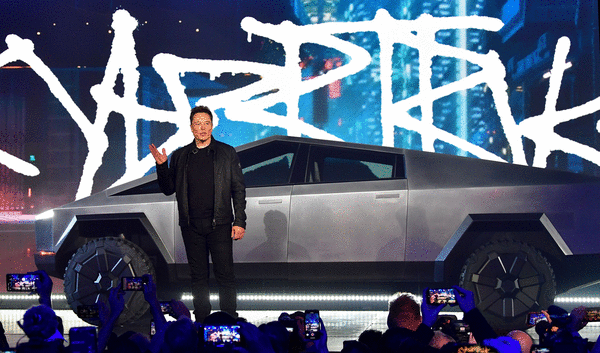
The Cybertruck, Tesla's would-be competitor in the EV pickup truck market, has long since secured its place as the Edsel of the electric vehicle age.
It's been derided as unwieldy and ugly and unable to match other pickups in basic functionality. In the colorful take of Tesla critic Will Lockett, it's "the vehicular form of halitosis" and an "ick' on four wheels."
But one doesn't need words to describe how the Cybertruck has fared among the pickup-buying public; the numbers tell the story.
According to Cox Automotive's Kelley Blue Book, Tesla sold only 20,237 of the vehicles in 2025, down 48.1% from the 38,965 sold the year before. The slide continued in the first quarter of this year, Cox reported — 3,519 sold, down 45.1% from the 6,406 sold in the year-earlier period.
But there's more to the story — or to be more precise, less.
In the fourth quarter of 2025, of the 7,071 Cybertruck U.S. registrations, 1,279 went to SpaceX, the rocketship company headed by Tesla boss Elon Musk, which is planning an initial public stock offering sometime this year. An additional 60 were registered by other companies in the Musk empire, namely xAI, Neuralink and the Boring Co.
In other words, nearly 20% of all the Cybertrucks registered in the U.S. in the fourth quarter went to Musk's companies. Based on the Cybertruck's starting price of $70,000, that's the equivalent of $93.7 million in merchandise circulating within Musk's orbit rather than going to outside buyers.
The figures were compiled by S&P Global Mobility and reported by Bloomberg. I asked Tesla to comment but received no reply.
The transfers of Cybertrucks to other Musk companies raise questions about how he conflates the interests of his private companies and his public company (Tesla), arguably to the disadvantage of Tesla shareholders. More on that in a moment.
The sales numbers raise obvious questions about the future of the Cybertruck as part of Tesla's five-model lineup. They also undermine Musk's declared faith in the truck. When it was introduced in 2023, Musk asserted that he expected to sell 250,000 to 500,000 Cybertrucks a year once manufacturing capacity was fully engaged.
It would be hard to find market experts who took that prediction seriously, but few probably expected the shortfall to be so steep. Cybertruck's 48.1% decline in 2025 sales compared with 2024 was the sharpest such decline of any EV in the U.S. market over that period, in which EV sales generally slumped.
Initial Cybertruck sales of 38,965 in 2024 seemed almost to validate Musk's optimism. But negative perceptions took hold through the year and into 2025, starting with the ridicule the vehicle's boxy design attracted on the street.
Poor manufacturing quality has prompted U.S. regulators to order eight recalls of Cybertrucks since its introduction, culminating in the March 2025 recall of almost every Cybertruck to correct the tendency of a stainless steel exterior panel to come off the vehicle at freeway speeds, posing a hazard to other drivers.
Online reports and videos showing Cybertrucks defeated by conditions such as uneven terrain and steep grades that are routinely managed by rival pickups may also have sapped buyer enthusiasm for the model.
It's true that the Cybertruck has problems that aren't shared with other EVs. One is that it can't be sold in European Union countries, because the EU has found that its exterior design can imperil pedestrians.
Nor do other EV manufacturers have to contend with public obloquy being showered on their leaders; Tesla sales in Germany cratered last year after Musk threw his support behind the extreme-right neo-Nazi party Alternative for Germany. There, new Tesla vehicle registrations fell by 76.3% in February 2025 from the same month a year earlier — that is, to 1,429 from 6,029. The decline continued all year, resulting in an overall decline of 48.4%.
As my colleague Caroline Petrow-Cohen reported last year, public distemper over Musk's position as the leader of DOGE, the quasi-governmental body that ran roughshod through the federal workforce after Donald Trump launched his second term, also may have cut into Tesla sales in the U.S. A study by Yale researchers last year estimated that Musk cost Tesla as many as 1.26 million car sales since October 2022, when he acquired the social media platform Twitter and gave greater access on it to the far right and other extremist voices.
That said, Teslas remained the best-selling EVs in the U.S. market last year with nearly 60% of EV unit sales, according to Cox. Its full-year decline of 7% was exceeded by several other carmakers with EVs in their lineups, including BMW (down 16.7%), Kia (down 39.7%) and Ford (down 14.1%).
The U.S. EV market generally lost ground after the expiration of federal incentives last year, but many individual models slumped sharply, including Ford's all-electric version of its top-selling F-150 pickup, sales of which fell 18.5% from the year before (though it still outsold the Cybertruck).
Tesla's transfers of Cybertrucks to other Musk operations should concern Tesla shareholders, depending on how much, if anything, SpaceX and the other companies paid for the vehicles. In arm's-length transactions between related parties, the transfers should be marked at prices resembling those on the open market, whether individual or fleet sales.
Tesla, however, hasn't publicly disclosed these deals in its financial filings thus far, even to the extent of disclosing whether they've taken place at all. It would be interesting to know how SpaceX is using its Cybertrucks, since it wouldn't seem to need a fleet to transport equipment headed for space in the back of pickup trucks. Why Musk's AI or neurological companies need any such vehicles is hard to gauge.
As it happens, however, Tesla investors don't seem to have been fazed by Bloomberg's report. Tesla shares closed in Monday's trading at $392.51, higher than they were on April 15, the day before Bloomberg published, when they closed at $391.95.
This wouldn't be the first time that Musk has melded his personal interests with those of his public shareholders. The prototypical such action occurred in 2016, when he orchestrated Tesla's purchase of his SolarCity for $2.8 billion, a 35% premium from the latter's trading price. (Investment manager Jim Chanos, who had short positions in both companies, called the deal a "shameful example of corporate governance at its worst.")
At the time, Tesla's seven board seats were held by Musk and four of his cronies, including his brother Kimbal, and SolarCity's board included Musk and two of his cousins. On that occasion, Tesla investors turned queasy, pushing Tesla shares down by more than 10% the day the deal was announced.
Musk defended the deal as a triumph of clean energy industry synergy, but one struggles to find significant gains from the linkup. Energy generation and storage, which would cover SolarCity's business, accounted for about 13.5% of Tesla's revenue in 2025, nearly a decade after the merger.
What role the Cybertruck — indeed, any Tesla vehicles — will play in the company's future remains murky. Musk recently has talked about shifting the company's focus to AI, robotaxis and humanoid robots, but these all resemble pipe dreams. AI is more and more a marketing term with less meat on its bones than the incessant publicity about it suggests and Tesla's robotaxi venture today consists of about a dozen vehicles tooling around Austin, Texas, with human supervisors in the car or near at hand.
Musk last year projected that humanoid robots would generate "$30 trillion in revenue" for Tesla, though he acknowledged that he was "just guessing" and that there would be a "long way to go between here and making one billion robots a year." As I've reported, however, even some robotics experts argue that giving workaday robots humanoid features makes no sense functionally and is likely to be abandoned once manufacturers seriously contemplate how household robots should look and function.
None of this means that Tesla might not be able to recapture its mojo in the EV market. Consumer interest in EVs tends to rise and fall in lockstep with gas prices. EV makers had a tough 2025 in the U.S. But that could turn around this year if the runup in gas prices caused by President Trump's Iran adventure continues to drive up the cost of oil.
But Tesla faces a lot more competition for EVs than it ever has in the past; other companies such as Hyundai have moved down-market and China's BYD recently surpassed Tesla in global sales of battery-powered vehicles. BYD has been largely kept out of the U.S. market by high tariffs, but it may be impossible to keep its cars out forever. Tesla, which pioneered the EV market, may need a new model to compete with BYD and the foreign and domestic automakers already in the market, but the Cybertruck sure hasn't been looking like its savior.
©2026 Los Angeles Times. Visit at latimes.com. Distributed by Tribune Content Agency, LLC.










Comments