Private equity bankruptcies leave Pennsylvania and Ohio communities trying to resuscitate hospitals
Published in Business News
WARREN, Ohio — An empty seven-story hospital, where things are so quiet that homeless people have set up camp outside the locked doors, is a scar on this community two years after the collapse of the hospital’s for-profit corporate parent in Texas.
Dallas-based hospital chain Steward Health Care System LLC filed for Chapter 11 bankruptcy in May 2024 with $9 billion in liabilities, forcing the closure of 10 hospitals in four states and throwing 5,000 people out of work.
The 326-bed Trumbull Regional Medical Center and nearby 69-bed Hillside Rehabilitation Hospital were among those closures.
Both are in Warren, a Rust Belt town of 38,683 where digging is underway for a city bike trail with the hope of drawing tourists while one out of three residents lives in poverty.
The shuttering of Trumbull Regional and Hillside Rehabilitation, along with some 700 lost jobs, is part of the wreckage wrought by the corporate approach to medicine, say critics who argue such business strategies put profit ahead of patient care.
They blame the same motive for the closing of five eastern Pennsylvania hospitals since 2019 that had similar business models. Two Delaware County medical centers — Crozer-Chester Medical Center and Taylor Hospital — closed just last year after Los Angeles-based Prospect Medical Holdings went bankrupt. Hospital job losses totaled 2,651.
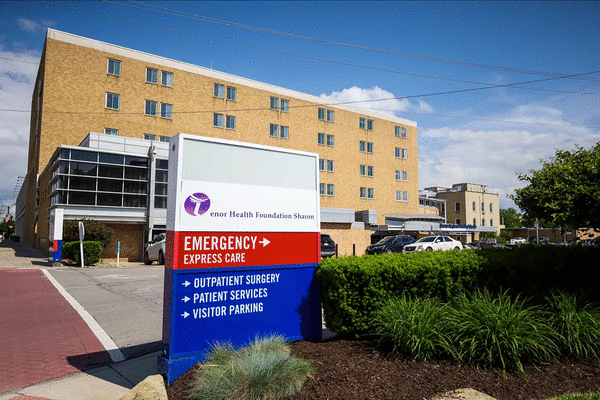
Private investment woes also stranded Steward’s 62-bed Sharon Regional Medical Center, a Western Pennsylvania hospital 20 miles northeast of Warren. It closed for two months before reopening a year ago as Sharon Regional Health System.
The going since then hasn’t been easy.
Sharon Regional continues to bleed red ink, officials say, despite an $11 million infusion from a community loan package that came with the dream of reviving post-industrial Mercer County.
The road ahead for Sharon Regional won’t get any easier: Federal Medicaid funding cuts, labor and supply cost inflation, and lease payments for hospital property that Steward had sold off threaten to derail the hospital’s wobbly recovery.
The operating model for the various closed facilities went like this:
Private equity investors bought the hospitals, then sold the real estate under the patient towers, parking garages and other medical buildings, creating a windfall for investors.
Suddenly saddled with rent payments, though, Sharon Regional and the other hospitals were forced to defer capital improvements and shrink services while operating capital was sapped.
Advocates of corporate medicine say private equity ownership can offer benefits to a health care system that sometimes doesn’t pay enough attention to the bottom line. The model, they argue, can bring cost controls, supply chain efficiencies and centralized management to ailing community hospitals, saving jobs and local access to medical care.
Critics aren’t convinced, based on examples such as the empty buildings that the Warren community now must deal with.
“Steward Health Care — alongside Cerberus Capital Management and Medical Properties Trust — gutted dozens of hospitals across the United States in order to extract maximum profit,” U.S. Sen. Edward J. Markey, D-Massachusetts, wrote in a 2024 report. “In doing so, Steward became a case study of the extent of harm that corporate greed can have on health care access, quality and safety.”
A total of 488 U.S. hospitals were private equity owned in 2025, according to the Private Equity Stakeholder Project, a nonprofit watchdog group in Chicago. That’s more than triple the number in 2018, when there were about 130.
Of the total private equity-owned hospitals last year, nearly 30% were in rural areas, such as Cambria County, where Duke LifePoint Healthcare in Johnstown owns three hospitals and numerous doctors’ offices serving 11 rural counties.
New York City-based Apollo Global Management, among the biggest private equity firms, owns LifePoint Health, half of the for-profit partnership that owns the Johnstown health system.
Pennsylvania does not ban private equity ownership of hospitals, but it’s considering measures to better assess them.
Legislation introduced in the General Assembly in January would empower the state attorney general to review and block hospital acquisitions, including those purchased by investors seeking a return on their money. Similar House and Senate bills were introduced last year, backed by Gov. Josh Shapiro, but they went nowhere.
Like Pennsylvania, Ohio doesn’t restrict private equity ownership of hospitals.
In Warren, the hospital closings have become a line in the sand for Niki Frenchko, 51, a native of Ohio’s post-industrial Mahoning Valley, former Trumbull County commissioner and a Republican candidate for Congress in the spring primary.
Frenchko, whose campaign posters feature smiling pictures of the candidate with various firearms as a defender of the Second Amendment, said she plans to introduce the Community Hospital Stabilization Act to protect hospitals from unscrupulous investors.
“It’s the vulture capital playbook,” she said about the hospitals’ collapse. “This is my community. These are my neighbors. It’s wrong.”
The patient went down quickly
The Warren closings happened quickly.
Hillside Rehabilitation closed in September 2024, four months after Steward went belly up 1,000 miles away in Texas.
In October of that year, Medicare stopped paying for care at Trumbull Regional, which had opened in 1908 as Warren General Hospital. Medicare reimbursement is blood to a hospital, critical to keeping the lights on.
The facility, then called Insight Hospital & Medical Center, surrendered its state license in November 2024 after the state health department found safety and patient care deficiencies. Problems were found with the hospital’s fire alarm and sprinkler system, elevators and emergency lighting.
A backup generator didn’t work when tested and there was inadequate oxygen pressure in supply lines used by patients.
Insight officials did not return calls seeking comment.
The closure of Trumbull Regional alone reduced the city’s wage tax revenue to $84 in 2025 from $937,000 in 2024, according to city treasurer Tom Letson. Hillside Rehabilitation employees generated another $5,600 for the city from the 2.5% tax in 2024, and that also evaporated the following year.
That accounts for about 9% of Warren’s general fund budget of $10.5 million, which covers police, fire, public works and other key municipal services.
The shuttering of Trumbull Regional hit especially hard.
“It was the bigger of the two hospitals, and it’s just gone,” said Matt Martin, 49, executive director of Trumbull Neighborhood partnership, a nonprofit redevelopment group. “Many, many working people and neighborhoods ... depended on those hospitals for jobs. It’s just destitute now.”
Meanwhile, the 137-bed St. Joseph Warren Hospital, a short drive from Trumbull Regional, has been picking up the slack as that hospital’s nonprofit corporate parent, Bon Secours Mercy Health, of Blue Ash, Ohio, builds a $50 million freestanding emergency room just outside Warren.
But the aftershocks of the hospital closings are still felt a half mile from city hall, where Warren Family Mission, a homeless shelter and food bank, has seen an uptick in the number of people seeking help, said its executive director, Caitlin White. Overall, the mission served 130,000 meals last year, up from the 117,000 served in 2024.
How much of that increase has been driven directly by the hospital closings is uncertain.
At the same time, White said she is disappointed to see a number of businesses closing shortly after opening in Warren’s tidy downtown.
“Warren is my community, and it gets your hopes up that we’re going to revitalize this,” she said, referring to a time when storefronts glowed again. “And in a year, the business closes down.”
More bad news came to Warren earlier this year when Ultium Cells LLC — a General Motors and LG Energy Solution joint venture formed to meet what had been a sizzling market for electric vehicles — furloughed more than 1,300 people. Slowing demand for electric car batteries was blamed as the Mahoning Valley’s dream of becoming Voltage Valley faded.
Still in recovery in Sharon
Twenty miles away in Mercer County, Pa., the 62-bed former Steward holding Sharon Regional continues to struggle with expenses a year after reopening.
Tenor Heath Foundation Inc., a Pasadena, California-based nonprofit, assumed ownership of the hospital from bankruptcy court in March 2025.
“There’s no question, we didn’t have the amount of working capital that we’d hoped,” CEO Radha Savitala said, adding that the hospital has needed many repairs. “There has been extensive water pipe and roof leaks. A huge part of our working capital went to infrastructure.
“Expenses are still over revenue.”
Sharon Regional continues to negotiate with vendors over bills that have slipped into arrears, Savitala said.
Financial stress can lead to closure of nonprofit hospitals as well: UPMC South Side, which closed in 2018, and Suburban General, which closed in 2010, are examples in the Pittsburgh area, even with the advantage of not having to meet investors’ hunger for profits.
With margins in the industry often thin, the private equity model magnifies losses, critics say.
Despite the challenges and the fact that it’s operating with 32% fewer full- and part-time employees than before bankruptcy, Sharon Regional is limping back to life, reopening its round-the-clock heart catheterization lab in December — time-sensitive care that saves lives in instances of a severe heart attack. It is the only such facility offering the services in Mercer County, population 108,000.
And the hospital is a much tighter operation today with far fewer primary care doctors’ offices in the community and employees — 572 versus 850 the day it folded in bankruptcy.
The 203-bed Meadville Medical Center an hour away in Crawford County has prospered at Sharon Regional’s expense — although that was not the original strategy.
MMC, which briefly considered acquiring Sharon Regional out of bankruptcy, instead assumed control of its closed nursing school and picked up five of Sharon Regional’s primary care practices in Mercer County and Trumbull County, Ohio.
The medical practices — formerly part of a feeder system for patients to Sharon Regional — are instead sending patients to MMC.
“Those physician practices were going to be closed,” MMC President and CEO Philip E. Pandolph said. “We really just wanted to preserve access for the community.”
Since the MMC acquisition, the number of patients coming to Meadville for care has risen about 10%, Pandolph said.
“We hope it continues to be successful in the future,” he said. “We’re going to continue our presence in that community.”
‘An act of terrorism on our public’
Back in Warren, it’s a cool, early spring morning at the Mocha House, a one-time American Legion hall and now popular breakfast spot.
A woman approaches Frenchko in the parking lot with words of encouragement.
“Don’t let those boys hold you down,” she says. “You kick butt and they don’t want you to.”
Seated inside, Frenchko fumes about the closing of Trumbull Regional, which she can see outside her living room.
“To me, it’s an act of terrorism on our public,” she said. “That’s not making America great to leave that kind of carnage.”
At another table, retired city water department worker Larry Boling, 76, chatted with friends, also regulars at the eatery. He, too, was dismayed to lose Trumbull Regional.
“How are you going to develop without a hospital?” he said. “People won’t want to move here without a hospital.”
But the news isn’t all gloomy for a city long battered by economic boom and bust cycles.
Kleenex, Huggies and Kotex product maker Kimberly-Clark has begun hiring for 500 advanced manufacturing jobs for an $800 million plant being built just outside the city. The Irving, Texas-based company is constructing a one-million-square-foot-plus facility at the site of a former steel plant as part of its larger domestic investment strategy.
The state of Ohio kicked in $17 million for site preparation and infrastructure improvements, with entry level jobs at the plant starting at $25 an hour — $6 an hour lower than a starting registered nurse at Trumbull Regional.
The plant opening is set for late 2027.
“Everybody’s banking on that,” 68-year-old Warren City Council President John R. Brown Jr. said, sipping his morning coffee.
©2026 PG Publishing Co. Visit at post-gazette.com. Distributed by Tribune Content Agency, LLC.









Comments