Bill Dudley: Kevin Warsh has no good reason to lower rates
Published in Business News
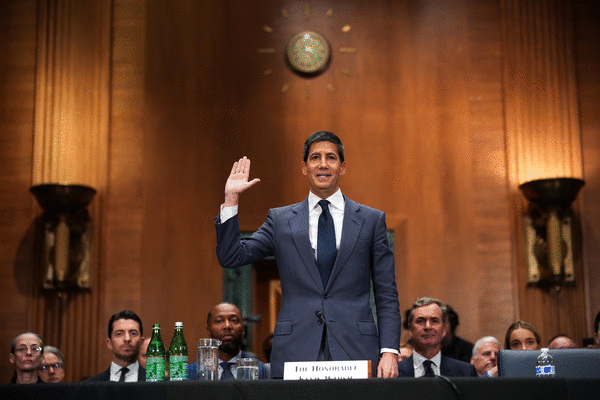
Kevin Warsh, the prospective chair of the Federal Reserve, keeps coming up with new reasons to lower short-term interest rates, an outcome that President Donald Trump has long demanded.
His latest rationale — that inflationary pressures are subsiding — is no more convincing than its predecessors.
Reason number one was artificial intelligence. The technology, Warsh argued, will at some point push down inflation by enhancing workers’ productivity, so the Fed should get ahead of the curve by lowering rates now. Yet the AI investment boom has so far had the opposite effect, turbocharging demand for everything from construction workers to graphics processing units. In one recent poll, about four out of five economists favored waiting to see how the effects unfold.
A second narrative focuses on the Fed’s balance sheet — specifically, the shedding of assets amassed in previous stimulus efforts. This, Warsh reasons, will have a monetary tightening effect that must be offset with lower interest rates. The shrinkage, however, will likely be spread out over years and, at perhaps $1 trillion of the Fed’s $6.7 trillion balance sheet, not be very significant compared with the $31 trillion in U.S. Treasury securities held by the public.
Now comes a third rationale, which Warsh rolled out at his Senate confirmation hearings: The Fed can lower rates because inflation isn’t really a problem. The measures he prefers — “trimmed averages, where we take out all of the tail risks, all of the one-off items” — suggest a “quite favorable” trend, he said. Most likely, he was referring to the Dallas Fed’s trimmed mean price index for personal consumption expenditures, which as of March was up 2.3% from a year earlier, well lower than broader measures.
This reasoning has four flaws. First, such alternative measures are meant as indicators of future inflation. Using them to suggest the Fed has met its 2% target for overall inflation would risk undermining the central bank’s credibility.
Second, the large and potentially persistent rise in energy prices shouldn’t be dismissed as noise. It’s likely to push up core inflation as the higher cost of oil, natural gas and fertilizer seeps into goods and services that use the commodities.
Third, overall inflation matters. It can affect expectations, which then drive further increases in wages and consumer prices, creating a vicious cycle that’s very difficult to stop. To keep inflation expectations well-anchored, the Fed must maintain the public’s confidence in its commitment to its 2% target — confidence that ignoring overall inflation would erode.
Fourth, other measures of underlying inflation don’t look great. The Dallas trimmed mean is actually the lowest of the ten measures that the Federal Reserve Bank of Atlanta tracks, and might understate the actual trend. The other nine average to 2.9%, and they’re likely to rise over the next few months as higher energy prices spread to other items.
Warsh should be careful about cherry-picking data that conform to President Trump’s preferences. Markets are already concerned about the Fed’s independence. Increasing those worries even more will only complicate the job of achieving the central bank’s 2% inflation target.
____
This column reflects the personal views of the author and does not necessarily reflect the opinion of the editorial board or Bloomberg LP and its owners.
Bill Dudley is a Bloomberg Opinion columnist. A former president of the Federal Reserve Bank of New York, he is a member of Coinbase Global's advisory council.
©2026 Bloomberg L.P. Visit bloomberg.com/opinion. Distributed by Tribune Content Agency, LLC.






Comments