Michael Hiltzik: A crypto mogul's lawsuit against a Trump-linked crypto firm shows the peril of investing with Trump
Published in Business News
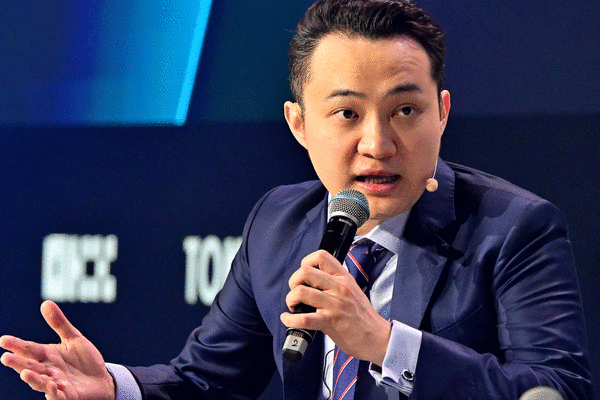
Here are a couple of rules for anyone thinking of investing in cryptocurrencies, courtesy of one of the biggest crypto tycoons on the planet:
First, don't believe what crypto firms tell you about the security of your investments.
Second: Be wary — very wary — of investing with a crypto firm associated with the Trump family.
These warnings come from Justin Sun, one of the leading tycoons in the crypto space, who last week filed a $45 million lawsuit in San Francisco federal court against World Liberty Financial, an arm of the family's investments in crypto.
Sun claims that World Liberty Financial, a Florida company, has blocked his transfers of the WLF crypto tokens he values at $45 million, largely in retaliation for his refusal to invest more than that in the firm.
He says its management has threatened to "burn" his tokens, or render them permanently worthless, and to report him to U.S. criminal authorities if he continues to refuse. Days before filing his lawsuit, Sun issued a lengthy broadside against WLF on X, labeling the firm "World Tyranny" Financial. His response to their threat was a tweet stating that he's "innocent."
WLF didn't reply to my request for comment.
But the day after Sun filed his case, WLF Chief Executive Zach Witkoff tweeted that the lawsuit "is a desperate attempt to deflect attention from Sun's own misconduct. His claims are entirely meritless and World Liberty looks forward to getting the case thrown out promptly." WLF has agreed, in the meantime, to not burn or dispose of Sun's tokens until the case is decided or settled, according to a court filing.
The lawsuit is rooted in World Liberty's connection to Trump. The firm was launched in 2024 with a two-hour online livestream featuring Trump. The firm identifies his sons Donald Jr., Eric and Barron as co-founders. President Trump is listed as a co-founder emeritus, as is Steve Witkoff, the real estate developer who serves as Trump's Middle East envoy with responsibility for negotiating a peace deal with Iran. Zach and Alex Witkoff, his sons, are also listed as co-founders.
A business entity controlled by the Trump family owns 38% of WLF and receives up to 75% of the revenue from sales of its crypto token WLFI. WLF also says that the popularity of its products and services depend in part on President Trump's "reputation and popularity."
As it happens, Sun implies he made his initial investment in World Liberty as an expression of confidence in the Trump family and to Trump's putative commitment to "decentralized finance" — financial transactions that don't require centralized intermediaries such as banks and brokers, a goal of the entire crypto field.
Sun, who says he is a citizen of the Caribbean nation of St. Kitts and Nevis (though he formerly identified himself as a citizen of China) and a resident of Hong Kong, claims to have rescued World Liberty Financial in November 2024 from what was looking like a bungled rollout. The firm had hoped to raise $300 million by selling its WLFI crypto tokens to foreign investors and wealthy Americans, but had raised only $12 million on its first day and $22 million in its first month.
Then Sun stepped in, spending $45 million between November 2024 and January this year to acquire 3 billion WLFI tokens. Sun proclaimed himself WLF's largest investor and wrote on X: "The U.S. is becoming the blockchain hub, and Bitcoin owes it to @realDonaldTrump!" WLF responded by naming Sun a corporate adviser and gifting him an additional billion tokens, then valued at $15 million.
After Sun's investment became public, he asserts in his lawsuit, "World Liberty took off," ultimately raising $550 million through WLFI sales. What was extraordinary about this was that the tokens had no tradable value. They were "governance" tokens, meaning that they gave their owners only the right to vote on certain management policies. WLF prohibited their sale or transfer, though it said they would probably become tradable sometime in the future.
That made them even less valuable than cryptocurrencies such as bitcoin, which at least can be bought and sold. Sun says in his lawsuit that he acquired his stake because "he has long been (and remains) an ardent supporter of President Trump and the Trump family" and because he "cares deeply" about WLF's stated goal of promoting "decentralized finance."
At first, Sun's investment seemed to pay off. After Trump became president, the Securities and Exchange Commission settled a 2023 case charging him and his trading firm with fraud and other securities law violations. The settlement required Sun's firm to pay a meager penalty of $10 million but didn't require an admission of wrongdoing.
But last year, just before Sun's WLF tokens were to become tradable, the firm "secretly" changed its rules to allow it to restrict token transfers by specific holders. Although token holders supposedly held the right to vote on any such change, Sun claims, no vote was held: "World Liberty simply took the power for itself," the lawsuit states.
In the months before that change, Sun asserts, its management had been trying to pressure him into investing more in WLF. "To ratchet up the pressure," his lawsuit says, the firm "froze his tokens," meaning they could not be transferred to anyone.
In September, WLF announced on X that it suspected Sun of "misappropriation of other holders' funds," which Sun calls "a false and defamatory claim that World Liberty has never proven." (He says he may bring a separate lawsuit over the purported defamation.)
Sun, as Trump might say, is no angel. Investigative reporters have tried to unwind his various corporate acquisitions, which include the peer-to-peer streaming service BitTorrent, and his claims of citizenship not only in St. Kitts and Nevis, but also Malta.
Prior to filing his lawsuit, his most notable public action may have come in September 2024, when he spent $6.2 million to buy an artwork consisting of a banana duct-taped to a wall, and then ate the banana and uploaded a video of the meal.
As for Trump, in 2021 he termed crypto a "scam" but subsequently "warmly embraced its supposed virtues," as federal Judge Jed S. Rakoff, who has presided over lawsuits alleging crypto-related fraud, wrote in an essay in December.
Among other pro-crypto actions, Trump has given a full pardon to the black-market crypto trader Ross Ulbricht, who was convicted of money laundering in New York federal court and sentenced to life imprisonment. Trump has offered sit-down private dinners for big crypto investors, including investors in World Liberty Financial.
Some of these investors haven't been shy about trumpeting their stakes in Trump crypto ventures. As I reported in May, DWF, a crypto firm based in the United Arab Emirates, announced that it had bought $25 million in coins issued by World Liberty Financial, in part to "enhance regulatory engagement with U.S. policymakers."
"Trump's cryptocurrency ventures are nothing more than a fig leaf for payoffs from foreign nationals & foreign gov'ts," Sen. Richard Blumenthal, D-Connecticut, tweeted on May 7. Blumenthal's target was the offer of a sit-down private dinner with Trump scheduled for May 22 at his Virginia golf club, and personal tours of the White House for the biggest buyers of $TRUMP, a "memecoin" assiduously promoted by Trump and his family.
Trump spokeswoman Anna Kelly responded to my questions about how these transactions appeared to involve conflicts of interest with an email stating, "President Trump only acts in the best interests of the American public.... President Trump's assets are in a trust managed by his children. There are no conflicts of interest."
Then there's the comprehensive dismantling of the federal government's oversight of cryptocurrencies, in which the Biden administration treated crypto as securities subject to SEC regulation. As Sen. Elizabeth Warren, D-Massachusetts, complained in an April 15 letter to SEC Chairman Paul Atkins, that agency's enforcement activity declined last year by 20%, to the lowest level in two decades.
Last year the SEC dismissed seven enforcement cases involving crypto. The agency called this "a necessary course correction in its approach to enforcing the federal securities laws in the context of crypto assets." And as I reported recently, the Department of Labor is proposing to open the door to crypto investments in 401(k)s and other individual retirement plans.
Clearly, the regulatory gloves are off crypto, which as recently as 2024 the FBI called a hive of "pervasive" criminality. As an investor, you're on your own — even if you think you're safe because your deal partners are Donald Trump and his family.
©2026 Los Angeles Times. Visit at latimes.com. Distributed by Tribune Content Agency, LLC.





Comments