Injury from 'return-to-office' mandate qualifies for workers' comp, state Supreme Court rules
Published in Business News
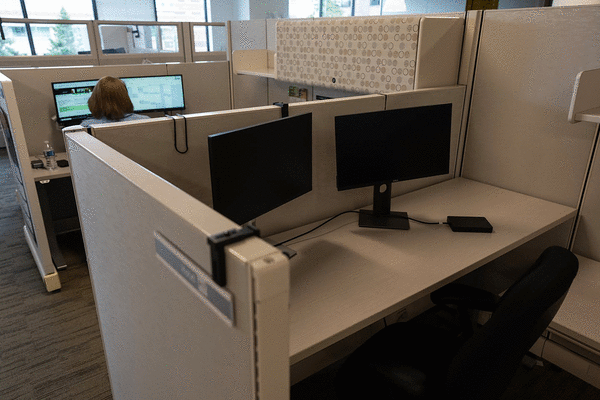
As work from home and work in the office continue to bleed into each other, legal questions are being raised over when, exactly, you’re working for your employer.
The Minnesota Supreme Court ruled unanimously Wednesday that a Dakota County employee who was injured while loading her car with work equipment after being told to return to the office during the COVID-19 pandemic is entitled to relief under the Workers’ Compensation Act.
It’s one of the first instances of the state’s highest court examining when an injury suffered as a result of the world’s new hybrid work reality is eligible for medical benefits.
Eric Schwab, an attorney focused on workers’ compensation law, represented Cindy Ludwig, the Dakota County employee. He said Minnesota’s workers’ compensation courts are seeing more claims around locationally elastic work situations.
Those cases raise a fundamental question, Schwab said, of “when are you working and when aren’t you?”
Ludwig began working from home in March 2020 after Dakota County issued a stay-at-home order during the COVID-19 pandemic. She loaded up everything she needed to do her job remotely — her office chair, laptop, keyboard, headset, computer monitors, cords, docking station and binders.
In 2021, Ludwig’s managers told her she would be returning to the office on Sept. 8 to begin a new hybrid schedule.
She testified that she left her home slightly earlier than usual, at 7:15 a.m., because she wanted to get her equipment set up in the office before the workday started, at company request. While loading a plastic bin with her equipment into her van’s back seat, she fell on her back.
She suffered injuries to a disc and joints in her spine and was prescribed pain medication.
Seven days later, she returned to work but needed a cane to get around.
A little over a month later, she fell at work and hit her head and knees and was prescribed a spinal cord stimulator. Six months after that, she fell at home and injured her ankle.
She filed a workers’ compensation claim seeking payment of medical expenses and wage loss. Her claim sought compensation for permanent and total disability under the special-errand exception. That exception says if an employee is injured while carrying out an errand for their employer, it is part of their employment from “time the employee leaves home until the time the employee returns” and makes them eligible to be compensated.
Ludwig’s claim was denied by a compensation judge who ruled that bringing her equipment back to the office was “part of her commute” and not a special errand.
She appealed to the state Workers’ Compensation Court of Appeals. It overruled the compensation judge and determined that Ludwig was returning her equipment at her employer’s request and the special-errand exception applied.
Dakota County appealed to the state Supreme Court.
Justice Sarah Hennesy wrote in her opinion that when the county ordered Ludwig back to the office, it requested that she return all her equipment “before working hours” so she could set up her workstation and begin work on time.
The fact that returning the office equipment was an integral part of Ludwig’s job but also a special request and “not one which was regular and recurring during the normal hours of employment” steered the court’s opinion.
Still, Hennesy noted that in a “world of hybrid work” the court recognized the transportation of equipment will not always rise to the level of being a special errand outside of a regular commute.
“But this case does not concern an employee’s regular day-to-day commute pursuant to an established hybrid work schedule,” Hennesy wrote. “Ludwig’s injury occurred while she was returning to her office with her equipment for the first time following a prolonged work-from-home order during the pandemic, to begin — for the first time — a new hybrid schedule."
Schwab said that while Ludwig remains in constant pain and needs a wheelchair or walker to get around, she was happy the court sided with her.
“She likes to think that hopefully she made it easier for someone else in kind of a similar situation to get benefits in the future,” Schwab said.
The state Supreme Court first ruled on special-errand exceptions in 1935, and Schwab said they are highly specialized to the individual compensation claim. He noted the Supreme Court recently had declined to hear a special-errand exception case — which had some similarities to Ludwig’s case — that was denied a claim.
In that case, a Hennepin County District Court employee was ordered to work from home on Dec. 23, 2021, because of safety concerns at the courthouse. That was the day former Brooklyn Center police officer Kimberly Potter was found guilty of manslaughter for killing Daunte Wright.
Upon returning to work four days later, the employee noticed the skyway entrance to the courthouse was still closed for security reasons. He walked through the plaza and, while carrying his laptop in a briefcase, slipped on ice, broke a rib and suffered a concussion.
He argued that he had been ordered to work from home and bring his equipment, making it a special-errand.
His claim was denied because the court found that bringing back his laptop was “incidental to his regular commute” and that he had backup equipment at the office that he could have used if he needed.
The question of whether the Supreme Court should more stridently clarify what work equipment falls under the special-errand exception was on Justice Anne McKeig’s mind.
She wrote in a concurring opinion that because the court did not differentiate between different kinds of work equipment — for instance the regular transportation of a work laptop versus equipment that needs to be permanently moved from home to office — it had expanded the definition of equipment “in a way that is untenable for today’s world of hybrid work” and “blurred beyond recognition” the line between what is a work commute and what is a special errand.
A message seeking comment was left with the attorney representing Dakota County.
©2026 The Minnesota Star Tribune. Visit at startribune.com. Distributed by Tribune Content Agency, LLC.









Comments