Boeing will boost Max production this summer, marking 2nd bump since the blowout
Published in Business News
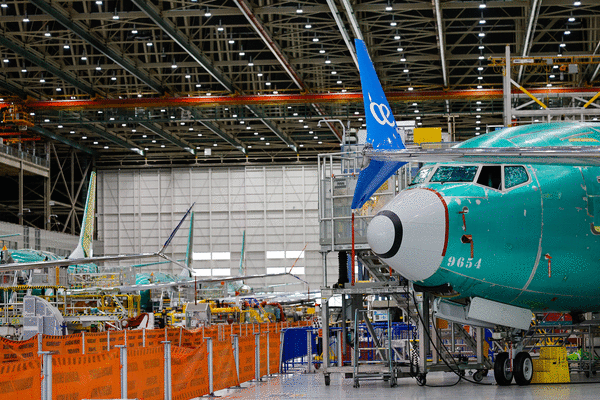
After years of dampened 737 Max product, Boeing is hoping to bring its troubled workhorse back to pre-crisis production levels.
Boeing plans to increase monthly production of its 737 Max this summer – marking its second increase since the midair panel blowout upended its manufacturing system more than two years ago and bringing the planemaker closer to its all-time high Max production rate.
CEO Kelly Ortberg said Wednesday that Boeing aims to increase Max production from 42 planes per month to 47 this summer, in line with its plan to bump production up in increments of five to ensure it is prepared for each raise.
The Federal Aviation Administration capped Boeing’s Max production at 38 planes per month, an unprecedented move, after a fuselage panel flew off an Alaska Airlines 737 Max shortly after takeoff in January 2024.
The narrowbody plane built in Renton is Boeing’s most popular commercial product, and among the most lucrative. Its production rate, which was disrupted following the panel blowout and after two fatal 737 Max crashes in 2018 and 2019, can deeply impact the company’s financial health.
It took Boeing more than a year and half to secure approval from the FAA for its first rate increase – moving from 38 planes per month to 42 in October. The planemaker expects to move faster this time around.
“Our production system is very stable,” Ortberg said Wednesday in an interview with CNBC, after Boeing announced its first quarter financial results. “All systems are a go for this next rate increase.”
Boeing’s increased production cadence has driven its financial recovery.
On Wednesday, Boeing said it lost $7 million in the first three months of the year, a significant turnaround from the same three months a year ago, when it reported a net loss of $31 million.
Revenue increased 14% year over year, from $19.5 billion to $22.2 billion. Boeing still spent more money than it brought in, reporting a cash burn of $1.5 billion in the first quarter this year, but shrunk the gap compared to the same quarter in 2025, when it reported a cash outflow of $2.3 billion.
Bolstered by its plan to continue increasing commercial airplane production, Boeing executives said Wednesday the company expected to turn cash flow positive in the second half of the year and report positive free cash flow of $1 billion to $3 billion for the full year.
In another bright spot for the first quarter, Boeing did not report any large unexpected shortfalls from delayed commercial or defense programs.
Boeing’s commercial airplanes unit, defense division and aftermarket support business all reported increased revenue for the first quarter, compared to same time period in 2025.
Still, Boeing has one major area of focus for the next year: working through the FAA’s certification process for its long-delayed commercial programs, the 737 Max 7 and Max 10, and the 777X family. Ortberg said Wednesday the company is on track for all three models to enter service in 2027.
With “recent program wins and operational improvements in all of our segments, we’re well on our way to fully putting the recovery behind us,” Ortberg told analysts Wednesday.
Bumping Max production
To get ready for the planned rate increase, Boeing has been pulsing its system, Ortberg said. In other words, the company is testing whether its production lines are able to move at a faster clip without introducing any errors or quality concerns.
The company is following the same process it did last year when it moved from rate 38 planes a month to 42, Ortberg said, including monitoring a pre-defined set of metrics to ensure its adhering to quality and safety standards.
The FAA had to grant Boeing permission to make the increase last time, but it’s not clear if Boeing needs the same formal approval this time.
“Safety drives everything we do,” the regulator said in a statement Wednesday. “FAA safety inspectors conduct extensive planning and reviews to ensure Boeing can safely produce at an increased rate. Our heightened level of oversight will continue.”
After the planned rate increase this summer, Boeing will work toward building 52 Max planes per month, a cadence it maintained before two fatal 737 Max crashes grounded the plane and slowed production. Before the crashes , Boeing had planned to increase to a rate of 57 Max planes per month.
This time, as Boeing considers a move to rate 52 – and beyond – it will no longer be able to rely on a significant surplus of aircraft parts that it has tapped into to support rate increases in the last few years.
In that respect, the bump from 42 to 47 won’t be that different, Ortberg said, but the increase to 52 and higher will be significant. That’s when it will have to work with the other companies supplying aircraft parts for the Max to ensure all parts of the supply chain are ready to move up.
“We have areas that we continue to work, (it) will be a focus when we move to that next rate,” Ortberg said. But, in the meantime, “let’s get from 42 to 47 here in front of us (and) just continue to work the constraints where we see them.”
In order to reach rates above 47 per month, Boeing is activating a fourth Max production line in Everett. It plans to have that line running this summer but will start with a “low rate of initial production” to ensure it meets all FAA standards, Boeing’s Chief Financial Officer Jay Malave said Wednesday.
Boeing also reiterated Wednesday that it had corrected a Max production issue identified in March, when it found small scratches on some wiring. Boeing has repaired all 25 affected planes and delivered most of those aircraft to customers, Ortberg said.
The long-delayed 777X
In January, Ortberg told analysts that Boeing’s largest “hangover” heading into the new year was certification of its long-delayed new programs: the 737 Max 7 and 10, and the 777X family.
Marking another possible setback, he said then Boeing had identified a potential engine durability issue on the 777-9, the company’s newest widebody passenger plane and the first of the 777X family slated to enter service.
This week, Boeing and engine-maker GE Aerospace said they are close to identifying a fix.
“The crack that we uncovered during a shop visit, which is part of a flight test engine, is something we’ve seen before,” GE CEO Lawrence Culp said Tuesday during the company’s own first quarter earnings call. “We think we are at root cause and we’re finalizing the modification as we speak.”
Boeing remains on track for first 777-9 delivery in 2027 and has continued to progress through flight testing, Ortberg said.
The FAA recently granted Boeing permission to move to the next phase of the certification process, which involves “natural ice testing.” That’s good timing, he continued, as it can still find ice in Alaska, “so we don’t have to search for weather.”
Boeing expects to build five 777-9 planes per month, Ortberg said.
It already has about 30 planes built and is preparing for a process called “change incorporation,” where the company reworks its existing planes to incorporate all the changes it has made through certification.
In the 777-9’s case, that will involve some extensive work, particularly for the older planes, and will take several years, Ortberg said. “It is a pretty massive activity that we have underway.”
Impact of the Iran war
While airlines navigate skyrocketing jet fuel prices amid the Iran war, Boeing hasn’t experienced the same negative impacts as its aviation counterparts.
None of the manufacturer’s airline customers in the Middle East have asked to defer deliveries amid the conflict, Ortberg said Wednesday. Other airlines have told the company they’d be willing to accept an earlier delivery if Boeing needs to reshuffle its order book because of the war.
About 14% of the manufacturer’s backlog of orders are slated for customers in the Middle East, he continued. Two-thirds of that backlog is slated for deliveries in 2030 and beyond. Boeing has delivered four aircraft to customers in the region since the war began.
As a defense manufacturer, Boeing also stands to benefit from the conflict, as the U.S. churns through its stockpiles of weapons. Boeing was one of several companies urged by President Donald Trump to increase weapons production shortly after the war began.
That demand increase could offset any impact to Boeing’s commercial deliveries, Ortberg said.
“While we are seeing some regional instability as a function of the Iran war, we remain confident in the long-term future of our industry,” he said. “Aviation has seen moments like this before, whether it’s by recessions, a pandemic or conflict, the resilience of our industry has always led to a recovery and a return to growth.”
©2026 The Seattle Times. Visit seattletimes.com. Distributed by Tribune Content Agency, LLC.








Comments