Target revamps grocery strategy as more customers opt for budget or premium chains
Published in Business News
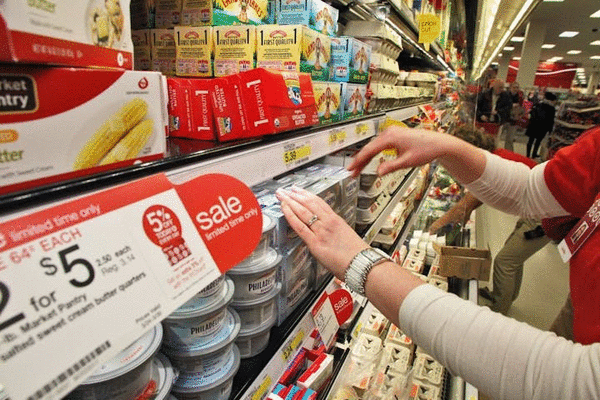
More grocery shoppers are picking a side: trading down to bargain chains or trading up to higher-end grocers, leaving middle-market retailers like Target with less room to compete.
In the Twin Cities and across the country, the industry’s growth continues to concentrate at opposite ends of the market.
“You look at the overall grocery landscape — by and large, it has remained bifurcated,” said Amanda Lai, director of food industry practice at McMillanDoolittle. “The grocers in the middle are probably feeling more of the squeeze.”
That middle also includes traditional supermarket chains like Cub and Hy-Vee. The Twin Cities’ top three grocers — Walmart, Target and Cub — all lost market share last year.
The gains flowed to discount chains such as Aldi and Trader Joe’s, as well as premium grocers such as Whole Foods.
Minneapolis-based Target has spent years trying to define its role in grocery and remains a secondary stop for many shoppers, Lai said, especially at stores outside Minnesota where the food and beverage departments tend to be smaller.
Groceries account for just over 20% of its sales, compared with more than half at Walmart, and purchases are often incremental rather than part of a weekly stock-up.
At its investor day last month, Target acknowledged it needs to sharpen its grocery strategy as part of a broader effort to pull out of a sales slump that has lingered since the pandemic.
“Shopping for food at Target should feel distinctly Target. Delightful, joyful, unlike what you’ll find anywhere else,” said Cara Sylvester, Target’s chief merchant, at the retailer’s financial community meeting in March.
The competitive Twin Cities grocery market helps illustrate Target’s challenge and shows where, at least in Minnesota, the retailer lost ground.
In 2022, as pandemic disruptions eased and inflation picked up, Target fell from first to fifth in the metro grocery rankings, according to Chain Store Guide.
That was the same year Walmart became the region’s top grocery seller — a position it still holds, according to the 2025 report. Company executives have attributed some of its growth to gains among higher-income shoppers.
Target has since climbed back to No. 2, with Cub holding a solid third-place spot.
“As Minnesota’s hometown grocer, Cub is focused on strengthening the shopping experience across its existing Twin Cities locations by delivering greater value and everyday reliability for the communities we serve,” a spokeswoman said.
Walmart, when combined with its subsidiary Sam’s Club, accounts for almost a quarter of grocery sales in the metro. Sam’s Club memberships in the U.S. grew by 6% last year, and same-store sales increased 5.1%, excluding fuel.
“We continue to invest in quality and value, helping customers save time and money,” a Walmart spokeswoman said.
While Walmart leans further into full-service grocery, Aldi and Trader Joe’s continue to expand.
Deloitte research shows roughly half of global consumers now identify as value-seekers, including a third of higher-income households. And as much as 40% of perceived value comes from factors beyond price, including quality, trust and the shopping experience.
“Value-seeking exists across all age groups and income levels,” said Matt Marsh, managing partner at Deloitte’s Minneapolis office. “Value doesn’t mean cheap — it means delivering more than consumers expect.”
Part of Target’s push over the past decade has centered on its owned brands, a higher-margin strategy that doesn’t differentiate the company as much as it previously did because its competitors have strengthened their private-label grocery offerings.
Meanwhile, Trader Joe’s and Aldi have built their businesses around tighter assortments, “reducing the sense of ‘everything to everyone’ and leading with what makes them unique,” Lai said.
A Trader Joe’s spokeswoman said the company is eyeing additional stores in Minnesota but does not have any confirmed locations for the next year.
“MVP brands, or those that deliver ‘more value for the price,’ from low to premium, are seeing higher purchase intent and winning household share,” Marsh said.
In Target’s preview of its revamped grocery strategy in March, executives showed off displays featuring items labeled grain-free, gluten-free and high-protein.
The company is earmarking a significant chunk of its $5 billion investment this year for grocery, expanding the section’s footprint in 130 remodeled stores and leaning into what executives describe as its strength in “style and design.”
Target officials, while acknowledging the need to refine the strategy, also note that food and beverage sales have grown from $15 billion in 2019 to $25 billion in 2025, driven in part by expanded health and wellness offerings.
“It gets back to Target’s original roots of being cheap chic,” Lai said. “Aspirational, but for the masses, now applied to what’s trendy and important.”
Sylvester, of Target, said, “We are not trying to be an everything grocer or just another grocer down the street.”
Target’s challenge, Lai said, is that it’s “not the cheapest,” but also not “the most differentiated or highest quality,” making it harder to compete with value-driven chains and upscale grocers.
“Target is writing a new chapter focused on growth, with food and beverage as a foundation of this work,” a spokeswoman said.
Economists and analysts have debated just how pronounced the K-shaped divide, a term describing the growing wealth gap, has become. Some have described a more nuanced “E-shaped” economy, with three income groups spending steadily rather than two diverging paths.
A review by the Federal Reserve Bank of Minneapolis points to mixed evidence. Some data shows a sharp split, while other measures suggest a subtle divide.
Allison Luedtke, an associate professor of economics at St. Olaf College, said some of the narrative is anecdotal.
“People say that they see people wealthier than them spending more, and they see people less wealthy than them spending less,” she said. “It doesn’t appear to necessarily be true everywhere in the economy, but it does seem to be true in groceries.”
A true K-shaped economy would mean higher-income households continue increasing spending while middle- and lower-income consumers see more pressure on budgets and devote a larger share of income to essentials such as food.
Groceries are “still pretty expensive, both from a tariff cause and from inflation,” Luedtke said. “After inflation cooled, prices didn’t really come back down. They stayed pretty high.”
©2026 The Minnesota Star Tribune. Visit at startribune.com. Distributed by Tribune Content Agency, LLC.







Comments