Fight over private home listings heats up in WA as real estate giants clash
Published in Business News
Imagine you're shopping for a home. You've been scouring Zillow and Redfin for months with no luck. But, unbeknown to you, your dream home is actually for sale — you’ll just never see it, let alone get a chance to compete for it.
That scenario is a nightmare for homebuyers, and for the group in charge of Washington's real estate listing database.
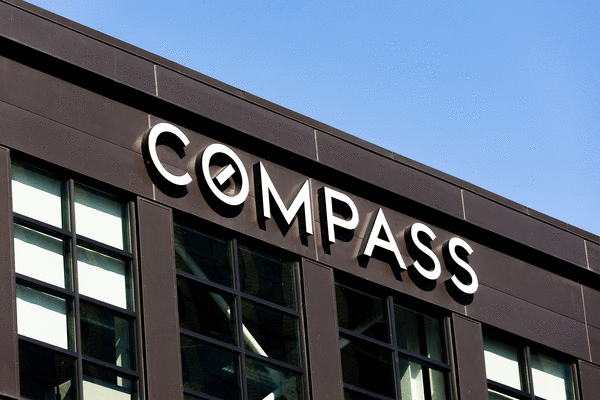
For the past year, a group that collects home-sales listings in much of Washington and part of Oregon, called the Northwest Multiple Listing Service, has defended its ban on private listings in federal court against the real estate brokerage Compass. In a lawsuit filed last April by Compass, the New York-based company claims NWMLS’s ban — which virtually all other multiple listing services in the county lack — is anti-competitive.
But NWMLS has fired back, alleging in court filings last week that Compass’ marketing practices are a deceptive scheme to create a closed-door real estate system that violates Washington’s Consumer Protection Act.
The case is “a battle for the future of the American real estate market,” NWMLS said in a news release Friday.
The filings are the latest development in a raging debate over private listings that has played out like a corporate cold war among real estate giants. It’s seen a slew of lawsuits, a new Washington law, constant maneuvering and a scramble for control.
Why should the average person care about this industry infighting? The outcome of the clash will determine where a seller's freedom to advertise their properties as they wish ends and a buyer's right to access all homes available for sale and receive transparent information begins.
Choice versus transparency
NWMLS’s influence on the real estate market is substantial.
It’s the default marketplace for Washington home listings. But if inventory outside of its database grows through off-market listings, NWMLS will become less essential to agents and their clients. As a result, its relevance relies on preserving the traditional home-selling process.
Typically, a home sale goes like this: A seller hires a real estate agent who helps prepare the house for sale through immaculate staging and professional photos. When the house is ready, the agent adds the listing to the multiple listing service. That allows other agents to see the house is for sale and home-shopping websites, such as Zillow and Redfin, to display the listing.
But Compass offers sellers a different path: a calculated three-phase marketing program to maximize profit.
Sellers first test pricing privately with an off-market listing only accessible only to Compass agents and their clients. Then, they build anticipation by labeling it as “Coming Soon” on Compass’ website. Finally, they launch the listing widely on the multiple listing service.
Compass claims this method boosted final sale amounts in 2024 by an average of 2.9%, compared with Compass listings that went directly to the multiple listing service.
Washington’s multiple listing service, NWMLS, calls the program a deceptive scheme designed to manipulate and hide critical data from the public. The practice artificially resets a listing’s days-on-market and price history to deceive buyers about its true demand, NWMLS claims.
NWMLS alleges Compass incentivized its brokers to violate their professional agreements, prioritizing corporate growth over transparency and consumer interests.
Compass’ marketing practices are also contrary to a Washington law that goes into effect in June, NWMLS claimed. Senate Bill 6091, which the governor recently signed, bans real estate brokers from marketing residential real estate to exclusive groups.
The bill’s primary sponsor, Sen. Marko Liias, D-Edmonds, told The Seattle Times last month that he wanted to enshrine the ban in law, considering NWMLS’s ongoing legal challenges with Compass.
NWMLS has asked the court to uphold its ban and award yet unknown damages.
Justin Haag, CEO of NWMLS, said the case is about putting people over corporations.
“We are standing up for the principle that every family has the right to see every home for sale, because housing data belongs in the sunlight, not in a private vault,” he said in a statement. “It is time to make the housing market more equitable for everyone instead of simply making real estate CEOs richer.”
In a statement on Friday, Compass turned those claims against NWMLS.
NWMLS “wants to maintain tight control over the Seattle-area real estate market and protect its power and money,” Compass spokesperson Devin Daly Huerta said.
Consumers want more choice and are pushing back on industry-imposed mandates, he said, adding that Compass is confident it will prevail in court.
“Instead of focusing on solutions that benefit consumers and promote competition, NWMLS is retaliating against us for exposing its illegal scheme to deprive homeowners of their rights and block competition,” he said. “This is how monopolists like NWMLS treat their customers.”
Money at stake
One thing is clear: Real estate giants stand to gain or lose money and power in the legal battle.
Although they’re technically not-for-profit, multiple listing services such as NWMLS make money through subscription fees. Private listings threaten their role as listings gatekeepers.
On the other hand, bans like NWMLS’s jeopardize Compass’ competitive edge over high-end private listings.
Home-listing websites, which rely on access to public listings for traffic and revenue, have skin in the game too.
Seattle-based Zillow and Redfin once both loudly condemned advertising listings before they were added to the multiple listing service. But over the last month, both have flip-flopped.
Redfin announced a three-year syndication agreement with Compass to showcase its “coming soon” listings — and eventually Compass’ private listings — on its website.
Weeks later, Zillow followed with its own version of “Coming Soon” listings called “Zillow Preview,” which don’t need to display how long a listing has been up or any price changes. After Zillow changed its policy to allow premarket listings, Compass dropped its lawsuit challenging the platform’s former ban on non-MLS properties.
Zillow said its standards still block Compass’ private listings.
The new Washington law does not ban “Coming Soon” or “Zillow Preview” listings, but NWMLS requires homes for sale to be added to its database before any advertising. The organization considers such listings similar to private listings because they are technically active listings, but they are not submitted to the service.
“ 'Coming soon’, ‘Preview’ or ‘Private’ listings are marketing ploys that do not benefit sellers or buyers; they only serve to benefit the listing firm,” Haag, the NWMLS CEO, said in a statement last month.
Unless Compass and NWMLS can come to an agreement, the battle over private listings could drag on in federal court for years.
©2026 The Seattle Times. Visit seattletimes.com. Distributed by Tribune Content Agency, LLC.










Comments