Why Honda put the brakes on its all-EV future
Published in Business News
Honda Motor Co. is having second thoughts about its Second Founding.
Along with General Motors Co. and Volkswagen AG, the Japanese automaker has been the most committed major legacy automaker to an all-electric vehicle future. Internally called the “Second Founding,” Honda’s electric vehicle transition was rooted in the company’s moral conviction to head off an existential global warming threat to humanity driven by transportation fossil fuels.
For a 75-year-old Japanese company that made its reputation as maker of some of the highest-performing internal combustion engines in the world from motorbikes to watercraft to Formula One engines, Second Founding required an engineering shift. Honda committed to ending ICE production by 2040 — including an $5 billion investment in its Ohio EV Hub, the company’s international crown jewel for EV production.
But as consumer demand for EVs flat-lined in Honda’s largest market, the United States — and as sales cooled in its second largest market, China — the Second Founding became an existential threat to Honda itself.
In a stunning about-face, Honda has canceled production of its so-called 0 Series EVs for North America — the SUV, Saloon, and Acura RSX (a smaller, Indian-made 0 Alpha Series SUV remains in development for the India and Japan markets). Production of joint EV projects (the GM-made Honda Prologue and EV Hub-made Sony AFEELA) are in doubt, with the GM joint-venture Acura ZDX also canceled. Honda is taking a $15 billion loss and is returning to its ICE foundation: producing gas and gas-electric hybrid vehicles on its flexible Marysville line.
Ripples from Toyota to Ohio
Honda’s pivot comes on the heels of a combined $50 billion in charges incurred by GM, Ford Motor Co., and Stellantis NV as they have dialed back similar, ambitious EV plans of their own. Meanwhile, two of Honda’s chief Japanese competitors, Toyota and Subaru, have taken a more measured approach to electrification despite the threat of massive government fines. Toyota has developed fuel-efficient, gas-electric hybrid powertrains for much of its lineup while partnering with automakers like Subaru on small-volume EVs to gauge customer demand.
“We have to stop the bleeding,” Honda's chief executive officer, Toshihiro Mibe, told media on its March 12 earnings call in Tokyo, announcing that he would forfeit 30% of his compensation for three months and give up performance-linked pay. “Then we have to think about how to rebuild our business competitiveness and produce results. We are seeing global warming, (and) as a company, we have to deal with this ... we will not give up. (But) the market is slowing down. We were saying 100% EV, but this target, realistically, it will be difficult to achieve.”
While Mibe reiterated Honda’s social commitment, he also emphasized the role government EV mandates played in forcing automakers to make EVs — in particular California (Honda’s largest market within the United States).
“Honda shifted strategic direction towards EV popularization (as) we anticipated increasingly stringent environmental regulations would come into full effect in various countries in the latter half of the 2020s. For example, under (California) ACC II automotive environmental regulation, penalties up to $20,000 per vehicle would be imposed on noncompliant vehicles,” said Mibe. “This is not just Honda, but all companies doing business in U.S. were thought of this as a bottleneck. The investment was very large.”
California was poised to mandate 35% EV sales for the current 2026 model year with penalties of $20K for each car under that threshold. Automakers like Honda would have been on the hook for billions in penalties until Congress this year rescinded the state’s ability to set emissions rules independent of federal regulations.
“These three Honda EVs that have been canceled point to a business model that doesn't make sense and was only going to be executed to satisfy regulatory requirements,” said Karl Brauer, California-based Senior Auto Analyst for iSeeCars.com. “Without those punishments coming from the government, it just doesn't make sense to produce those vehicles.”
Honda’s EV transition was meant to comply with the United Nations’ net-zero goal for a “complete transformation of how we produce, consume, and move about.”
Honda’s U-turn sent ripple effects across the globe, including in the Midwest, where two of Honda’s five U.S. assembly plants — Maryville and East Liberty, Ohio — are located.
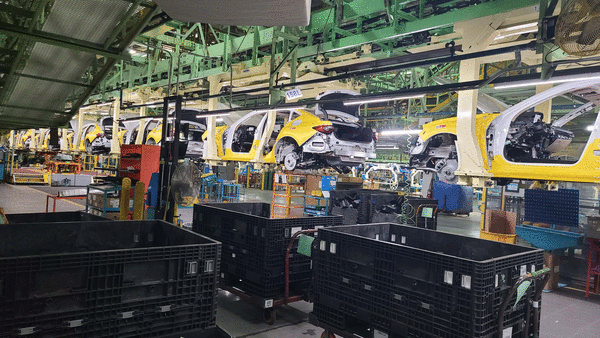
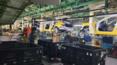
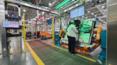
The Marysville line, Honda’s longest-running manufacturing facility producing ICE cars for 40 years, was the epicenter of the EV Hub: a state-of-the-art, flexible line capable of spitting out EVs, ICEs and battery-electric hybrids depending on market demand.
“I’ve worked on manufacturing projects throughout my career,” Associate Chief Engineer and 23-year Honda veteran Tim Leopold told The Detroit News last year. “This is the most challenging. For the Second Founding of Honda ... we had to reimagine (and) retool our lines in order to lead us into the future. Marysville being the first to launch an EV product, we were charged ... with taking on new manufacturing technologies.”
EV Hub
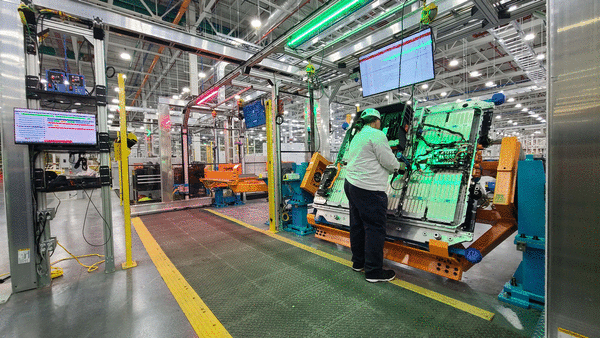
Honda’s manufacturing north star for its all-electric-by-2040 goal, the EV Hub was designed to bring together battery components from Midwest satellite operations to assemble Honda’s first, in-house-built electric vehicles: the Acura RSX this fall, followed by 0 Series SUV and Saloon EVs.
The plant’s flexibility appears prescient in the face of the 0 Series’ model cancellation.
"Honda established a highly flexible manufacturing environment in Ohio capable of building the right products to meet customer demand. That flexibility remains central to our strategy,” said Honda/Acura Midwest Public Relations spokeswoman Lynn Seely. “We will continue producing gasoline and hybrid vehicles at both the Marysville Auto Plant and the East Liberty Auto Plant."
Said Mibe in his news conference: “This decision was by no means an easy one. Nevertheless, we made this decision believing that introducing these three models without an outlook for business viability may result in early production discontinuation.”
Prologue to the Second Founding
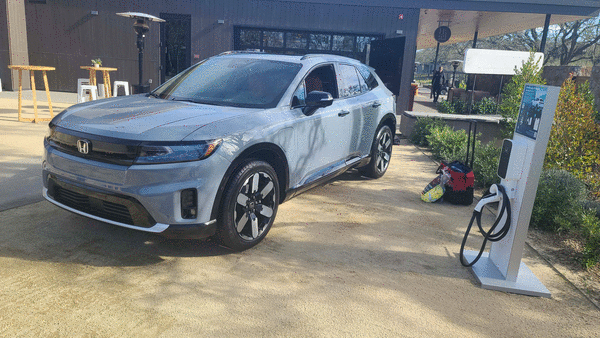
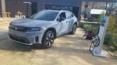
Honda’s Second Founding predated the EV Hub with the introduction of the Honda Prologue in 2024 — named as the gateway to Honda’s all-EV future. The Mexico-assembled Prologue and its sister Acura ZDX (Tennessee assembly) were built on GM’s Ultium battery platform under a corporate partnership.
“Internally at Honda, we talk about the Second Founding of Honda as a reset — a switching of our mind about embracing electric vehicles and making sure every associate has an opportunity to contribute to a fundamental change in Honda from an engine company to an electrified company,” said John Hwang, product development leader for the Prologue EV, in an interview with The News in 2024.
The Prologue was followed by a full-court press to preview its O Series models, Honda’s first in-house EVs. It was led by Mibe, appointed CEO in 2021 to lead the Second Founding.
O Series revolution
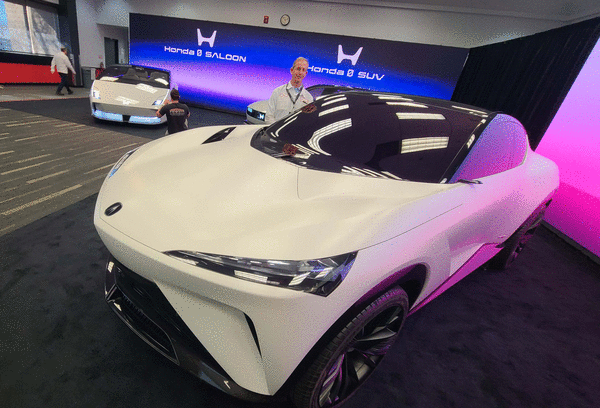
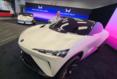
Introduced at the Consumer Electronics Show in 2024, the O-Series models (0 for zero emissions) — Saloon and SUV — were radically different from ICE best-sellers like the Civic and CR-V to signal Honda’s radical new direction. The 0 models shared design elements like illuminated, cube-like front-and-rear fascias and cutting-edge steer-by-wire yoke steering wheels.
“The mobility we dream of is not an extension of the trend of ‘thick, heavy, but smart’ EVs,” said Mibe on the Las Vegas convention stage, taking a jab at porky EVs from other automakers. “We will create a completely new value from zero based on ‘thin, light and wise’ as the foundation for our new Honda 0 EV series to further advance the joy and freedom of mobility to the next level.”
Honda was back at CES 2025 with 0 Series models closer to production trim. Interiors were revealed with software-intensive big screens that promised Level 3, hands-free self-driving capability — leapfrogging the industry’s Level 2 driver assistance leaders, Tesla and GM.
Next up: last fall’s Tokyo Mobility Show. Despite softening EV demand from Japan to the United States, Honda was a headliner with Mibe introducing the company’s Ohio-made Acura and Honda electric lineup.
But in an interview with media in Tokyo, Mibe betrayed the first cracks in Honda’s strategy even as he reiterated the urgency of global warming catastrophe.
“Electrification now is a little bit different from what we were expecting before,” Mibe told media at Honda’s Tokyo headquarters. “Maybe (we’ll see) a five-year delay as compared to our first expectations. And probably that means from 2040 the electrification (will) have to go faster, but as long as humankind has not abandoned efforts for global warming, we have to keep up with our responsibility on the business side.”
The Prologue was also proving a tough sell in the U.S. market. Though 39,194 unit sales for 2025 were up over 2024, it lagged Honda’s comparable Pilot/Passport gas sales of 179,440 — making up just 3% of Honda U.S. sales volume. Worse, Prologue sales had fallen off a cliff in the fall after Congress eliminated the $7,500 EV sales subsidy.
“We anticipated 30% (EV sales) in 2030,” said Mibe. “What changed (was) greenhouse regulation was removed. And also because ... in America, the consumer sentiment was really down.”
EV U-turn
Analyst Brauer was dumbfounded that Honda would commit to an all-electric future, given the diversity of markets it plays in. China and the United States combined account for about 50% of Honda's global sales, yet are as different as salt and pepper: China’s nationalistic, centralized economy benefits from 80% of the world’s battery materials, while the consumer-driven U.S. economy benefits from the world’s largest fossil fuel reserves.
“I think they were looking at Tesla, thinking they are going to experience the success of Tesla,” said Brauer of the Texas-based EV-maker. “But all our data shows Tesla is its own creature ... and if you think you can do what they're doing, you're wrong.”
Continued the iSeeCars analyst: “There appears to have been a purposeful, willful rejection of where the customer was versus where the automaker was. U.S. EV sales and market share growth stalled in the fall of 2024.”
At Honda’s earnings call to media, Executive Vice President Noriya Kaihara said Marysville would concentrate on new gas-hybrid models for “the second half of the 2020s” — including larger SUVs — while also bringing in advanced, hands-free driver assistance software developed with its 0 Series cars.
Honda’s U-turn follows GM, which announced in 2020 that it was going all-electric by 2035. CEO Mary Barra modified that ambition in January 2024, telling investors the company would continue to invest in gas-powered vehicles to meet consumer demand.
Despite Honda’s stumble, CEO Mibe reiterated the automaker’s focus on producing EVs to achieve the UN’s Net Zero goals.
“As of today, EV demand is declining in North America and other regions. However, this trend will not be permanent,” he said. “To achieve carbon neutrality when EV demand resumes, Honda will be ready to fulfill customer expectations and offer compelling products unique to Honda. We must lay the groundwork for EV business.”
©2026 www.detroitnews.com. Visit at detroitnews.com. Distributed by Tribune Content Agency, LLC.








Comments