For Gopuff, Super Monday is the national holiday
Published in Business News
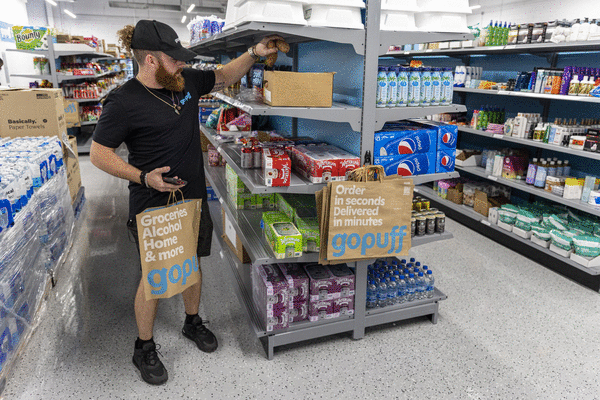
Sunday’s Super Bowl LX, featuring some 66 ads costing corporate brands an average $8 million for half a minute, shone a light on America’s snacking trends, tracked closely by Gopuff, the Philadelphia-based national delivery service.
The game between the Seattle Seahawks and the New England Patriots, also featuring Bad Bunny’s Spanish-language halftime spectacular, was watched by nearly 40% of Americans. Their delivery orders gave marketers a broad, almost instant view of what Americans were ordering, and how their ads were working — or not, said Michael Peroutka, GoPuff’s head of ads, in his Super Bowl postmortem report Monday.
The product with the most spectacular Super Bowl increase didn’t advertise.
Orders for limes during the game jumped over 600% over previous Sundays in 2026. Limes are, after all, a key ingredient in popular plates like guacamole and pico de gallo, served with Mexican beers and margaritas, and “easily forgotten at the store,” making them a natural for last-minute delivery, said Gopuff spokeswoman Brigid Gorham.
Though lime consumption has been growing rapidly, the increase was more than four times last year’s Game Day spike, and no one could say exactly why.
Lime sales exploded even more than Gopuff’s Basically-brand red party cups, a 3-year-old in-house brand, which was up 381% on Super Bowl Sunday above recent Sunday sales.
Overall, alcohol sales nearly doubled from recent Sundays. Soda sales were up more than one-third and salty snacks by about one-quarter. Compared to last year, when the Eagles were in the Super Bowl, the number of Philadelphia orders were up 7%.
Other Super Bowl Sunday growth-leaders included PepsiCo’s Tostitos Hint of Lime chips, which were up 398%.
But the top gains were two candies made by Italy-based candy maker Ferrero. Gopuff orders for Kinder Bueno, chocolates marketed heavily in Latin America and U.S. Hispanic neighborhoods, were up 444% vs. recent Sundays, and Ferrero’s Nerd Gummy Clusters, were up 418%.
Kinder Bueno and Nerd Gummy Clusters saw sales roughly double in the hour after their Super Bowl ads ran. Liquid Death and Dunkin also saw orders rise at least 50% after ads.
Day off?
Gopuff also noticed well before the game that a record 13 million American workers planned to schedule Monday off; 10 million planned to call out sick, go in late, or not show up, and millions more were thinking about it, according to a Harris Poll survey funded by work software maker UKG.
Cofounder Yair Gola and his colleagues saw those numbers and thought, “This ought to be a holiday.” Last fall, it set up a 501(c)4 lobbying group, the Super Monday Off Coalition, pledging at least $250,000 to get the effort rolling.
They hired retired Patriots quarterback Tom Brady and comic Druski to promote the cause.
The company’s contribution to the lobbying would be funded by 1% of Gopuff’s profits from sales of certain boxes of beer, sugary drinks, hot dogs, and other products from Thanksgiving to game day. Heavy users who placed at least four $30 orders in that period would also get $20 “Gocash” discounts and receive a chance at a Birkin handbag, a Rolex watch, and other prizes.
By Monday, Gopuff hadn’t announced its planned donation, but the campaign was declared “a winner” by Charles R. Taylor, a Villanova University marketing professor who tracks Super Bowl ads. He spotlights not just successful marketing but also ineffective efforts like Nationwide’s painful 2015 “Boy” campaign and GM’s 2021 “No Way Norway” misfire.
Partnering with high-profile Brady and Druski gives “instant visibility and credibility” with fans and wider audiences, Taylor said. Even if the campaign costs more than Gopuff actually donates to the cause, a national holiday is “a clever hook” watchers will remember, Taylor said.
Going public?
Gopuff raised over $5 billion from Saudi, Japanese and U.S. private investors during the digital-delivery investment boom that lasted into the COVID years. These big investors hoped Gopuff (officially Gobrands) founders and early investors would win them big profits by selling shares in a high-priced stock market initial public offering (IPO) or selling to DoorDash, Uber or other delivery giants.
But app use and delivery growth slowed in the COVID recovery. Gopuff’s perceived valuation tumbled as its publicly traded rivals’ share prices fell. The company, which had expanded to hundreds of city neighborhoods and college towns, shut marginal centers and laid off staff at its Spring Garden Street headquarters to reduce losses and save investors’ capital for better times.
Now Gopuff is showcasing efforts to win new investor attention.
In the past year the company announced an on-screen snacks-order app targeting Disney+, ESPN and Hulu views, a cash-with-your-order partnership with online-broker Robinhood, hot warehouse-brewed Starbucks coffees from stores in Philadelphia and some other areas, and a partnership with Amazon to speed grocery delivery in Britain, where Gopuff remained after ending its European programs.
Gopuff has added a warehouse camera feed and local product-sales stats for fans who want to know what neighbors are buying, app-based order updates, and user product recommendations. It added over-the-counter pharmacy items and new lines of vegan organic GOAT Gummies (which Brady is also promoting).
The company also began accepting SNAP EBT electronic food-stamp accounts and donated $5 million for SNAP when the federal shutdown threatened low-income families dependent on the program.
New hires include economist Matt McBrady, a veteran private-equity investor, former adviser to President Bill Clinton and sometimes Wharton instructor, as Gopuff’s new chief financial officer, noting his experience taking companies through public stock offerings.
Last fall Gopuff raised $250 million, its first investment since a 2021 convertible-bond financing that had valued the company at a stock-market-bubble-inflated $40 billion.
This time, the largest investors included previous Gopuff backers Eldridge Industries and Valor Equity Partners, along with Robinhood, Israeli billionaire Yakir Gabay, the cofounders, and other earlier investors. Eldridge chairman in a statement called Gopuff “resilient.”
Valor partner Jon Shulkin cited the company’s “focus, innovation and substantial gains in profitability.”
This latest capital-raise implied a valuation of $8.5 billion — a fraction of Gopuff was worth on paper during the digital-delivery bubble, but enough for the venture capitalists to hope they may yet get their money back with at least a modest profit.
©2026 The Philadelphia Inquirer, LLC. Visit at inquirer.com. Distributed by Tribune Content Agency, LLC.





Comments