Trump says US to decertify, levy tariff on planes from Canada
Published in Business News
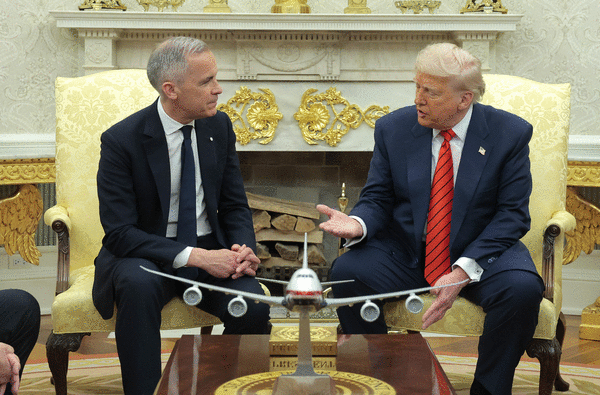
President Donald Trump said he would charge a 50% tariff on aircraft from Canada sold in the U.S. and decertify all planes made in that country until Ottawa agreed to approve certain jets made by Gulfstream, a unit of General Dynamics Corp.
Trump said Canada had “wrongfully, illegally, and steadfastly refused to certify the Gulfstream 500, 600, 700, and 800 Jets,” in a social media post Thursday. In response, he said the U.S. would decertify “Bombardier Global Expresses, and all Aircraft made in Canada, until such time as Gulfstream, a Great American Company, is fully certified.”
Trump claimed that Canada was “effectively prohibiting the sale of Gulfstream products in Canada through this very same certification process.”
“If, for any reason, this situation is not immediately corrected, I am going to charge Canada a 50% Tariff on any and all Aircraft sold into the United States of America,” he added.
It’s unclear how much of a threat Trump’s declaration poses to the Canadian-made aircraft already in service with airlines in the U.S. However, Bombardier’s CRJ line of regional jets are widely used by U.S. carriers, with American Airlines Group Inc. counting about 200 CRJ aircraft in its regional fleet last year, according to American’s website. Delta Air Lines Inc.’s regional partners had more than 150 CRJs in operation aircraft as of the end of 2024, according to a securities filing.
“I don’t know what this is or where it’s coming from, but it’s beyond a bad idea for the president to get in the way of safety and certification,” said Richard Aboulafia, an aviation analyst and managing director at AeroDynamic Advisory. “And does he have any authority to do this?”
Bombardier Inc. and Canadian government officials didn’t immediately respond to requests for comment. A spokesperson for the Federal Aviation Administration referred a request for comment to the White House. The agency is responsible for certifying aircraft in the U.S.
Gulfstream announced in April last year that it had received certification from the FAA and the European Union’s aviation regulator for the G800.
Trump’s move is the latest escalation of trade tensions with a major U.S. trading partner, including a recent threat to hit Canadian goods with a 100% tariff if the country made a trade deal with China.
Trump has bristled at comments from Canadian Prime Minister Mark Carney at the World Economic Forum in Davos that offered an implicit denunciation of Trump’s approach to economic and foreign policy. The White House has also expressed annoyance at a recent agreement between Ottawa and Beijing that essentially swapped canola sales to China for a quota of electric vehicle sales to Canada.
The two leaders spoke earlier this week, with Carney standing by his comments at Davos and seeking to explain Canada’s push to diversify its trade with other nations.
The back-and-forth comes as the countries prepare to renegotiate their continental trade pact, known as USMCA, which Trump agreed to in his first term. The U.S. and Canada are not applying tariffs to most goods traded under that agreement, with some exceptions, including the auto sector.
That means a large proportion of Canadian exports are entering the U.S. duty-free, though significant tariffs remain on key sectors like steel and aluminum.
Earlier Thursday, Trump threatened to tariff countries that provided or sold oil to Cuba, in a move that could subject Mexico to higher levies.
Bombardier’s Exposure
More than half of Bombardier’s global fleet of over 5,200 aircraft is operated in the U.S. In 2024, 64% of Bombardier’s sales came from the U.S., compared with 3% from Canada.
The planemaker, headquartered near Montreal, has a complicated supply chain that includes manufacturing across North America.
“We have more than 2,800 U.S.-based suppliers across 47 states and are creating tens of thousands of jobs in the U.S.,” Bombardier Chief Executive Officer Eric Martel said last year. “The vast majority of our platforms are made up of more U.S. parts and systems than any other country.”
More than half of the costs for the Bombardier’s Global 7500 jet are tied to U.S. manufacturing, for example. The wings are made in Texas, avionics in Iowa and motors in Indiana, but the assembly and finishing are done in Canada.
The U.S. Trade Representative produces a lengthy report on non-tariff barriers to trade. Canada’s certification process for aircraft isn’t mentioned in the 2025 version of that report.
(With assistance from Laura Dhillon Kane, Mathieu Dion, Derek Decloet and Melissa Shin.
©2026 Bloomberg L.P. Visit bloomberg.com. Distributed by Tribune Content Agency, LLC.









Comments